VALPARAISO – Knowledge breeds hope, and also improved health, is the message Sister Emmanuel Kurtzweg, OFS, gave during a talk on Fertility Education and Medical Management (FEMM), a women's health program at Franciscan Health. The goal of FEMM is to empower women with a knowledge of their bodies to optimize reproductive health, distinct from hormonal birth control.
“FEMM provides women with an informed choice,” said Sister Kurtzweg, enabling women to make voluntary, well-considered decisions that can be made on the basis of options.
Speaking to more than 100 colleagues and interested members of the public at Journeyman Distillery on April 15, Sister Kurtzweg described the women's health program focused on hormonal health, tracking cycles, and treating reproductive disorders. It provides tools to map hormonal patterns, including a free app.
“Infertility is a symptom, not a disease,” she explained. Hormone production, which is controlled by the brain, signals the ovaries to develop an egg in women and produce the main female hormones, estrogen and progesterone. “Those hormones influence reproductive and general health.”
In men, Sister Kurtzweg added, the brain signals the testes to produce sperm and the main male hormone, testosterone.
“Evangelizing Reality: Science & the Culture of Life” focused on how FEMM is influencing modern medicine and the latest in reproductive endocrinology, with doctors and nurse practitioners available at Franciscan Health hospitals and through a telehealth app.
“I’m always interested in learning more about women’s health,” said Laurie Parpart, of Portage, a maternal health instructor at Purdue Northwest in Westville. “I know women with fertility issues and I want to know more about FEMM and what it can do.”
Kathleen Martinez, of LaPorte, is a nursing student at PNW who had two reasons for attending the talk after seeing it posted on a bulletin board at the school. “I know people with fertility problems and I hope to get information for them, and I’m potentially interested in becoming a midwife.”
Grant Jochum, a Fellowship of Catholic University Students (FOCUS) missionary at St. Teresa of Avila Catholic Student Center in Valparaiso, knows the Order of St. Francis sisters from their visits to minister to Valparaiso University students. “I’m open to learning about any issues involving the culture of life and the gift of our sexuality,” he said. “To promote a healthy family life, it’s important for everyone to know about health issues, especially early in life.”
Sister Kurtzweg brought her message to life with the example of Isabella, a 16-year-old who was misdiagnosed for seven years until a different doctor investigated her symptoms – abnormal hair growth, acne and weight gain – and diagnosed her with polycystic ovarian syndrome.
“That doctor focused not on how to make her cycle normal, but what her cycle was telling us about her health,” said the presenter. “Once she was treated with medication, her hair growth normalized, her acne disappeared and she lost 34 pounds without dieting.”
FEMM research has shown that when symptoms are investigated and underlying causes are diagnosed, “more than half of women conceive (a child) normally,” Sister Kurtzweg stressed. She advised women to seek a medical consultation if they experience three or more abnormal cycles within a year, or two consecutively.
She also addressed menopause, which begins with ovulatory failure during the perimenopause transition starting between ages 45-55, on the average, and proceeds to menopause one year after a final menstruation. Hormone Replacement Therapy (HRT), she added, “does not delay menopause, but has positive impacts on bone health, cardiovascular risk and quality of life,” with an emphasis on health, exercise, sleep and nutrition.
“It’s a matter of ‘to treat or not to treat,’” she noted.
Lisa Kiger, of Valparaiso, met Iqi ‘Susie’ Scheffler, of Chesterton, at the presentation, and they agreed women’s health is a “hot topic” that deserves more attention. “It’s important to learn more, and I want to get the Catholic and medical opinions on reproductive issues,” said Kiger, a parishioner at St. Paul in Valparaiso.
Destinie Alcantar, of Chesterton, a registered nurse at Franciscan Health Michigan City, said the more knowledge women with fertility problems get, “the more they realize they are not the only ones. It may take time, but there is a solution, and we (in the medical profession) are there to work with them.”
For more information about FEMM, contact Sister Emmanuel Kurtzweg, OSF, at Franciscan Health Michigan City at 861-8785 or sister.emmanuel@franciscanalliance.org.
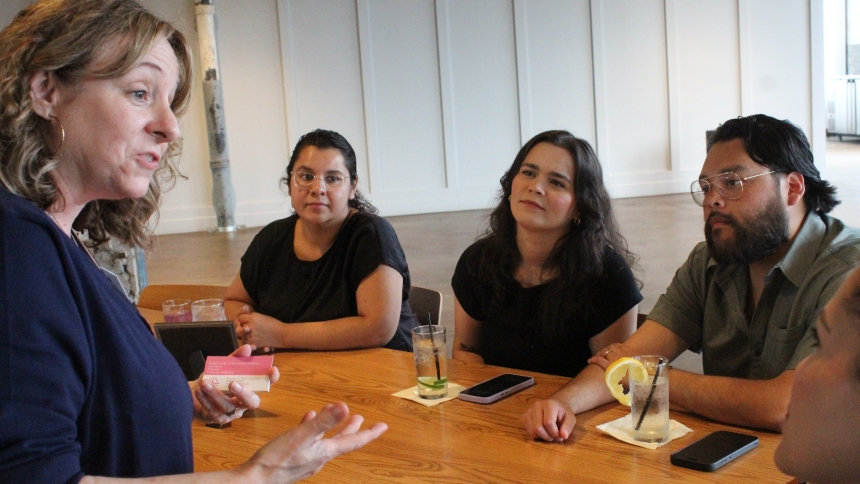
Caption: Kristine Coronado ( from left) , co-executive director for Right to Life of Northwest Indiana, explains the work of her organization in Porter and LaPorte counties, to Stephanie Valdovinos, of Valparaiso, and Destinie and Jose Alcantar, of Chesterton, guests at the “Evangelizing Reality: Science & the Culture of Life” program at Journeyman Distillery in Valparaiso on April 15. Both Valdovinos and Destinie Alcantar are registered nurses at Franciscan Health Michigan City who came at the invitation of speaker Siter Emmanuel Kurtzweg, OSF, to learn more about fertility issues. (Marlene A. Zloza photo)