“The ability to access vast amounts of data should not be confused with the ability to derive meaning and value from it.” – Pope Leo XIV.
MERRILLVILLE – A video was shared with staff of the Pastoral Center in December 2025 in which Bishop Robert J. McClory talks to viewers about Our Lady of Lourdes and the importance of sharing prayer intentions. While the video at first glance seemed harmless, upon closer review, it was discovered to be fake, generated by Artificial Intelligence (AI) for the purposes of soliciting money.
“My heart sank when we realized it was fake,” said Cecilia Cicone, digital media strategist for the Diocese of Gary. “We knew something like this was possible, but didn’t expect our bishop would be a target so soon. Content generated and manipulated by AI isn’t something that is coming – it’s here.”
In her work throughout the diocese, Cicone stresses the importance of viewing social media with a critical eye and reporting anything online that may seem suspicious or a “little off.”
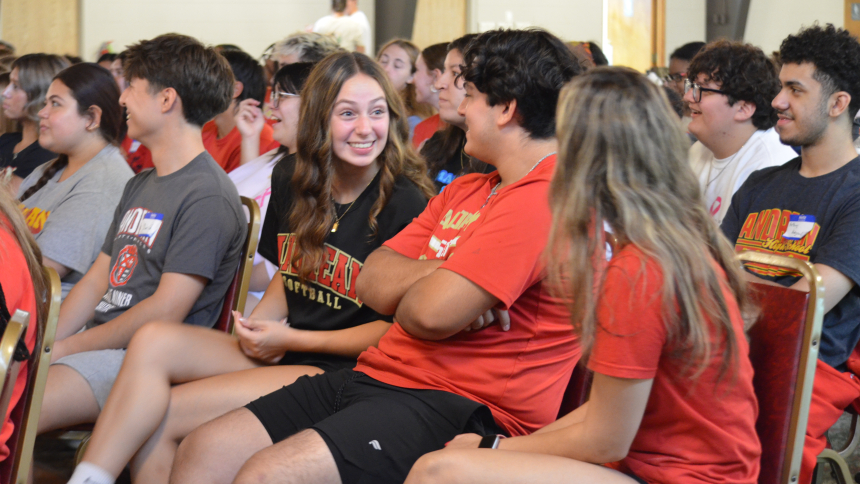
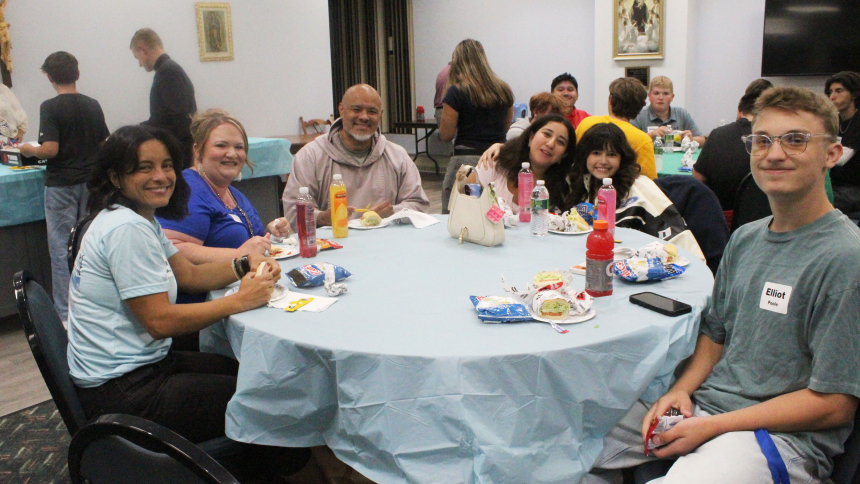
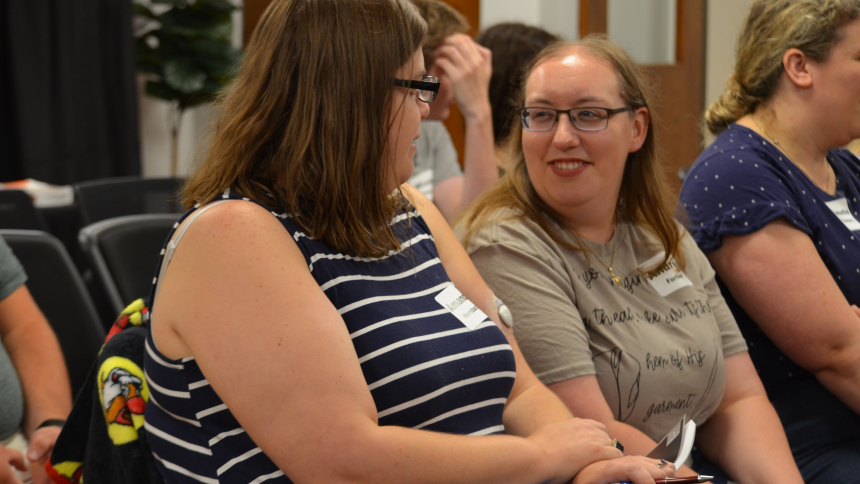
The Diocese of Gary held a Saturday Formation event on Feb. 21 on the topic “The Ethics of AI and Its Role in Evangelization.” That same day, Pope Leo XIV advised priests, during an interview, not to use AI to write homilies or seek likes on TikTok.
"Like all the muscles in the body, if we do not use them, if we do not move them, they die,” Pope Leo said. “The brain needs to be used, so our intelligence must also be exercised a little so as not to lose this capacity."
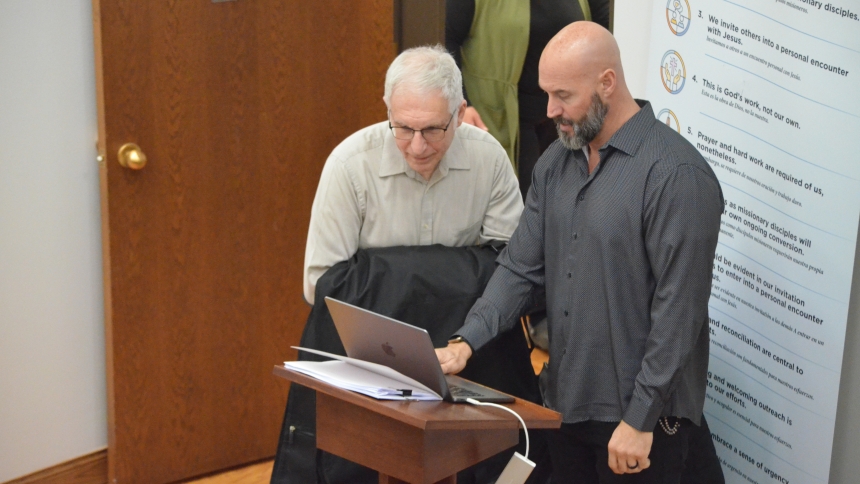
Bobby Fredericksen, host of the Catholic Couple podcast, provided some catechesis related to technology to those gathered at the Pastoral Center for the discussion about AI. As an example of what AI can do, Fredericksen explained that his Microsoft PowerPoint presentation was created using the technology. The parishioner of St. John the Evangelist verbally told the system what content and photos he would like it to include, and the system generated the visual presentation.
“This is what’s possible,” he said. “This is how we can use it while still using our brain to think. We don’t want to outsource our thinking.”
Fredericksen drew attention to the fact that the Church has always adapted to a variety of technologies from the printing press to radio, television, the internet and social media. He recommends that Catholics step into these advancements with what he calls moral clarity.
“Not every capability is good simply because it’s possible,” he said. “The question isn’t ‘Can we build it?’ but ‘Should we build it?’”
Fredricksen shared the reminder that “God didn't save us through an algorithm. He saved us by becoming incarnate, by becoming flesh.” He said that while AI can calculate faster than humans and analyze patterns, it can’t love, can’t sacrifice and can’t receive grace.
According to Fredricksen, the faithful do not need to be afraid of artificial intelligence, but advised they not be naive about it.
“The question is not ‘Will AI shape the future?’ because it will,” he said. “The question is ‘Will being disciples of Jesus shape our views (on how we use it)?”
Deacon Jim Caristi, who led a separate talk in Spanish, defined artificial intelligence as a set of technologies that allow computer systems to learn, reason, perceive and solve complex problems. Those include voice assistants like Siri and Alexa, personalized recommendations on Netflix or Spotify, bank fraud detection, real-time GPS navigation and large language models such as ChatGPT, Gemini, Copilot and Grok.
In large language models, a neural network is used to obtain a list of "reasonable" words. Each of these words has an associated probability. The program randomly chooses one of the most probable words.
“They construct responses that are synthesized word by word from everything they have learned,” Deacon Caristi said. “They can't figure out how to do anything; they can't reason. They don't even know how to count.”
Deacon Caristi said the programs can be helpful in subjects like writing, doctrine and history but will never replace someone highly knowledgeable on those religious topics, and he emphasized that facts must always be checked for accuracy. Some dangers of using AI, he shared, are accepting what it produces without critical thinking, using content that was AI-generated without attribution and using it to replace medical, legal or pastoral judgment.
Deacon Caristi concluded by discussing how AI can assist with evangelization, while noting the importance of human interaction in that process.
“Evangelization is about sharing the faith to transform individuals and society,” he said. “It is achieved through words and actions rather than coercion. We can evangelize anywhere people live, work and are born.”
Julie Modesto, a parishioner of St. Paul in Valparaiso, said it was important to have the conversation about AI because “right off the get-go, I think the initial feeling you get is fear and wonder ‘How is it going to affect me?’ and ‘How is this going to affect the Church?’”
Modesto said one of the most impactful things she heard during the presentation was the reminder of the power of prayer and the message that God will continue to guide His people in the future. She also felt comforted, understanding that AI could still be used with heartfelt and good intentions.
“We know a lot more than what I thought we knew,” she said. “I feel confident in our pope and in the Vatican. We know where we stand. It's about being human, and it is about using the gifts that God gave us. It's going to be ultimately God that shows us how to use this technology, and we know we are going to be okay.”
If you have any questions or concerns about the authenticity or origin of content that you find online or elsewhere, please email or call the Office of Communications at communications@dcgary.org or (219)769-9292.
Sources and Further Reading
60th World Day of Social Communications (2026) – https://www.vatican.va/content/leo-xiv/en/messages/communications/documents/20260124-messaggio-comunicazioni-sociali.html
Rome call for AI Ethics (2020) – https://www.vatican.va/roman_curia/pontifical_academies/acdlife/documents/rc_pont-acd_life_doc_20202228_rome-call-for-ai-ethics_en.pdf
World Day of Peace Message (2025) – https://www.vatican.va/content/francesco/en/messages/peace/documents/20241208-messaggio-58giornatamondiale-pace2025.html
World Day of Social Communications (2024) –
https://www.vatican.va/content/francesco/en/messages/communications/documents/20240124-messaggio-comunicazioni-sociali.html
Antiqua et Nova (2025) –
https://www.vatican.va/roman_curia/congregations/cfaith/documents/rc_ddf_doc_20250128_antiqua-et-nova_en.html