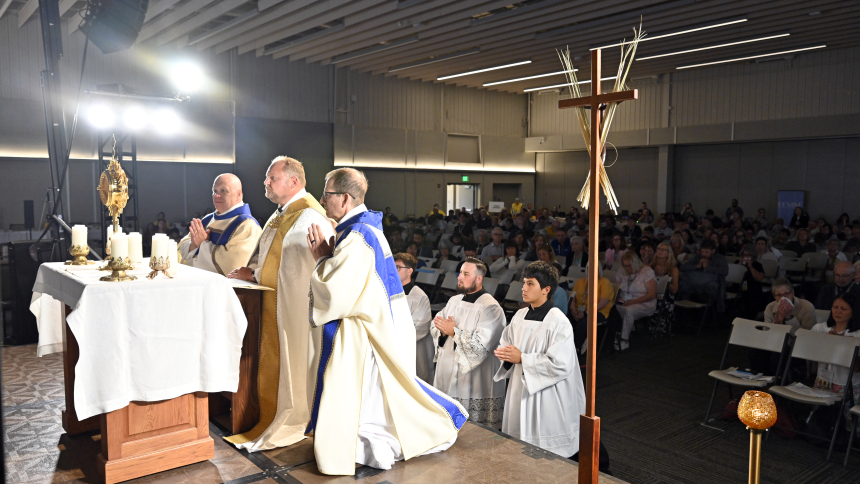
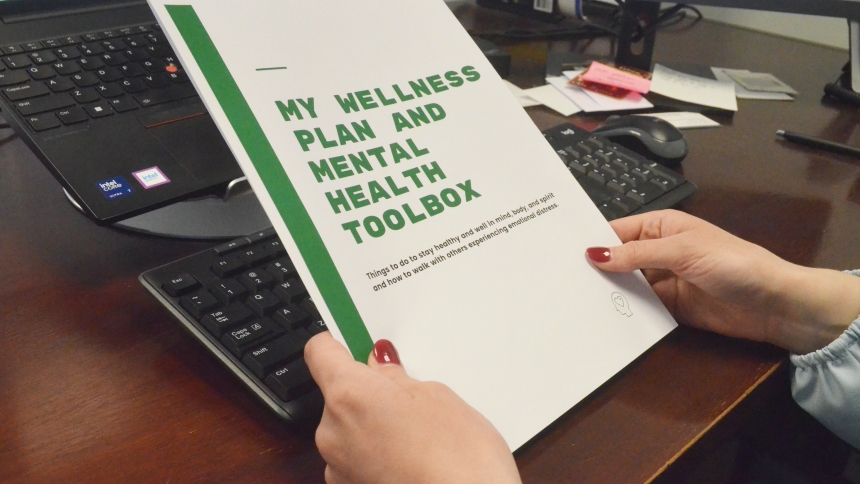
"We have all known the long loneliness, and we have learned that the only solution is love and that love comes with community." – Dorothy Day
MERRILLVILLE – Mental health can be an uncomfortable topic. In an effort to ease some of the insecurities about approaching the subject, and make those working within parishes feel more confident, the Diocese of Gary held a formation session titled “Mental Health Basics for Ministry.”
While the presentation on Feb. 24 led by Vicky Hathaway, coordinator for youth and young adult ministry, focused primarily on teenagers, the tools and information shared during the discussion could be applied to those in any career field and those of any age.
Taking Care of Your Own Mental Health
Hathaway started her talk by urging those in ministry to take time to review their own mental health. Health, she said, looks at the whole person – the whole person’s well-being. Every part of the person matters, she added, especially in ministry. When talking about the well-being of a person that includes the areas of physical, spiritual and mental health.
“If we have a cold, we take cold medicine. If we are bleeding, we go to the doctor, and we get stitches. If we're experiencing cancer, then we go get treatment,” she said. “We have all of those different areas, and it's the same thing with spirituality. We have spiritual leaders.
We have ministry leaders. We have priests. We have spiritual directors. We have a lot of people who are there to help us take care of our spiritual needs and well-being.”
One important part of oneself that might be stigmatized in some instances and perhaps be more hidden is mental well-being. Mental well-being, Hathaway said, is really important because it's one of the key parts of a person.
“It's how we feel. It's how we care,” she said. “We need to really make sure that we're taking care of our mental health as we're entering into anything that we do. Our job as ministers is to make sure that we're taking care of the whole person, and getting people the assistance that they need.”
Defining Mental Health, Mental Illness and Traumatic Stress
Mental health involves effective functioning and daily activities, resulting in productive activities such as work, school, caregiving, fulfilling relationships and the ability to adapt and cope to change and adversity. A person with positive mental health, Hathaway described, is someone who is able to maintain fulfilling relationships that aren't abusive, that aren't hurtful, and is able to adapt to change and cope with adversity.
Mental illness refers collectively to all diagnosable mental disorders, such as health conditions involving significant changes in thinking, emotions, mood, distress or problems functioning in social work or family activities.
“I think a big key to this is diagnosable mental disorders,” Hathaway said. “We all experience times of stress. We all experience times of anxiety. We all experience this because we're humans. That's part of human life is experiencing these different feelings and emotions. When it starts to affect how we're functioning in our space, functioning in our world, functioning in our relationships, and our ability to cope with change and adversity, that's when it enters into mental illness.”
Mental illnesses can only be diagnosed by professionals such as a psychiatrist or clinical doctors. You can't self-diagnose.
“You can't Google your symptoms and say, ‘Yep, this is what I have,’” Hathaway said. “You have to go to a doctor and see an objective professional who can help. They have studied and have the education for this.”
Hathaway explained that a mental illness is also usually prolonged. A one-time moment of feeling anxious does not tend to lead to a diagnosable mental disorder. It is something that is usually more long-term, something that happens over time, that can be a sign of a mental illness
Trauma is an emotional or physical response to one or more physically harmful or life-threatening events or circumstances with lasting adverse effects on mental, spiritual and physical well-being. It can be any emotional, physical or life-threatening event or circumstance that heightens a sense of fear. The response could happen after an event that an individual personally experienced, something that he or she has witnessed or something that has happened to someone that he or she loves and has witnessed from afar.
Statistics on Mental Health
About 50% of adolescents have had a mental health disorder at some point in their lives. Over 80% of young people have experienced at least one traumatic event by the time they leave high school. One-fourth of teenagers will experience clinical anxiety or depression, and only one in eight of those teens will receive help.
One in six teens, 12 to 17 years old, reported a major depressive episode – prolonged feelings of depression – in 2020. Within that age group, there has been a 31% increase in mental health-related visits to the emergency room.
“It blows my mind that children in that age group could even begin to report a major depressive episode, that they even know what that is,” said Bernie Barrett of St. Thomas More in Munster. “If they are reporting this at 12 or 17, then that means they’ve experienced it even younger.”
For adults, anxiety disorders are the most prevalent, followed by depression and post-traumatic stress disorder. Suicide is the second leading cause of death for children and adults ages 10 to 34. The most recent data shows that one in five adults experiences mental health concerns. One in 20 experience serious mental health illnesses or serious mental illnesses. One in 15 experience both substance use disorder and mental illness combined.
“Most of the people that we've encountered when we engage in ministry are probably dealing or have dealt with a mental illness or mental health crisis,” Hathaway said. “They might also know people, so maybe they're not experiencing it, but someone in their family is experiencing it.”
The Role of Ministry Leaders
Hathaway shared the reminder that the role of a ministry leader is to make sure people know Christ's love and to show them that the Church supports them. Those in ministry, she explained, are expected to keep those they engage with safe and let them know that they're not alone.
Hathaway stressed that it is also important for ministry leaders to remember their role and maintain boundaries. She acknowledged that sometimes it can be very easy for those in ministry to cross some boundaries. Oftentimes, ministry leaders can give so much of their time that they don't have time for themselves.
As a parish ministry leader, Hathaway said, he or she is there to teach about the faith. They help others learn about Christ and the Church, while walking with their young people and their parents or guardians as they navigate life.
She said, “It's really just being there, being a presence in their life, listening to them, learning about what's happening in their life and accompanying them.”
Hathaway emphasized that ministry leaders are not therapists, counselors or there to diagnose individuals or situations. If they notice something going on with an individual, she said, it’s important not to ask leading questions, but they can ask clarifying questions like “What happened?” or “Who was there?”
A good motto to keep in mind that Hathaway shared is “When in doubt, refer out.” She recommended that those in ministry research what mental facilities and organizations are in their area, so they can help a person get the treatment they need. Creating and posting a list of emergency phone numbers can also be helpful.
“It’s important to refer to people who are professionally trained to talk about mental health matters,” she said. “They're such a great resource. It can be really dangerous to say to someone, ‘Just pray more, and it'll go away.’ Prayer can motivate us to get the help that we need, but telling someone just to pray who is depressed can be dangerous in certain circumstances.”
Hathaway noted ministry leaders are mandated to report situations of abuse, requiring the need to talk with authorities in those circumstances. She encouraged ministry leaders to inform their supervisor and pastor right away if a crisis situation occurs.
“I was grateful for all the information,” said Steve Rudnick of St. Edward in Lowell. “Education in mental health care is something I never had training in. I am considering prison ministry so this was helpful.”
To view the entire presentation online, visit https://www.garyoyya.org. For more information, contact Hathaway at 219-769-9292, ext. 88229 or email vhathaway@dcgary.org.
In the event of a crisis
911
National Suicide Lifeline: 988
Crisis Text Line: Free, 24/7 support from a trained crisis counselor.
Chat: Text HOME to 741741
National Domestic Violence Hotline: Help for if you or someone you know is experiencing violence.
Call: 1 (800) 799-7233
TTY: (800) 787-3224
Chat: Text LOVEIS to 22522
National Addiction & Recovery Helpline: Free, confidential treatment referral and information for individuals and families.
Call: 800-662-HELP (4357)
TTY: 800-487-4889
-Veterans' Crisis Line: Confidential, 24/7 support for veterans experiencing emotional distress or considering hurting themselves.
Call: (800) 273-TALK(8255)
TTY: (800) 799-4889