



Welcome to the Diocese of Gary! As disciples of Jesus Christ, we are called to share the love of God and the message of the Gospel with others. We do this first in the way we honor each other in the workplace, and secondly, in how we serve others through our ministries.
The Diocese of Gary and all its entities are committed to interacting with all diocesan, parish and school employees in a consistent, just and respectful manner. The Diocese of Gary encourages an inclusive workplace that honors and values all. It is expected that all employees actively endorse this core value and follow the policies, procedures and guidelines included in the employee handbook.
The employee handbook is available for review at each parish, school and diocesan office. Every employee, lay minister, teacher and volunteer is encouraged to read this handbook (Appendix A) and discuss questions with their supervisor or with someone from the diocesan human resources office. Those who teach in our schools have additional employment guidelines through school faculty handbooks. For these employees, the guidelines in the faculty handbook have primacy over the employee handbook.
The employee handbook is not an employment contract nor a legal document. If any law contradicts any of the terms or conditions contained in this handbook, then the applicable law shall supersede conflicting terms or conditions. The employee handbook is not intended to be all-inclusive but is designed to provide employees with a substantial overview personnel policies, procedures and benefits. Personnel and policy practices are under constant review, so benefits, policies and forms can be added, changed or deleted at any time with or without notice, although it is the practice of the Diocese of Gary to communicate these changes through supervisors to employees.
The Diocese of Gary serves a diverse local Church and understands the importance of exploring multi-cultural approaches to fulfill our mission. The Diocese of Gary is committed to embracing and recruiting a diverse workforce, including race, gender, nationality, native language, religion (and more) to help the diocese best serve and share the love of the Father with the many different people who reside in the Northwest Indiana “region.” Let us build each other up as we work together to fulfill our call to be missionary disciples and build up the Kingdom of God.
Section 100: Employment Policies
- 101: Equal Opportunity Policy
-
The Diocese of Gary and all its entities is an Equal Opportunity Employer with the guidelines established for religious organizations in Federal and State law. We are committed to providing equal employment opportunity in all employment policies and practices. Consequently, it is the constant goal of the Diocese of Gary to administer its policies without regard to race, color, religion, national origin, age, gender, marital status, veteran status, service membership, sexual orientation, amnesty, or physical disabilities (not affecting one’s ability to perform the essential functions of one’s job with or without accommodation). This policy applies to all terms and conditions of employment, including, but not limited to, hiring, placement, promotion, termination, layoff, recall, transfer, benefits, leaves of absence, compensation, and training.
There are certain ministerial positions in the Diocese of Gary for which it is necessary for the employee to be Catholic, and some positions for which preference in hiring shall be given to people who are practicing Catholics and who have a full understanding of the Catholic faith. Since the unique and distinctive mission of the Diocese of Gary is primarily religious, the diocese, whenever possible, will retain a Catholic in good standing to perform work for the diocese.Such preference is allowed under state and federal law as a bona fide job qualification and does not constitute an act of discrimination.
It is the goal of the Diocese of Gary to offer employment opportunities to the most qualified candidate. It is also the goal of the Diocese of Gary to offer employment opportunities to women at all levels, except those positions precluded by canon law.
An employee understands that as an employee of a Catholic Institution, an employee is expected to abide by Catholic Church teachings, both within and outside their employment duties, and regardless of his/her religious affiliation. As such, the employee agrees to refrain from conduct of lifestyle which would be in contradiction to Catholic doctrine or morals. Employees understand and agree that the Employer has the right to dismiss an employee for violation of these standards, thereby terminating any and all rights the employee may have to continued employment.
- 102: General and Sexual Harassment Policy
-
In an inclusive Christian work environment, there cannot be accommodations for behavior that preys on our differences. When individuals feel intimidated and threatened because of such factors as sex, race, color, national origin, age, religion, service membership, disability or sexual orientation, the entire work environment is diminished, and individuals may feel harassed. It is for this reason that the Diocese of Gary has established its harassment policy.
“Harassment” is defined as any act, pattern of actions, attitudes, or behavior whose purpose or effect creates a hostile, offensive or intimidating work environment. Harassment can also result from an unintentional but negligent act, pattern of actions, attitudes, or behavior whose effect creates a hostile, offensive or intimidating work environment which continues after it is brought to the individual’s attention.
Practically, harassment can occur whenever one employee or group of employees engages in:
- Verbal abuse
- Physical abuse
- Racial insult or inappropriate humor
- Derogatory ethnic slurs
- Unwelcome sexual advances or touching
- Inappropriate Internet usage or any other means of electronic communication related to any of the above.
The Diocese of Gary and all its entities cannot and will not tolerate harassment of any kind that is inconsistent with our understanding of the Gospel message. All employees are responsible to report any appearance of harassment to their pastor, immediate supervisor, or the Diocesan Chief Human Resources Officer immediately after the occurrence. Failure to report harassment in a timely manner may make it difficult for the Diocese to adequately investigate and justly resolve the matter. Upon notification of potential harassment, all reports will be investigated immediately. False or malicious reports will result in discipline up to and including termination. At no time will an employee be retaliated against for bringing forth harassment concerns in the workplace.
The Diocese of Gary is committed to providing a work environment that is free from all forms of discrimination and conduct that can be considered harassing, coercive or disruptive, including sexual harassment. Actions, words, jokes, or comments based on an individual’s sex, race, color, national origin, age, religion, service membership, disability, sexual orientation, or any other legally protected characteristic will not be tolerated.
Sexual harassment is defined as unwanted sexual advances or visual, verbal, or physical conduct of a sexual nature. This definition includes many forms of offensive behavior and includes gender-based harassment of a person of the same sex as the harasser. The following is a partial list of sexual harassment examples:
- Unwanted sexual advances
- Sexual comments
- Sexual jokes
- Offering employment benefits in exchange for sexual favors
- Making or threatening reprisals after a negative response to sexual advances
- Visual conduct includes leering, making sexual gestures or displaying sexually suggestive objects or pictures, cartoons, or posters
- Verbal conduct that includes making or using derogatory comments, epithets, slurs, or jokes
- Verbal sexual advances or propositions
- Verbal abuse of a sexual nature, graphic verbal commentaries about an individual’s body, sexually degrading words used to describe an individual, or suggestive or obscene letters, notes, or invitations
- Physical conduct includes touching, assaulting, or impeding or blocking movements.
Unwelcome sexual advances (either verbal or physical), requests for sexual favors and other verbal or physical conduct of a sexual nature constitute sexual harassment when: (1) submission to such conduct is made either explicitly or implicitly a term of condition of employment; (2) submission or rejection of the conduct is used as a basis for making employment decision; or (3) the conduct has the purpose or effect of interfering with work performance or creating an intimidating, hostile, or offensive work environment.
If an employee experiences or witnesses sexual or other unlawful harassment in the workplace, he or she is to report it as soon as possible to the employee’s immediate supervisor or the Diocesan Chief Human Resources Officer. An employee may raise concerns and make reports without fear of reprisal or retaliation. All reports and allegations of harassment much be reported to the Diocesan Chief Human Resources Officer for immediate investigation.
All allegations of harassment will be quickly and discreetly investigated. To the extent possible, confidentiality of the complainant, any witnesses and the alleged harasser will be protected against unnecessary disclosure. You will be informed when the investigation is completed.
Any Parish Coordinator who becomes aware of possible sexual or other unlawful harassment must immediately advise the Diocesan Chief Human Resources Officer or any member of management so it can be investigated in a timely and confidential manner. Anyone engaging in sexual or other unlawful harassment will be subject to disciplinary action, up to and including termination of employment.
The Sexual harassment policy will be disseminated to all employees on an annual basis or upon any changes in the policy. Training on policy will be offered to all employees on a periodic basis and evidence will be placed in employees’ personal file.
No management or other employees may retaliate or discriminate against any employee for filing a complaint. Anyone acting in such a manner will be subject to disciplinary action up to and including termination of employment.
- 103: Child Abuse and Sexual Misconduct Policy
-
The Diocese of Gary and all its entities are committed to the careful enforcement of our sexual misconduct policies (see Appendix C). It is a sad reality of our society that children are victimized in this manner. The Diocese upholds the mandated reporter standard set by the State of Indiana in mandatory reporting the “suspicion” of any appearance of abuse of a minor to the proper authorities.
In addition to our stringent policy on child abuse, the Diocese of Gary also maintains a zero tolerance of any type of sexual misconduct among the priests, deacons, religious and laity serving or employed by the Diocese of Gary.
- 104: Drug and Alcohol Use Policy
-
The Diocese of Gary desires to provide a drug-free, healthful, and safe workplace. To promote this goal, employees are required to report to work in an appropriate mental and physical condition to perform their jobs in a satisfactory manner.
While on the premises of all diocesan facilities and while conducting business- related activities off diocesan premises, no employee may use, possess, distribute, sell or be under the influence of alcohol or illegal drugs. Occasionally, employees may be invited guests to diocesan functions where alcohol is served such as dinners or programmatic events. As long as the employee is not working at the event or operating in an official capacity, alcohol may be consumed in a moderate and legal manner. The legal use of prescribed drugs is permitted on the job only if it does not impair an employee’s ability to perform the essential functions of the job effectively and in a safe manner that does not endanger other individuals in the workplace. The Diocese of Gary reserves the right to conduct reasonable suspicion drug testing when an employee appears under the influence of drugs or alcohol and requires drug testing after an employee sustains a workplace injury.
Violations of this policy may lead to disciplinary action, up to and including immediate termination of employment, and/or required participation in an approved treatment program. Such violations may also have legal consequences.
Employees with questions or concerns about substance dependency or abuse are encouraged to discuss these matters with their immediate supervisor or the Diocesan Chief Human Resources Officer to receive assistance or referrals to appropriate resources in the community.
Employees with drug or alcohol problems that have not resulted in, and are not the immediate subject of, disciplinary action may request approval to take unpaid time off to participate in a rehabilitation or treatment program through the diocesan health insurance benefit coverage if eligible. Leave may be granted if the employee agrees to participate in approved treatment program; abides by all diocesan policies, rules and prohibitions relating to conduct in the workplace; and if granting the leave will not cause the Diocese of Gary or any of its entities any undue hardship.
Under the Drug-Free Workplace Act, an employee who performs work for a government contract or grant must notify the Diocese of a criminal conviction for drug-related activity occurring in the workplace. The report must be made within five days of the conviction.
Employees with questions on this policy or issues related to drug or alcohol use in the workplace should raise their concerns with their immediate supervisor or the Diocesan Chief Human Resources Officer without fear of reprisal.
- 105: Ethics and Conduct
-
The successful operation and reputation of the Diocese of Gary and all its entities is built upon the Christian principles of fair dealing and ethical conduct of our employees. Our reputation for integrity requires careful observance of the spirit and letter of all applicable laws and regulations, as well as a scrupulous regard for the highest standards of conduct and personal integrity.
The continued success of the diocesan mission is dependent upon the trust of those we serve and the professionalism of those we work with. As employees and volunteers, we are called to be stewards and maintain high ethical standards. To preserve that principle, employees owe a duty to the Diocese to act in a way that will merit the continued trust and confidence in all those we encounter.
The Diocese of Gary will comply with all applicable laws and regulations. In general, the use of good judgment, based on high ethical principles, will guide all employees and volunteers to conduct all diocesan business in accordance with the letter, spirit, and intent of all relevant laws and to refrain from any illegal, dishonest, or unethical conduct.
An employee understands that as an employee of a Catholic Institution, an employee is expected to abide by Catholic Church teachings, both within and outside their employment duties, and regardless of his/her religious affiliation. As such, the employee agrees to refrain from conduct of lifestyle which would be in contradiction to Catholic doctrine or morals. Employees understand and agree that the Employer has the right to dismiss an employee for violation of these standards, thereby terminating any and all rights the employee may have to continued employment.
Acceptable conduct includes assuming a friendly, cordial, and cooperative Christian attitude with our colleagues. This means discord and rancor within our own ranks cannot be tolerated. In seeking a healthy, trusting environment, consistent with the message of Jesus, it is expected that all differences of opinion, conflicts and/or misunderstandings be dealt with promptly by addressing the issue(s) to whoever is the source of the issue. To assume a posture of resentment, resistance and/or a critical negativity, notwithstanding the satisfactory fulfillment of one's other duties, is a violation of this policy. Employees who violate this policy will be subject to disciplinary action, up to and including termination of employment. (See Section 709)
If matters between colleagues cannot be resolved by open dialogue, then either side to the dispute may approach their immediate supervisor or the Diocesan Chief Human Resources Officer to discuss a mutually acceptable approach of mediating the problem.
Compliance with this policy of ethics and conduct is the responsibility of every diocesan employee. Disregarding or failing to comply with this standard of business ethics and conduct could lead to disciplinary action, up to and including possible termination of employment.
- 106: Conflict of Interest Policy
-
Employees have an obligation to conduct business within guidelines that prohibit actual or potential conflicts of interest. The purpose of these guidelines is to provide general direction if an employee is uncertain whether a potential conflict of interest exists. If an employee is uncertain if a conflict of interest exists, the employee can seek further clarification on issues from the Diocesan Chief Human Resources Officer.
A conflict of interest is defined as a situation in which financial or personal considerations may compromise or have the appearance of compromising the judgment and objectivity of an employee or volunteer.
An actual or potential conflict of interest occurs when an employee is in a position to influence a decision that may result in a personal gain for that employee or for a relative as a result of diocesan business dealings. For the purposes of this policy, a relative is any person who is related by blood or marriage, or whose relationship with the employee is similar to that of persons who are related by blood or marriage.
If employees have any influence or relationships that influence transactions involving purchases, contracts, or leases, it is imperative that they disclose to the Diocesan Chief Human Resources Officer, as soon as possible, the existence of any actual or potential conflict of interest so that safeguards can be established to protect all parties.
Personal gain may result not only in cases where an employee or relative has a significant ownership in a firm or business with which the Diocese does business, but also when an employee or relative receives any kickback, substantial gift, or special consideration as a result of any transaction or business dealings involving the Diocese.
As employees and volunteers, we are called to be good stewards and maintain high ethical standards. This policy is intended to set forth standards for behavior to avoid potential conflicts of interest that could compromise the objectivity that is essential for effective decision-making and damage the reputation of the individuals involved and the Diocese. Each employee and volunteer will be required to sign a conflict-of-interest disclosure at the time of hire and is encouraged to update as needed.
This policy applies to all lay employees and volunteers of the Diocese of Gary, its entities, and agencies, including Catholic Charities. It also applies to members of the Diocesan Finance Council, Advisory Boards of all diocesan agencies, and their various subcommittees and advisors.
There are four basic types of conflicts of interest, each of which will be explained in the sections that follow:
- Business interests or investments
- Gifts, payments, or favors
- Employment of relatives
- Confidential information
Employees and volunteers must disclose:
- Any business, investment or ownership interest in any entity with which the Diocese has (or is negotiating) any transactions or arrangements.
- Any compensation received (or offer of compensation) from any entity with which the Diocese has (or is negotiating) any transaction or arrangements.
Employees and volunteers must also disclose if their family members have any business interests or compensation as described above.
Disclosure must:
- Occur as soon as possible.
- Include all relevant information.
- Be made in writing on the attached form.
- Be submitted to the Human Resources Office.
The Diocesan Chief Human Resources Officer, in consultation with appropriate parties, will determine if the disclosed situation is permissible or not with respect to diocesan policies and recommend a plan to either manage, reduce, or eliminate the conflict.
Employees and volunteers must disclose Gifts, Payments, and Favors:
No employee or volunteer may offer, exchange, or accept gifts, payments, or favors, either directly or indirectly, from any individual or organization which is conducting or soliciting business with the diocese. “Gifts, payments and favors” include, but are not limited to, gifts of objects or money, vacations, and loans. The term “indirect” includes the offering or acceptance of gifts, payments and favors by a relative, a person acting on behalf of the employee, or a business entity in which the employee or volunteer has an interest.
This policy does not preclude the offering or accepting of Christmas remembrances, thank you gifts, business meals, or occasional gifts of nominal value, the sum total of which may not exceed $50.00 from any organization in a calendar year. Any exceptions to this policy require the prior knowledge and consent of the employee’s immediate supervisor or the Diocesan Chief Human Resources Officer.
Employees and volunteers must disclose employment of relatives:
In order to retain the objectivity that is essential to effective decision-making, relatives are not to hire or supervise one another or check, review, and/or process work of one another. Supervisors may further restrict the employment of relatives where close proximity might disrupt optimal performance of functions.
A relative, for this purpose, is defined as: husband, wife, father, mother, stepfather, stepmother, child, stepchild, grandparent, grandchild, in-law, brother, sister, niece, nephew, aunt, or uncle.
The purpose is to prevent situations in which an employee’s family situation may create a conflict of interest with his or her job duties. Any exceptions to this policy require the prior approval of immediate supervisor or the Diocesan Chief Human Resources Officer.
Employees and volunteers must not disclose confidential information:
Employees and volunteers often become aware of confidential information concerning diocesan matters, other employees or volunteers, and persons who are served by the various programs of the Diocese. Such information should be kept private and should not be used for personal gain or in a manner that would harm the Diocese or any employee, volunteer, or person served by the Diocese.
- 107: Personal Relationship Policy
-
The employment of relatives or individuals involved in a dating relationship in the diocesan office may cause serious conflicts and problems with favoritism and employee morale. In addition to claims of partiality in treatment at work, personal conflicts from outside the work environment can be carried over into the day-to- day relationships.
For purposes of this policy, a relative is any person who is related by blood or marriage, or whose relationship with the employee is similar to that of persons who are related by blood or marriage. A dating relationship is defined as a relationship that may be reasonably expected to lead to the formation of a consensual “romantic” relationship. This policy applies to all employees without regard to the gender or sexual orientation of the individuals involved.
Generally, relatives of current employees may not occupy a position that will be working directly for or supervising their relative. Individuals involved in a dating relationship with a current employee may also not occupy a position that will be working directly for or supervising the employee with whom they are involved in a dating relationship. The Diocese of Gary also reserves the right to take prompt action if an actual or potential conflict of interest arises involving relatives or individuals involved in a dating relationship who occupy positions at any level (higher or lower) in the same diocesan office that may affect the review of employment decisions.
It is the responsibility of those involved in such a relationship to disclose the existence of the relationship to the immediate supervisor or the Diocesan Chief Human Resources Officer. The individuals concerned will be given the opportunity to decide who is to be transferred to another available position. If that decision is not made within 30 calendar days, the Diocese will decide who is to be transferred or, if necessary, terminated from employment.
Employees in a close personal relationship should refrain from public workplace displays of affection or excessive personal conversation.
- 108: Whistleblower Policy
-
The purpose of this policy is to protect those individuals who want to raise issues of illegal, dishonest, or unethical behavior with the assurance of not becoming a target of subsequent recrimination. This formal policy has been implemented in the spirit of the initiatives of the Sarbanes-Oxley Act that was signed into law in July 2002. This law prohibits publicly traded companies from taking any adverse employment action against an employee because of his/her protected whistleblowing activities, but some of the concepts are appropriate for non-profit organizations as well.
A whistleblower is defined by this policy as an employee of a parish, school, or other diocesan-associated entity who reports an activity that he/she reasonably believes to be illegal or dishonest or reports unethical behavior to one or more of the parties specified in this policy. The whistleblower is not responsible for investigating the activity or for determining fault or corrective measures; appropriate management officials are charged with these responsibilities.
"Dishonest" or "unethical" is defined as violating some objective and publicly identifiable standard of conduct, not merely the reporter's subjective opinion. Examples of illegal or dishonest activities are violations of federal, state, or local laws; billing for services not performed or for goods not delivered; or other fraudulent financial reporting. Examples of dishonest and unethical behavior include violations of employer policies in the respective Employee Personnel Manual, Code of Personal and Ethical Conduct, or similar published policies.
If an employee has knowledge of or a concern of illegal, dishonest, or fraudulent activity or of unethical behavior, the employee is to contact: his/her immediate supervisor, Pastor, Dean or the Diocesan Chief Human Resources Officer An employee who intentionally files a false report of wrongdoing will be subject to discipline up to and including termination. Whistleblower protections are provided in two important areas – confidentiality and against retaliation. To the extent practical under the circumstances, the confidentiality of the whistleblower will be maintained. However, identity may have to be disclosed to conduct a thorough investigation, to comply with the law and employer policy and to provide accused individuals with their legal rights of defense. The employer and associated entities will not retaliate against a whistleblower. This includes, but is not limited to, protection from retaliation in the form of an adverse employment action such as termination, compensation decreases, poor work assignments and threats of physical harm for making a report. Any whistleblower who believes he/she is being retaliated against must contact their immediate supervisor or the Diocesan Chief Human Resources Officer immediately either through written or verbal communication, i.e., signed written letter, in-person visit, etc. The right of a whistleblower for protection against retaliation does not include immunity from personal complicity in wrongdoing or any other misconduct.
- 109: Media Communication
-
The Diocese of Gary receives inquiries from the media regarding diocesan matters from time to time. At the bishop’s request, all contact between diocesan offices and the media are coordinated through the Office of Communications. This office also coordinates calls to and from the media in collaboration with diocesan offices. Employees should not offer any comments if contacted by a reporter, but in a timely manner refer all media inquiries to the Office of Communications. Provide the name of the reporter, who he/she represents, and contact information.Communications office personnel will contact the reporter for more details about the inquiry and subsequently coordinate media contact with appropriate diocesan personnel. After consulting with the Office of Communications, employees should follow outlined instructions for responding to the media. A word of caution: there is no such thing as “off the record” so be careful to limit conversations with the media. Failure to adhere to this policy may result in disciplinary action. Diocesan parishes and priests should follow these best practices.
Section 200: Hiring Policies of the Pastoral Center
- 201: Hiring Procedure Policy
-
When a staff position is opened, through resignation, transfer, retirement or dismissal, or newly created, the Office Coordinator will complete and file with the Office of Human Resources a “Position Request Form” (See Appendix D). This form is to provide the following information:
I. Title of Position
- Position Description (See Section 302)
- State whether position is to be considered exempt or non-exempt (See Section 301)
- State whether position is to be considered part-time or full-time
- Salary Classification
- Recommended starting salary
- Benefits to be offered
- Whether the position requires a ministerial prerequisite to be a Practicing Catholic in good standing
II. Jobs will be posted via job boards such as Indeed, placed on employee bulletin boards or through the diocesan website describing position and requirements. A position will be posted for a minimum of five days. Supervisors can consider internal and external candidates simultaneously.
III. Employment Justification
- A brief description why the particular office has this particular employment need at this particular time.
IV. Employment Authorization
- Signed by Office Coordinator
- Signed by Chief Human Resources Officer
- Signed by Chief Financial Officer
- Submittedto the Bishopor Bishop’s designeefor signed authorization.
No employment postings, interviews, etc. may take place until the “Position Request Form” is returned and the Chief Human Resources Officer declares the position “open.” Once the “Position Request Form” is properly authorized and returned to the Office Coordinator, the Chief Human Resources Officer will begin the search for the most qualified candidate.
- 202: Pre-Employment Procedure Policy
-
All applicants are required to complete a written “Employment Application”. In doing so, all potential employees are responsible for making available to the Diocese of Gary employment related facts about themselves with regard to their qualifications, experience, related skills and abilities and any other factors which may affect job assignments or continued performance. Applicants will also provide a list of references.
- 203: Employment Application Policy
-
The Diocese of Gary relies upon the accuracy of information contained in the employment application, as well as the accuracy of other data presented throughout the hiring process and employment. Any misrepresentations, falsifications, or misleading responses, material omissions in any of this information or data may result in the exclusion of the individual from further consideration for employment or, if the person has been hired, termination of employment.
- 204: Employment Reference Check Policy
-
To ensure that individuals who join the diocesan staff are well qualified and have a strong potential to be productive and successful, it is the policy of the Diocese of Gary to check at least two employment references for eligible applicants. The Office of Human Resources will check at least two professional references during the interview process.
- 205: Search Process Policy
-
The Chief Human Resources Officer will assist the Office Coordinator with:
- Facilitating inter-office applications
- Placing employment ads (cost will be charged to the Office with the opening)
- Screening of internal and external candidates
- Scheduling interviews, checking references, etc.
- 206: Hiring Process Policy
-
The Office Coordinator will select the candidate that is, in his/her opinion, the best qualified for the position. The Office Coordinator makes the selection based on the individual’s competence for the position as determined through evaluation of written applications and resumes, personal interviews and written references. All appointments are confirmed in writing when an “Offer Letter” is issued by the Chief Human Resources Officer.
- 207: Office Transfer Policy
-
When a job opening has been declared “open,” the position will be posted through electronic mail as well as employee bulletin boards. It is the policy of the Diocese of Gary to, whenever possible, promote or transfer qualified staff members.
If a Pastoral Center staff person wishes to apply for an open position, they are to notify, in writing, the Chief Human Resources Officer of their intention to apply within ten working days of the posting. The Chief Human Resources Officer will contact both the Office Coordinator who is seeking applicants and the applicant’s current Office Coordinator. Office Coordinators should always seek to work collaboratively in such matters, keeping regular communication on the matter. Staff members should not be deprived of other employment opportunities with the Diocese, even if their departure from one office will leave an employment gap in that office.
- 208: Employment Compliance Posting and Reporting
-
The Diocese of Gary and all its related entities will comply with all federally and state mandated laws regarding employment posters and mandated reporting. Annually, no later than January 31, the Diocese of Gary and all its entities will report and mail W-2s and 1099s to reporting agencies, employees and contractors.
If you are unable to locate this information, please ask your supervisor.
Section 300: Employment Status and Records
- 301: Employment Category Policy
-
It is the intent of the Diocese of Gary and all its entities to clarify the definitions of employment classifications so that employees understand their employment status and benefit eligibility. These classifications do not guarantee employment for any specified period of time. Accordingly, the right to terminate the employment relationship at-will at any time is retained by both the employee and the Diocese of Gary.
Each employee is designated as either NON-EXEMPT or EXEMPT according to federal and state wage and hour laws. All employees are paid at least the federal minimum wage.
- NON-EXEMPT employees are usually paid an hourly rate and entitled to time and a half overtime pay for all hours worked over 40 hours in a work week under the provisions of federal and state laws. Most positions will fall under this category.
- EXEMPT employees are usually paid a salary and are employed as bona fide administrative, executives, professionals, outside sales, certain computer positions and others defined by the government. In order for someone to be paid on a salary basis, they must meet all the requirements of the FLSA regulations. To qualify for exemption, employees generally must meet certain tests regarding their job duties and be paid on a salary basis no less than $684 per week. Job titles do not determine exempt status. In order for an exemption to apply, an employee’s specific job duties and salary must meet all the requirements of the Department’s regulations.
If an employee is uncertain of their employment status, they should direct their questions to the Office of Human Resources.
In addition to the above categories, each employee will belong to one other employment category.
REGULAR FULL-TIME employees are those who are not in a temporary or introductory status and who are regularly scheduled to work a full-time schedule of 30 hours a week for at least 40 weeks per year. Generally, they are eligible for the diocesan benefit package, subject to the terms, conditions, and limitations of each benefit program.
REGULAR PART-TIME employees are those who are not assigned to a temporary or introductory status and who are regularly scheduled to work 29 hours per week or less. While they do receive all legally mandated benefits (such as Social Security and Workers’ Compensation Insurance), they are ineligible for other diocesan benefits except for employee only contributions to the company sponsored 403(b) retirement savings plan if they choose to participate.
INTRODUCTORY all employees are categorized as introductory during the first 90 days of employment. This time gives employees and supervisors the opportunity to evaluate performance and position fit and determine whether further employment in a specific position or with the Diocese is appropriate. Employees who satisfactorily complete the introductory period of three months (90 days) will then be classified in their new employment classification (i.e. regular full time, part time etc. ).
CONTRACTOR Contractors are often retained to perform a specific job or project for a specified amount of time.They are self-directed, invoice for their services and are issued a tax form 1099 for services rendered.
INTERNSHIP Interns are utilized occasionally for project-based work and are subject to applicable rules and regulations.
CONTRACTED EMPLOYEES (Teachers and Principals only) Employees who are given employment contracts are teachers and principals only. For more information, please contact the Office of Catholic Schools.
TEMPORARY employees are those who are hired as interim replacements or seasonal employees to temporarily supplement the work force, or to assist in the completion of a specific project. Employment assignments in this category are of a limited duration. Employment beyond any initially stated period does not in any way imply a change in employment status. Temporary and seasonal employees retain that status unless and until notified in writing of a change. While temporary and seasonal employees receive all legally mandated benefits (such as Workers’ Compensation Insurance and Social Security), they are ineligible for all of the diocesan benefit programs.
- 302: Position Description Policy
-
All roles within the Pastoral Center are to have a “position description.” These descriptions are kept in the Office of Human Resources and describe their ministerial function within the Church.
The position descriptions are to specify or indicate:
- The title of the role which accurately conveys its function
- To what extent, if any, is Catholicity (i.e., a knowledge and practice of the Roman Catholic faith) a necessity for ministry
- The FLSA exemption status: Exempt or Non-Exempt
- The essential functions of the role for purposes of complying with the Americans with Disabilities Act
- The minimum requirements and qualifications for the role
- The preferred requirements and qualifications for the role
- The duties and responsibilities of the role and how the role contributes to the overall diocesan mission of the Catholic Church
- The Office Coordinator to whom the role is accountable and direct reports if applicable.
- 303: Personnel Data Changes
-
Every employee will fill out an “Employment Information Sheet” (See Appendix E). It is the responsibility of each employee to promptly notify the Diocese of Gary of any changes in personnel data. Personal mailing addresses, telephone numbers, number and names of dependents, individuals to be contacted in the event of an emergency, educational accomplishments, and other such status reports should be accurate and current at all times. If any personal data has changed, please present a modified “Employment Information Sheet” to the Office of Human Resources.
- 304: Personnel File Policy
-
The Diocese of Gary maintains a personnel file on each employee. The personnel file includes such information as the employee’s job application, resume, records of training and salary increases along with other employment records.
Personnel files are the property of the Diocese of Gary and access to the information they contain is restricted on a need-to-know basis only. Generally, only the Bishop and the Office of Human Resources have access to an employee’s personnel file.
Within the first two weeks of employment the Office Coordinator, along with the Chief Human Resource Officer, will review the diocesan personnel manual with the new staff member. Upon reviewing the manual, the new staff person will execute the “Acknowledgment and Acceptance” form verifying that the policies have been reviewed, explained and accepted and will be kept in the personnel file (see last page of Policy Manual). The Benefits Coordinator will also explain the benefits available to the new staff member and the steps necessary for enrollment.
An employee who wishes to review his or her own personnel file should contact the Office of Human Resources and complete a Personnel File Request Form. With reasonable advance notice, employees may review their own personnel files in the presence of Human Resources personnel or an individual appointed by the Bishop.
- 305: New Employee Orientation
-
Recognizing the importance of starting out the employment relationship correctly, the Diocese of Gary offers a new employee orientation for all newly hired employees. The initial orientation with the Office of Human Resources or Business Manager will include new hire paperwork, benefits enrollment, employee handbook and job description review. The department supervisor will provide ministry orientation to include:
- Orientation to Office and Office Mission
- Orientation to purpose of Diocesan Services
- Process for 90 day check in
- Office tour
- Expectations
- Timekeeping requirements
- Purchasing office supplies
- General office operations such as mileage/business reimbursements etc.
- Other
- 306: Performance Evaluations
-
Office Coordinators and employees are strongly encouraged to discuss job performance and goals on an ongoing, informal, day-to-day basis. Formal performance evaluations are conducted at least annually to provide both supervisors and employees the opportunity to give feedback and discuss goals.
- 307: Employee Engagement
-
The Diocese of Gary fosters work environments where everyone’s contributions make a difference and matter. Culture centers on working together to be and to make missionary disciples. To enhance the work experience, there is an Employee Engagement Committee who seeks new ways to foster this vision in the Pastoral Center. This rotating team of employees works to promote collaborative relationships by encouraging employee interactions, communications, and opportunities for prayer and spirituality in the workplace. If you are interested in being a part of this committee, let your supervisor or HR know.
Section 400: Employment Benefit Policies
- 401: Payroll Deductions
-
Such programs include:
- Dependent Health Coverage
- Voluntary Insurance Coverage
- Approved Pre-Tax Deductions such as 403(b)
- 402: Direct Deposit
-
Employees of the Pastoral Center are required to have their earned wages deposited directly into their individual bank checking and/or savings account. Electronic pay stubs are available through our payroll processing company either online or on the app. If your account needs to altered in anyway, please notify the Payroll Department immediately to complete the necessary forms, electronic requests will not be honored.
- 403: Vacation Policy
-
Vacation time off with pay is available to eligible employees to provide opportunities for rest, relaxation, and personal pursuits. Employees in the following classifications are eligible to earn and use vacation time as described in this policy:
- Regular full-time employees
- Regular part-time employees (Pro-rated vacation)
Vacation time is awarded at the beginning of the calendar year for use from January 1 to December 31 that same calendar year. New employees are eligible to use earned vacation time after the first 30 days of service.
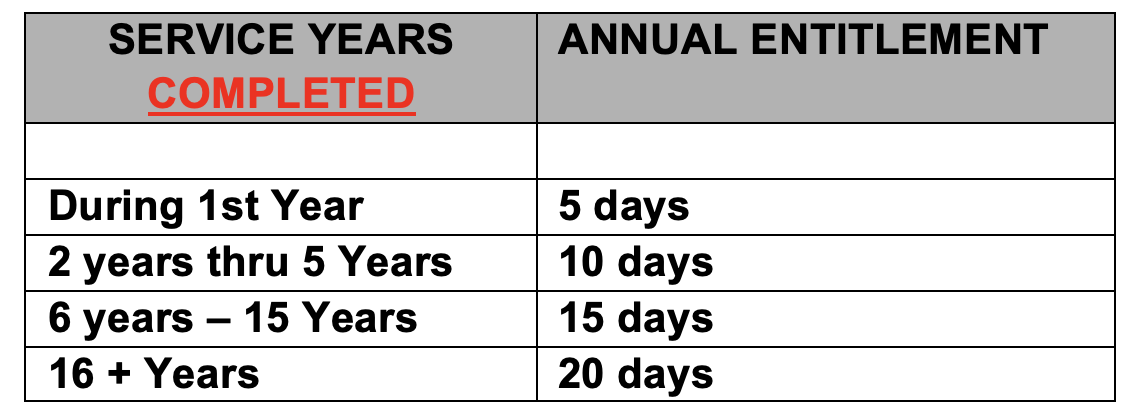
An employee’s annual vacation time is awarded based on years of service. At the beginning of the year following an employee’s first, fifth and 15th anniversary date, the annual accrual rate increases for the upcoming calendar year.
The following schedule shows an employee’s annual award the year after reaching these service milestones:
- 404: Personal Days Policy
-
All employees are entitled to take two personal business days each year. Anyone who begins employment before July 1st will receive two days of personal business leave for that calendar year, and anyone who begins employment after July 1st will receive one day of personal business leave for that calendar year. Personal days are non-cumulative and will not be paid upon termination of employment.
- 405: Holiday Policy
-
Federal law does not require employers in the private sector such as the Diocese of Gary to have a holiday policy or to observe federally recognized holidays. Notwithstanding this fact, the Diocese of Gary gives its employees 13 paid days off for the following holidays.
- New Year’s Day (January 1st)
- Martin Luther King, Jr. Day (Third Monday in January)
- Good Friday (Friday before Easter)
- Easter Monday
- Memorial Day (Last Monday in May)
- Independence Day (July 4th)
- Labor Day (First Monday in September)
- Day before Thanksgiving
- Thanksgiving Day (Fourth Thursday in November)
- Day After Thanksgiving
- Christmas Eve (December 24th)
- Christmas Day (December 25th)
- Day After Christmas (December 26th)
The Diocese of Gary will grant paid holiday time off to all eligible employees immediately upon hire. Holiday pay will be calculated based on the employee’s straight-time pay rate (as of the date of the holiday) times the number of hours the employee would otherwise have worked on that day. If a holiday falls on a normally scheduled day for part time employees, it will be paid. If it does not, the part time employee will not receive holiday pay. Holiday pay hours are not counted towards overtime eligibility. Eligible employee classification(s) are:
- Regular full-time employees
- Regular part-time employees
If a recognized holiday falls during an eligible employee’s paid absence (e.g., vacation and sick leave), the employee will be ineligible for holiday pay resulting in double pay. However, scheduled vacation leave may bookend a paid holiday when approved by their supervisor.
If eligible non-exempt employees work on a recognized holiday, flextime will be provided.
If a recognized holiday falls on a Saturday, eligible employees are scheduled for time off with pay on the Friday prior to the holiday if they are scheduled to work that day.
If a recognized holiday falls on a Sunday, eligible employees are scheduled for time off with pay on the Monday following the holiday if they are scheduled to work that day.
- New Year’s Day (January 1st)
- 406: Sick Leave Policy
-
This section does not apply to teachers.
The Diocese of Gary provides paid sick leave benefits to all eligible employees for periods of temporary absence due to illnesses or injuries. Eligible employee classification is:
- Regular full-time employees
Eligible employees accrue sick leave benefits at the rate of 10 days per year (.83 of a day for every full month of service). Sick leave benefits are calculated on the basis of a “benefit year,” the 12-month period that begins when the employee starts to earn sick leave benefits.
Employees become eligible to accrue sick leave benefits upon hire. Paid sick leave can be used in minimum increments of one-half day. Employees may use sick leave benefits for an absence due to their own illness or injury or that of a family member.
Employees who are unable to report to work due to illness or injury should notify their supervisor and receptionist before the scheduled start of their workday, if possible. The Coordinator must also be contacted on each workplace injury; a physician’s statement must be provided verifying the disability and its beginning and expected ending dates. Such verification may be requested for other sick leave absences as well and may be required as a condition to receiving sick leave benefits. Before returning to work from a sick leave absence of five calendar days or more, an employee must provide a physician’s verification that he or she may safely return to work.
Sick leave benefits will be calculated based on the employee’s base pay rate at the time of absence and will not include any special forms of compensation, such as incentives, commissions, or bonuses.
If an employee receives an injury or becomes ill during a vacation or holiday, they may not transfer one of their sick days for a vacation day or a holiday.
A lifetime total of 30 sick days may be accumulated into a sick bank and used only for catastrophic medical conditions such as major surgery or life-threatening disease of the employee or an immediate family member. Once the maximum of 30 sick days is reached, no further sick days may accrue unless and until some or all of the previously accrued 30 sick days are used for a catastrophic medical condition. Unused lifetime accrued sick days are not to be calculated in any benefit settlement as a result of the employee’s resignation or discharge as they are not compensable. The Diocese of Gary reserves the right to determine what constitutes a “catastrophic medical condition.” All accumulated but unused sick days will be paid out automatically during an approved Family Medial Leave.
Sick leave benefits are intended solely to provide income protection in the event of illness or injury and may not be used for any other absence. Unused sick leave benefits will not be paid to employees at the time of their departure from their employment with the Diocese of Gary.
- Regular full-time employees
- 407: Bereavement Leave Policy
-
Employees who wish to take time off due to the death of an immediate family member should notify their Office Coordinator immediately.
All regularly scheduled employees receive up to three days time off with pay for the death of an immediate family member, including parent, brother, sister, spouse, child, grandparent, grandchild, mother/father-in-law, daughter/son-in-law, brother/sister-in-law, or step-relative. In the case of other relatives or close friends, employees are allowed one day off without pay at the supervisor’s discretion. If additional time off is needed, employees should use vacation time or personal time (if available) or unpaid personal day. Unless the Bishop sends you to a funeral as a representative of the Diocese of Gary, employees will not be paid regular wages. In the case of attendance at funerals of colleagues, peers or professional acquaintances, obtain your supervisor’s approval in advance.
- 408: Jury Duty Policy
-
The Diocese of Gary encourages employees to fulfill their civic responsibilities by serving jury duty when required. Employees may request up to two weeks of paid jury duty leave over any one-year period. Pay for time spent serving as a juror will be the difference between the per diem the court pays and the regular daily salary of the employee. In other words, if an employee regularly earns $50.00 a day from the Diocese of Gary, and the court pays the employee for serving as a juror $30.00 a day, then for up to two weeks, the Diocese of Gary will pay the employee $20.00 a day. To qualify for this benefit the employee must present proof of court payment and employee is expected to forgo the portion of regular pay that is compensated by the court.
Jury duty pay will be calculated on the employee’s base pay rate times the number of hours the employee would otherwise have worked on the day of absence. Employee classifications that qualify for paid jury duty leave are:
- Regular full-time employees
- Regular part-time employees
If employees are required to serve jury duty beyond the period of paid jury duty leave, they may use any available paid time off (for example, vacation benefits) or may request an unpaid jury duty leave of absence.
Employees must show the jury duty summons to their supervisor as early as possible before beginning jury duty so that the supervisor may make arrangements to accommodate their absence. Of course, employees are expected to report for work whenever the court schedule permits and provide proof of attendance afterwards.
Either the Diocese of Gary or the employee may request an excuse from jury duty if, in judgment of the Diocese of Gary, the employee’s absence would create serious operational difficulties.
The Diocese of Gary will continue to provide health insurance benefits for the full term of the jury duty absence.
Vacation, sick leave and holiday benefits will continue to accrue during unpaid jury duty leave.
A supervisor on an as needed basis will review circumstances outside the above parameters.
- Regular full-time employees
- 409: Family Medical Leave Act (FMLA)
-
The Family Medical Leave Act of 1993 (FMLA) provides an entitlement of up to 12 weeks of leave during a 12-month period.
The leave period commences with the date the leave begins.
FMLA leave is available for the following reason(s):
- the birth of a child
- the placement of a child for adoption
- the need to care for a family member (child, spouse, or parent) with a serious health condition as defined under the FMLA
- an employee’s own serious health condition
The Diocese of Gary provides an unpaid leave of absence, in accordance with the requirements of FMLA, to eligible employees. This leave may be paid, or a combination of paid and unpaid, depending on the amount of vacation time, personal days and/or applicable sick pay the employee has earned.
Employees are eligible if they have worked for at least one year and for 1,250 hours over the previous 12 months.
The Diocese of Gary maintains health care coverage for the duration of the leave. However, the employee must pay any applicable dependent contributions during the leave. Payment is by payroll deduction for the paid portion of the leave. The employee and their Office Coordinator should make written arrangements for payment of premiums during the unpaid portion of FMLA leave and notify the Coordinator of Benefits of the arrangements.
Employees will not earn seniority or employment benefits, such as vacation, personal and sick days during an FMLA leave period. All accumulated, unused sick days, vacation days and personal days will be paid out during an approved family medical leave of absence.
When possible, employees are restored to their original or an equivalent position upon their return from FMLA leave.
Request for leave must be in writing to your Office Coordinator and a copy forwarded to the Coordinator of Benefits and Chief Human Resources Officer. A 30-day advance written notice is required when the leave is foreseeable, and as soon as possible when the leave is unforeseeable. This notice should include the approximate ending date of the leave.
The Diocese of Gary requires medical certification to support a request for leave because of a serious health condition. The Diocese of Gary, at its own expense, may require an employee requesting a leave to obtain a second opinion from a physician designated or approved by the Diocese. If the second opinion differs from the original certification, the Diocese of Gary may require, at the expense of the Diocese, a third opinion to be obtained from a physician that is jointly approved by the employee seeking the leave and the Diocese of Gary. The opinion of the third physician is final and binding.
The Diocese of Gary may request periodic progress reports from the employee’s physician, and a fitness report to return to work release from the employee’s physician upon their return to work.
In the event that an employee does not return to work after FMLA leave for at least 30 days, the Diocese of Gary may collect from the employee any health and life insurance premiums that were made on the employee’s behalf during the leave.
The Diocese of Gary will also provide up to 26 weeks of FMLA leave during a single 12-month period to permit a spouse, son, daughter, parent or next of kin to care for a member of the Armed Forces, including a member of the National Guard or Reserves who is undergoing medical treatment, recuperation, or therapy is otherwise in outpatient status, or is otherwise on the temporary disability retired list, for a serious injury or illness. The Diocese of Gary will also provide 12 weeks of FMLA leave to the immediate family members (spouses, children or parents) of soldiers, reservists and members of the National Guard who have a “qualifying exigency,” such as an overseas assignment, recall to active duty or troop mobilization.
Personal Leave of Absence
The Bishop or his designee, office coordinator, supervisor or pastor may grant personal leave in blocks of 30 days for reasons other than those listed above at their discretion and consistently applied only to employees that have passed the introductory period. An employee must exhaust all vacation time prior to the unpaid personal leave.
Military Leave of Absence
Employees who are inducted into the U.S. Armed Forces or who are reserve members of the U.S. Armed Forces or state militia groups will be granted leaves of absence for military service, training or other obligations in compliance with state and federal laws. These employees may use accrued vacation leave but are not required to do so. At the conclusion of the leave, employees generally have the right to return to the same position held prior to the leave if possible or to a position with equivalent seniority, pay and benefits. The Diocese of Gary will pay the difference between military pay and regular wages/salary for up to one month. Employees must return to work no later than one week after an active duty.
Employees are requested to notify their supervisors as soon as they are aware of the military obligation.
Questions regarding the company’s military leave policy, applicable state and federal laws and continuation of benefits should be directed to contact the office of Human Resources.
- the birth of a child
- 410: Workers' Compensation Insurance
-
The Diocese of Gary provides a comprehensive Workers’ Compensation Insurance program at no cost to employees. This program covers any injury or illness sustained in the course of employment that requires medical, surgical or hospital treatment. Subject to applicable legal requirements, Workers’ Compensation Insurance provides benefits after a short waiting period or, if the employee is hospitalized, immediately.
Employees who sustain work-related injuries or illnesses shall inform their immediate supervisor. No matter how minor an on-the-job injury may appear, it is important that the injury be reported immediately. This will enable an eligible employee to qualify for coverage as quickly as possible. Parishes will report the
“First Report of Injury” form directly to Gallagher Bassett Insurance Company.
Neither the Diocese of Gary nor its self-insurance carrier will be liable for the payment of workers’ compensation benefits for injuries that occur during an employee’s voluntary participation in any off-duty recreational, social or athletic activity sponsored by the Diocese of Gary.
- 411: Flextime Scheduling Policy
-
Flextime allows employees the opportunity to adjust the hours of their daily schedule in order to accommodate their needs within a work week. For example, a supervisor may authorize an employee to come in late or leave early one day, and work longer on another day, or days in the same work week. The intention of flextime is to allow for schedule modifications on an occasional basis, not to allow tardiness, entire or half days off work. Flextime is not used to avoid paying overtime, but to allow scheduling flexibility. In ministry positions, work often occurs during evenings and weekends. In those occasional circumstances, accommodations can be made with the supervisor on scheduling options. Flextime will not be paid out upon termination of employment.
- 412: Remote Working
-
Remote work allows employees to work at home, on the road or in a satellite location for part of their workweek. The Diocese of Gary considers remote work to be a viable, accommodating work option when both the employee and the job are suited to such an arrangement. Remote work may be appropriate for some employees and jobs but not for others.
Remote work can be informal, such as working from home for a short-term project or on the road during business travel, or a formal, set schedule of working away from the office. Any remote work arrangement should be made and agreed upon between the employee and supervisor in advance.
When working remotely employees will be expected to ensure the protection of confidential work materials accessible from their home office. Steps could include the use of locked file cabinets and desks, regular password maintenance, and any other measures appropriate for the job and the environment.
Temporary remote work arrangements may be approved for circumstances such as inclement weather, special projects, or business travel. These arrangements are approved on an as-needed basis only, with no expectation of ongoing continuance.
Other informal, short-term arrangements may be made for employees on family or medical leave to the extent practical for the employee and the organization and with the consent of the employee’s health care provider, if appropriate.
All informal remote work arrangements are made on a case-by-case basis, focusing first on the business needs of the Diocese of Gary.
- 413: Health Insurance Policy
-
The Diocese of Gary’s health insurance plan -- Preferred Provider Organization (PPO) -- provides employees and their dependents access to medical insurance benefits. Employees in the following employment classification(s) are eligible to participate in the health insurance plan:
- Regular full-time employees working 30 + hours per week and at least 40 weeks per year
Eligible employees may participate in the health insurance plan subject to all terms and conditions as contained in the summary plan description. The details of our plan are explained in the plan booklet which is available from the Benefits Office. It is every employee’s responsibility to carefully read the plan information and direct any questions to the Benefits Office. It is important that eligible employees wishing to participate in the health insurance sign up within the first 30 days of employment without being subject to late enrollee penalties. If an eligible employee does not want to participate in the health insurance, they must complete a medical insurance waiver form. An employee who waives health insurance is not paid at a higher rate.
- Regular full-time employees working 30 + hours per week and at least 40 weeks per year
- 414: Life Insurance Policy
-
Life insurance offers you and your family important financial protection. The Diocese of Gary provides a basic life insurance plan for eligible employees.
Employees in the following employment classification(s) are eligible to participate in the life insurance plan:
- Regular full-time employees working 30 + hours per week and at least 40 weeks per year
Eligible employees may participate in the life insurance plan subject to all terms and conditions of the agreement in the Group/Life Handbook.
Details of the basic life insurance plan, including benefit amounts, are described in the plan information provided to eligible employees. Conversion of this policy is available upon separation of employment. Contact the Benefits Office for more information about the life insurance benefits.
- Regular full-time employees working 30 + hours per week and at least 40 weeks per year
- 415: Dental Insurance Policy
-
The Diocese of Gary’s voluntary dental insurance plan -- Preferred Provider Organization (PPO) and Health Maintenance Organization (HMO) provides employees and their dependents access to dental insurance benefits. The premium cost is 100% employee paid. Employees in the following employment classification(s) are eligible to participate in the dental insurance plan:
- Regular full-time employees working 30 + hours per week and at least 40 weeks per year
Eligible employees may participate in the dental insurance plan subject to all terms and conditions as contained in the plan booklet which is available from the Benefits Office. It is every employee’s responsibility to carefully read the plan information and direct any questions to the Benefits Office. It is also important that eligible employees wishing to participate in the dental insurance sign up within the first 30 days of employment without being subject to late enrollee penalties.
- Regular full-time employees working 30 + hours per week and at least 40 weeks per year
- 416: Vision Insurance Policy
-
The Diocese of Gary’s voluntary vision insurance plan provides employees and their dependents access to vision insurance benefits. The premium cost is 100% employee paid. Employees in the following employment classification(s) are eligible to participate in the vision insurance plan:
- Regular full-time employees working 30 + hours per week and at least 40 weeks per year
Eligible employees may participate in the vision insurance plan subject to all terms and conditions as contained in the plan booklet which is available from the Benefits Office. It is every employee’s responsibility to carefully read the plan information and direct any questions to the Benefits Office. It is important that eligible employees wishing to participate in the vision insurance sign up within the first 30 days of employment without being subject to late enrollee penalties.
- Regular full-time employees working 30 + hours per week and at least 40 weeks per year
- 417: Disability Insurance Policy
-
The Diocese of Gary’s voluntary disability insurance plan provides access to disability insurance benefits. Both Short-Term and Long-Term Disability policies are available. The premium cost is 100% employee paid. Employees in the following employment classification(s) are eligible to participate in the disability insurance plan:
- Regular full-time employees working 30 + hours per week and at least 40 weeks per year
Eligible employees may participate in the disability insurance plan subject to all terms and conditions as contained in the plan booklet which is available from the Human Resources Office. It is every employee’s responsibility to carefully read the plan information and direct any questions to the Human Resources Office. It is important that eligible employees wishing to participate in the disability insurance sign up within the first 31 days of employment.
- Regular full-time employees working 30 + hours per week and at least 40 weeks per year
- 418: Voluntary Life Insurance Policy
-
The Diocese of Gary’s voluntary life insurance plan provides employees and their dependents access to life insurance benefits. The premium cost is 100% employee paid. Employees in the following employment classification(s) are eligible to participate in the voluntary life insurance plan:
- Regular full-time employees working 30 + hours per week and at least 40 weeks per year
Eligible employees may participate in the voluntary life insurance plan subject to all terms and conditions as contained in the plan booklet which is available from the Human Resources Office. It is every employee’s responsibility to carefully read the plan information and direct any questions to the Human Resources Office. It is important that eligible employees wishing to participate in the voluntary life insurance sign up within the first 30 days of employment without being subject to late enrollee penalties.
- Regular full-time employees working 30 + hours per week and at least 40 weeks per year
- 419: 403(b) Retirement Savings Plan
-
The purpose of the 403(b) Thrift Plan is to enable you to accumulate long term savings for your retirement while benefiting from contributions from your pre-tax salary. Participation in this 403(b)-retirement savings program is voluntary. You are eligible to participate in the plan on the first day of the month coinciding with or immediately following your date of hire.
Employee contributions are always 100% vested. Full-time employees are eligible to receive employer matching contributions on the first of the month following one year of service. Employer matching contributions are 100% vested after 3 years of service.
Contact the Benefits Office for more information on the 403(b) Thrift Plan, including eligibility and enrollment.
- 420: Employee Assistance Program (EAP)
-
The Employee Assistance Program provides support, counseling, and resources for a variety of life issues, such as, emotional well-being, family and care giving, health and wellness, financial and legal, and work related. Resources are provided to you and your dependents at no cost, and any services provided are strictly confidential between you and the EAP provider.
Convenient online assistance is available and is also confidential. Online resources include access to a vast number of articles, self-guided assessments, and informational links.
Section 500: Timekeeping Payroll Policies
- 501: Timekeeping Policy
-
Full-time employees of the Diocese of Gary are paid for a 35-hour work week. The typical building hours of Pastoral Center will be open from 8:30 a.m. to 4:30 p.m., Monday through Friday. Employees may come in before or after building hours with supervisory approval.
All regular full-time employees are given a one-hour lunch period. Non-exempt employees are entitled to one 15-minute paid rest period or “break.” Regular part-time employees who work five or more hours in any given day are entitled to a one- hour lunch period and a 15-minute break.
The time of the lunch and rest periods shall be arranged to cause minimum disruption in work routine. It is the responsibility of each Supervisor to authorize the lunch and break times for those they supervise. The lunch break should be free from interruption and interference as this time is unpaid.
Accurately recording time worked is the responsibility of every employee. Federal and State laws require the Diocese of Gary to keep an accurate record of time worked in order to calculate employee pay and benefits.
Non-exempt employees should accurately record the time they work each day. Any employee who works over 35 hours must have the approval of his or her supervisor. All overtime work must always be approved before it is performed.
It is the employee’s responsibility to sign into the payroll system to certify the accuracy of all time recorded. The supervisor will review time records before payroll processing. All electric timecards will be retained in accordance to State and Federal law.
Altering, falsifying, tampering with time records or recording time on either one’s own or on another employee’s time record may result in disciplinary action, up to and including termination of employment.
- 502: Pay Policy
-
The Diocese of Gary issues paychecks for employees on a bi-weekly basis every other Friday. Each paycheck will include earnings for all work performed through the end of the previous payroll period.
In the event that a regularly scheduled payday falls on a day off, such as a weekend or holiday, employees will receive paychecks on the last day of work before the regularly scheduled payday.
If a regular payday falls during an employee’s vacation, the employee may receive his or her earned wages before departing for vacation, if a written request is submitted at least one week prior to departing for vacation.
Employees of the Diocese of Gary are provided the optional benefit of having their earned wages deposited directly into their bank’s checking and/or savings account at no additional cost.
- 503: Pay Deduction Policy
-
The law requires that the Diocese of Gary make certain deductions from every employee’s compensation. Among these are applicable federal, state, and local income taxes. The Diocese also must deduct Social Security taxes on each employee’s earnings up to a specified limit that is called the Social Security “wage base.” The Diocese matches the amount of Social Security taxes paid by each employee.
The Diocese of Gary offers programs and benefits beyond those required by law. Eligible employees may voluntarily authorize deductions from their paychecks to cover the costs of participation in these programs.
If you have any questions concerning why deductions were made from your paycheck or how they were calculated, your supervisor can assist in having your questions answered.
With regards to wage garnishment, the Diocese of Gary will follow all court orders, in accordance with the Consumer Credit Protection Act (CCPA), and any other applicable laws.
Upon receiving a court order, the payroll department will notify the employee immediately and begin withholding wages. The employee is responsible for protesting the garnishment in court.
In compliance with the CCPA, the Diocese of Gary will not terminate any employees who have been subject to garnishments in compliance with CCPA. In addition, the CCPA protects employees from termination related to wage garnishments due to child support, regardless of the number of garnishments. The CCPA´s anti-retribution statutes do not, however, prohibit firing for just cause.
- 504: Employment Termination Policy
-
Termination of employment is an inevitable part of personnel activity within any organization, and many of the reasons for termination are routine. Below are examples of some of the most common circumstances under which employment is terminated:
- Resignation – voluntary employment termination initiated by an employee
- Discharge – involuntary employment termination initiated by the organization
- Layoff – involuntary employment termination initiated by the organization for non-disciplinary reasons
- Retirement – voluntary employment termination initiated by the employee meeting age, length of service, and any other criteria for retirement from the organization.
- Disability – Voluntary employment termination due to the inability to perform the job with or without reasonable accommodation.
All involuntary terminations should be reviewed by the Chief Human Resources Officer prior to the event taking place.
The Chief Human Resources Officer will generally schedule exit interviews at the time of employment termination. The exit interview will afford an opportunity to discuss such issues as employee benefits, final compensation, or return of diocesan-owned property. Suggestions, complaints and questions can also be voiced.
Since employment with the Diocese of Gary is based on mutual consent, both the employee and the Diocese have the right to terminate employment at-will, with or without cause, at any time. Employees will receive their final pay in accordance with applicable state law.
Employee benefits will be affected by employment termination in the following manner. All accrued, vested benefits that are due and payable at termination will be paid.
- Resignation – voluntary employment termination initiated by an employee
Section 600: Office Expectation Policies
- 601: Smoking Policy
-
The Diocese of Gary desires to provide a safe and healthful work environment; therefore, smoking is prohibited within eight feet of any public entrance in accordance with State of Indiana statutes.
This policy applies equally to all employees and visitors.
- 602: Use of Phone and Mail Systems Policy
-
Personal use of the business telephone for long-distance and toll calls is not permitted, personal cell phones should be used for this purpose and are only to be used in emergencies or during designated break times.
To ensure effective telephone communications, employees should always speak in a courteous and professional manner.
Employees are expected to maintain their voice mail box and check it regularly insuring an appropriate greeting, and a password for security purposes.
- 603: Computer and Email Usage Policy
-
Computers, data files, the e-mail system and software applications provided to employees are the sole property of the Diocese of Gary and are to be used primarily for business purposes. The Diocese of Gary reserves the right to monitor communication and data at any time, with or without notice, to ensure compliance with this policy. Use of computers and e-mail system constitutes acceptance of such monitoring.
In order to protect the security of the network, protect data integrity, and protect computer systems, employees must have an assigned user id and password to access the Diocese of Gary computer and subsequent resources. The Diocese of Gary reserves the right to override any employee-selected passwords. Employees are required to provide the Technology Manager and/or Office Coordinator with any such passwords to facilitate access as needed.
External people who are determined to be strategically important to the Diocese of Gary, such as temporary staff, volunteers, or contractors, will be assigned a guest user id and password. At no time should a Diocese of Gary employee allow external people use of their login. In the case where an employee does provide another person access using their login, they will be held responsible for the actions of the individual using their account.
For security purposes, when employees leave unattended for an extended period any secure, controlled-access computer or other form of electronic data system to which they are assigned, they are required to log off or lock the system. Personal computers and/or devices are prohibited, unless authorized by Technology Manager.
As previously stated, the use of the e-mail system is primarily for business purposes. Brief and occasional personal use of the e-mail system is acceptable as long as it is not excessive or inappropriate, occurs only during personal time (lunch or other breaks), and does not interfere with the person’s job responsibilities. Employees should be aware that e-mail is not considered private and is the property of the Diocese of Gary.
The Diocese of Gary strives to maintain a workplace free of harassment and sensitive to the diversity of its employees. Therefore, the Diocese of Gary prohibits the use of computers and the e-mail system in ways which are disruptive, offensive to others, or harmful to morale.
For example, the display or transmission of sexually explicit images, messages, and cartoons are not allowed. Other such misuse includes, but is not limited to, ethnic slurs, racial comments, off-color jokes, or anything that may be construed as harassment or showing disrespect for others.
E-mail may not be used to solicit others for commercial ventures, political causes, outside organizations, or other non-business matters.
Employees should not open e-mail attachments if he/she is not expecting an attachment from someone he/she knows or trusts.
The Diocese of Gary purchases and licenses the use of various computer software for business purposes and does not own the copyright to this software or its related documentation. Unless authorized by the software developer, the Diocese does not have the right to reproduce such software for use on any other computer outside its network.
Employees may only use software on local area networks or on multiple machines according to the software license agreement. The Diocese of Gary prohibits the illegal duplication of software and its related documentation.
Employees are not permitted to download and/or install software applications, demos or upgrades without the approval or involvement of the Technology Manager and/or the Technical Services Manager.
Upon separation of employment, employees agree not to delete computer files or download company information for personal use.
Employees are to notify their Office Coordinator or the Technology Manager upon learning of violations of this policy. Employees who violate this policy will be subject to disciplinary action, up to and including termination of employment.
- 604: Internet Usage Policy
-
The Diocese of Gary recognizes that use of the Internet has many benefits for the Diocese of Gary and its employees. The Diocese of Gary provides Internet access to further its Mission and to assist employees in obtaining work related data and technology. Unacceptable usage of the Internet can place the Diocese of Gary and others at risk. The following guidelines have been established to help ensure responsible and productive Internet usage. Internet usage is primarily for business purposes. Personal use of the Internet is acceptable if it is not excessive or inappropriate, occurs only during personal time (lunch or other breaks), and does not interfere with the person’s job responsibilities.
All Internet, e-mail and digital information composed, transmitted or received via our technology devices and platforms are considered to be part of the official records of the Diocese of Gary. Consequently, employees should always ensure the business information contained in Internet e-mail messages and other transmissions is accurate, appropriate, ethical and lawful.
The equipment, services and technology provided to access the Internet remain at all times the property of the Diocese of Gary. As such, the Diocese of Gary may authorize the Technology Manager to monitor Internet traffic, and retrieve and read any digital information composed, transmitted, or received through our online connections and stored in our system(s).
Digital information which is composed, transmitted, accessed or received via the Internet must not contain content that could be considered discriminatory, offensive, obscene, threatening, harassing, intimidating or disruptive to any employee or other person. Examples of unacceptable content may include, but are not limited to, sexual comments or images, racial slurs, gender-specific comments, or any other comments or images that could reasonably offend someone on the basis of race, age, sex, religious or political beliefs, national origin, disability, sexual orientation, service status or any other characteristic protected by law.
The unauthorized use, installation, copying or distribution of copyrighted, trademarked, or patented material on the Internet is expressly prohibited. As a general rule, if an employee did not create material, does not own the rights, or has not received authorization for its use, it should not be posted to the Internet. Employees are also responsible for ensuring a person sending any material over the Internet has the appropriate distribution rights.
Internet users are urged to use caution when visiting unknown Internet sites and should take extreme caution when downloading software or files from the Internet. All downloaded and copied files are scanned for viruses prior to use; all compressed files are scanned before and after decompression.
Abuse of the Internet access provided by the Diocese of Gary in violation of law or diocesan policies will result in disciplinary action, up to and including termination of employment. Employees may also be held personally liable for any violations of this policy. The following behaviors are examples of previously stated or additional actions and activities that are prohibited and can result in disciplinary action:
- Sending or posting discriminatory, harassing, or threatening messages or images
- Using the Diocese of Gary’s time and resources for personal gain
- Stealing, using, or disclosing someone else’s code or password without authorization
- Copying, pirating or downloading software and electronic files without permission
- Sending or posting confidential material, trade secrets, or proprietary information outside of the Diocese of Gary
- Violating copyright law
- Failing to observe licensing agreements
- Engaging in unauthorized transactions that may incur a cost to the Diocese of Gary or initiate unwanted Internet services and transmissions
- Sending or posting messages or material that could damage the Diocese of Gary’s image or reputation
- Participating in the viewing or exchange of pornography or obscene materials
- Sending or posting messages that defame or slander other individuals
- Attempting to break into the computer system of another organization or person
- Refusing to cooperate with a security investigation
- Sending or posting of chain letters, solicitations or advertisements not related to business purposes or activities
- Using the Internet for political causes or activities, or any sort of gambling
- Jeopardizing the security of the Diocese of Gary’s electronic communications systems
- Passing off personal views as representing those of the Diocese of Gary
- Sending anonymous e-mail messages
- Engaging in any other illegal activities
- Installing other online services to access the Internet on the Diocese of Gary-owned computers.
This list is not all-inclusive, and the Diocese of Gary retains the right to hold employees accountable for unacceptable online activity and behavior within the workplace.
- 605: Social Media
-
The Diocese of Gary respects the right of employees/volunteers to use both professional and personal websites, social networks, wikis, weblogs and other emerging digital technologies not only as a form of self-expression, in their individual capacity, but also as a means to further the work of the church. As Pope Benedict XVI noted in his message for the 44th World Day of Communication, this new form of media "can offer priests and all pastoral workers a wealth of information and content that was difficult to access before, and facilitate forms of collaboration and greater communion in ways that were unthinkable in the past."
The United States Conference of Catholic Bishops (the "USCCB") embraces the message of the Holy Father and states in their June 2010 Social Media Guidelines, "social media provides a tool for building community." The USCCB guidelines immediately caution us of our responsibilities, however, by saying, "membership in communities also requires accountability and responsibility." Thus, the same rules that apply to our messaging and communications in traditional media still apply in the online and all digital social media space. Simply because the development and implementation of an online social media program can be fast, easy, and inexpensive does not mean that different rules apply. Employees/volunteers should bear in mind that posting of certain comments, photos, links or references to third party websites, social networks and weblogs may have a harmful effect on the church, its people, its reputation, and its employees/volunteers. If this is the case, employees may be subject to disciplinary action up to and including termination.
Special care must be given to following our guidelines in communicating with youth via social media as outlined in our code of conduct.
- 606: Use of Equipment Policy
-
Equipment is essential in accomplishing job duties which is often expensive and may be difficult to replace. When using property of the Diocese of Gary, employees are expected to exercise care, perform required maintenance, and follow all operating instructions, safety standards and guidelines. Equipment is for business purposes only and personal computers and prohibited unless approved by the Technology Manager.
Please notify the Technology Manager / IT if any equipment, machines or tools appear to be damaged, defective or in need of repair. Prompt reporting of damages, defects and the need for repairs could prevent deterioration of equipment and possible injury to employees or others. The Technology Manager can answer any questions about an employee’s responsibility for maintenance and care of equipment used on the job. The Technology Manager will issue all equipment and coordinate the return of any company property upon termination of employment.
The improper, careless, negligent, destructive or unsafe use or operation of equipment can result in disciplinary action, up to and including termination of employment.
- 607: Business Travel Expenses Policy
-
The Diocese of Gary will reimburse employees for reasonable business travel expenses incurred while on assignments away from the normal work location. All business travel must be approved in advance by the Office Coordinator.
Employees whose travel plans have been approved should make all travel arrangements practicing good stewardship.
When approved, the actual costs of travel, reasonably priced meals excluding alcohol, lodging and other expenses directly related to accomplishing business travel objectives will be reimbursed by the Diocese of Gary. Employees are expected to limit expenses to reasonable amounts.
Employees who are involved in an accident while traveling on business must promptly report the incident to their immediate supervisor.
With prior approval, a family member or friend may accompany employees on business travel, when the presence of a companion will not interfere with the successful completion of business objectives. Generally, employees are also permitted to combine personal travel with business travel, as long as time away from work is approved. Additional expenses arising from such non-business travel/family travel are the responsibility of the employee.
When travel is completed, employees should submit completed travel expense reports along with check requests to their immediate supervisor within 30 days. Reports should be accompanied by receipts for all individual expenses.
Employees should contact their Office Coordinator for guidance and assistance on procedures related to travel arrangements, expense reports, reimbursement for specific expenses or any other business travel issues.
Abuse of this business travel expenses policy, including falsifying expense reports to reflect costs not incurred by the employee, can be grounds for disciplinary action, up to and including termination of employment.
- 608: Visitors in the Workplace Policy
-
To provide for the safety and security of employees and the facilities at the Pastoral Center, only authorized visitors are allowed in the workplace. Restricting unauthorized visitors helps maintain safety standards, protects against theft, ensures security of equipment, protects confidential information, safeguards employee welfare and avoids potential distractions and disturbances.
All visitors should enter the Pastoral Center through the Main Entrance. Authorized visitors will receive a nametag and directions or be escorted to their destination. Employees are responsible for the conduct and safety of their visitors. Visitors are asked to return the nametag upon leaving the building.
If an unauthorized individual is observed on the Pastoral Center premises, employees should immediately notify the Bishop’s Office or, if necessary, direct the individual to the Main Entrance.
- 609: Emergency Closings
-
At times, emergencies such as severe weather or power failures can disrupt the operations of the Pastoral Center. In extreme cases, such circumstances may require the closing of the Pastoral Center. This decision will be made by the Bishop or his designee and communicated via Flocknote.
When the Pastoral Center is officially closed due to emergency conditions and the employee is unable to work remotely, the time off from scheduled work will be paid. Employees may make an effort to make up the missed time within the same pay period. Remote work should be discussed between the supervisor and employee.
In cases where an emergency closing is not authorized, employees who choose not to report for work will not be paid for the time off unless they request the use of vacation or personal days from their immediate supervisor. Additionally, if an employee comes to work late or chooses to leave work early for weather-related reasons and the building is still open, they will need to use paid time off for the time they are out.
- 610: Cell Phone Usage in the Workplace
-
This policy outlines the use of personal cell phones at work, including special issues related to texting while at work, camera phones and the safe use of cell phones by employees while driving.
While at work employees are expected to exercise the same discretion in using personal cellular phones as is expected for the use of company phones. Excessive personal calls and non-business related texting during the workday, regardless of the phone used, can interfere with employee productivity and be distracting to others. Employees are, therefore, asked to make any other personal calls during non-working hours and to ensure friends and family members are aware of the company's policy. Flexibility will be provided in circumstances demanding immediate attention as determined by the supervisor.
The Diocese of Gary will not be liable for the loss of personal cellular phones brought into the workplace.
The Diocese of Gary prohibits employee use of cameras in the workplace, including camera phones, as a preventative step believed necessary to secure employee privacy, trade secrets and other business information.
Employees whose job responsibilities include regular or occasional driving are directed to refrain from using their phone while driving on company time. Safety must come before all other concerns. Regardless of the circumstances, including slow or stopped traffic, employees are strongly encouraged to pull off to the side of the road and safely stop the vehicle before placing or accepting a call. If acceptance of a call is unavoidable and pulling over is not an option, employees are expected to keep the call short, use hands-free options (which are mandated by law in some jurisdictions), refrain from discussion of complicated or emotional discussions and keep their eyes on the road. Special care should be taken in situations where there is traffic, inclement weather or the employee is driving in an unfamiliar area.
Under no circumstances can employees text while driving for work related purposes as this places themselves and others at risk. A violation may result in discipline up to and including termination.
Employees who are charged with traffic violations while driving during business travel will be solely responsible for all liabilities that result from such actions.
- 611: Centralized Database Safeguards
-
Securing our databases is our top priority; we have implemented several safeguards on all Diocesan devices as well as servers and authentication methods. Diocesan databases will have 2-Factor Authentication implemented on workstations, financial & statistical web applications and mobile devices. Prior authorization to utilize any applications will require approval from department supervisor and the Technology Manager.
- 612: Celebrations in the Workplace
-
Camaraderie is important in the workplace; however, staff are asked to be mindful of co-workers, the environment and inclusivity. Whenever possible, celebrations in the workplace should be extended to all pastoral center employees. Alcohol is prohibited to be present during workplace celebrations during working hours. When alcohol is present during non-working hours, consumption should be
limited or not consumed.
- 613: Office Housekeeping
-
The Diocese of Gary is committed to ensuring, so far as is reasonably practicable, the health, safety and welfare of all individuals while at work. An important component of protecting the health, safety and welfare of all individuals while at work includes actively encouraging good housekeeping practices.
Please be respectful of each other and leave public areas, such as the conference rooms, restrooms and kitchens in a clean and orderly condition for guests and other employees.
- 614: Dangerous or Emergency Situations
-
The Diocese of Gary makes every effort to insure a safe workplace. If a situation ever appears dangerous, local law enforcement should be contacted immediately by dialing 911 describing the nature of the threat.
- 615: Building Use and Security
-
To provide for the safety and security of employees and to avoid distractions, only authorized visitors are allowed on diocesan property. The Pastoral Center is open from 8:30-4:30 Monday through Friday, with exception of holidays. Arrangements may be made to access the building during non-working times through the Chief of Staff or designee. When utilizing the building after hours or on weekends, it is imperative that safety precautions be taken to maintain safety of the building. This includes locking all doors, not propping doors open and setting the appropriate security alarm measures.
Section 700: Employee Conduct Policies
- 701: Employee Conduct Expectations
-
To ensure orderly operations and provide the best possible work environment, the Diocese of Gary expects employees to follow rules of conduct that will protect the health and safety of all employees and the Catholic Church.
It is not possible to list all the forms of behavior that are considered unacceptable in the workplace. The following are examples of infractions of rules of conduct that may result in the disciplinary action, up to and including termination of employment:
- Demonstrating an attitude not consistent with the Mission of the Diocese of Gary
- Theft or inappropriate removal or possession of property
- Falsification of timekeeping or employment records
- Fighting or threatening violence in the workplace
- Boisterous or disruptive activity in the workplace
- Negligence or improper conduct leading to damage of employer or employer’s reputation
- Insubordination or other disrespectful conduct
- Smoking in unauthorized areas
- Sexual or other unlawful or unwelcome harassment
- Possession of dangerous or unauthorized materials, such as explosives or firearms, in the workplace
- Excessive absenteeism or any absence without notice and/or without valid reason
- Unauthorized absence from workstations during the workday
- Unauthorized use of telephones, mail system, computer, or other employer-owned equipment
- Unauthorized disclosure of business or confidential information
- Violation of personnel policies
- Unsatisfactory performance or conduct.
Employment with the Diocese of Gary at the Pastoral Center is with the mutual consent of the Diocese of Gary and the employee, and either party may terminate that relationship at any time, with or without cause, and with or without advance notice.
- Demonstrating an attitude not consistent with the Mission of the Diocese of Gary
- 702: Attendance and Punctuality Policy
-
In order to fulfill the Mission of the Church, the Diocese of Gary expects employees to be reliable and to be punctual in reporting for scheduled work. Absenteeism and tardiness place a burden on other employees and on our ability to collaborate effectively. In instances when employees cannot avoid being late to work or are unable to work as scheduled, they should notify their supervisor as soon as possible in advance of the anticipated tardiness or absence.
Poor attendance and excessive tardiness are disruptive. Either may lead to disciplinary action, up to and including termination of employment.
- 703: Personal Appearance Policy
-
A healthy attitude about oneself is demonstrated in one’s personal appearance. Dress, grooming, and personal cleanliness standards contribute to the morale of all employees and leave visitors with a positive feeling about the Mission of the Diocese of Gary.
During business hours or when representing the Diocese of Gary, employees are expected to present a clean, neat, tasteful, and professional appearance according to the standards of the Church. You should dress and groom yourself according to the requirements of your position and accepted social standards.
If the supervisor feels your personal appearance is inappropriate, you may be asked to leave the workplace until you are properly dressed or groomed. Under such circumstances, you will not be compensated for the time away from work. Consult your Office Coordinator if you have questions as to what constitutes an appropriate appearance. Where necessary, reasonable accommodation may be provided for a person with a disability.
Without unduly restricting individual tastes, the following personal appearance guidelines should be followed:
- Professional settings require professional dress
- Canvas or athletic type shoes are not appropriate professional attire
- Tank tops, tube or halter tops or shorts may not be worn under any circumstances
- Mustaches and beards must be clean, well-trimmed and neat
- Hairstyles are expected to be in good taste; unnaturally colored hair and extreme hairstyles, do not present an appropriate professional appearance
- Excessive makeup is not permitted
- Offensive body odor and poor personal hygiene is not professionally acceptable. Perfume, cologne, and after-shave lotion should be used in moderation or avoided altogether, as some individuals may be sensitive to strong fragrances
- Facial jewelry, such as eyebrow rings, nose rings, lip rings, tongue studs, and ear gauges is not professionally appropriate and must not be worn during business hours
- Torso body piercing with visible jewelry or jewelry that can be seen through or under clothing must not be worn during business hours
- Blue jeans or denim-type pants are not appropriate
- Visible body art and tattoos that are in good taste are acceptable at work, however, body art that may be considered excessive, depicting illegal activities or are offensive must be covered during business hours. The employer reserves the right to determine what is in good taste and what is considered unacceptable.
- Tight-fitting or provocative clothing is not appropriate
- Professional settings require professional dress
- 704: Return of Diocesan Property Policy
-
Employees are responsible for all diocesan property, materials or written information issued to them or in their possession or control. Employees must return all diocesan property, (i.e., keys, computer and phone passwords, etc.), immediately upon request or upon termination of employment.
The Diocese of Gary may also take all action deemed appropriate to recover or protect all of its property.
- 704: Resignation Policy
-
Resignation is a voluntary act initiated by the employee to terminate employment with the Diocese of Gary. Although advance notice is not required, the Diocese of Gary requests at least two weeks written notice of resignation from all employees.
Prior to an employee’s departure, an exit interview will be scheduled to discuss among other things, the reasons for resignation and the effect of the resignation on benefits.
- 706: Discipline Policy
-
The purpose of this policy is to state the diocesan position on administering equitable and consistent discipline for unsatisfactory conduct and/or performance in the workplace. The best disciplinary measure is one that does not have to be enforced and comes from good leadership and fair supervision at all employment levels.
The best interest of the Diocese of Gary lies in ensuring fair treatment of all employees and in making certain that disciplinary actions are prompt, uniform and impartial. The major purpose of any disciplinary action is to correct the problem, prevent recurrence and prepare the employee for satisfactory service in the future.
Although employment with the Diocese of Gary is based on mutual consent and both the employee and the Diocese have the right to terminate employment at-will, with or without cause or advance notice, the Diocese of Gary may use progressive discipline at its discretion.
Disciplinary action may call for any of four steps: (1) verbal warning; (2) written warning; (3) second written warning including suspension with or without pay, and (4) termination of employment – depending on the severity of the problem and the number of occurrences. There may be circumstances when one or more steps are bypassed. There may also be instances that call for the implementation of an Action Plan to correct the problem. Disciplinary concerns will be documented using the Diocese of Gary Progressive Discipline Form (Appendix).
Action plans give supervisors an opportunity to allow an employee to correct ongoing workplace concerns. There are many strategies and methods that can be applied in an Action Plan. Generally, failure to successfully complete an action plan will result in termination.
The Diocese of Gary recognizes that there are certain types of employee problems that are serious enough to justify either a suspension, or, in extreme situations, termination of employment, without going through the usual progressive discipline steps. At other times non-disciplinary leave (Administrative Leave of Absence) may be appropriate with or without pay at the discretion of the Chief Human Resources Officer.
By using a corrective discipline process, we hope that most employee problems can be corrected at an early stage, benefiting both the employee and the Diocese of Gary.
- 707: Employment Layoff Policy
-
Full-time and benefits eligible part-time employees who are terminated as a result of closing, consolidation, elimination of their positions or other staff reduction programs will be eligible for continued health insurance coverage under the same conditions as before they were terminated through the month in which the event happens. Non-contractual employees having at least one full year of service will also be eligible for severance compensation equal to the greater of two weeks or one week for every whole year of service, up to a maximum of six weeks. Employee layoffs, elimination of positions and downsizing will be done for business necessity only and will be done based on objective criteria such as job performance, length of service and overall business needs of the parish, school or other Diocese of Gary entity. If you have any questions about this process, employees should discuss with Office of Human Resources or their immediate supervisor.
- 708: Conflict Resolution Policy
-
The Diocese of Gary is committed to providing the best possible working conditions for its employees. Part of this commitment is encouraging an open and frank atmosphere in which any problem, complaint, suggestion, or question receives a timely response from the employee’s Office Coordinator or the Chief Human Resources Officer.
The Diocese of Gary strives to ensure fair and honest treatment of all employees. Office Coordinators and all staff members are expected to treat each other with mutual respect. Employees are encouraged to offer positive and constructive criticism.
If employees disagree with the application of established rules of conduct, policies or practices, they can express their concern through the problem resolution procedure. No employee will be penalized, formally or informally solely for privately voicing a complaint with the Diocese of Gary in a reasonable, business-like manner, or for using the problem resolution procedure.
If a situation occurs when employees believe that a condition of employment or a decision affecting them is unjust or inequitable, they are encouraged to make use of the following steps. The employee may discontinue the procedure at any step.
1) The employee presents the problem to his or her Office Coordinator within 14 calendar days after the incident occurs.
2) The Office Coordinator generally will respond to the problem during discussion or within 14 calendar days from the time the employee presented the problem to the Office Coordinator.
3) If the problem is not resolved after the time period set forth in step two, then the employee may present the problem to the Chief Human Resource Officer who will attempt to facilitate a solution within 10 calendar days from the time that the employee presented the matter to the Chief Human Resource Officer’ attention.
3a) The Director Chief Human Resources Officer counsels and advises the employee.
3b) The Chief Human Resource Officer discusses the matter with the appropriate Office Coordinator.
3c) The Chief Human Resource Officer presents a written opinion to the supervisor of the objective issues involved in the dispute.
4) The employee presents the problem to the Bishop or his designee in writing if it is not resolved.
5) The Bishop or his designee reviews and considers the problem. The Chief Human Resource Officer informs the employee of any decision within 14 calendar days upon receipt of the written complaint and place the copy of the response in the employee’s personnel file and any other personnel files deemed appropriate. The Bishop or his designee has full authority to make any adjustment deemed appropriate to resolve the problem.
Participation in this Conflict Resolution Policy is optional.