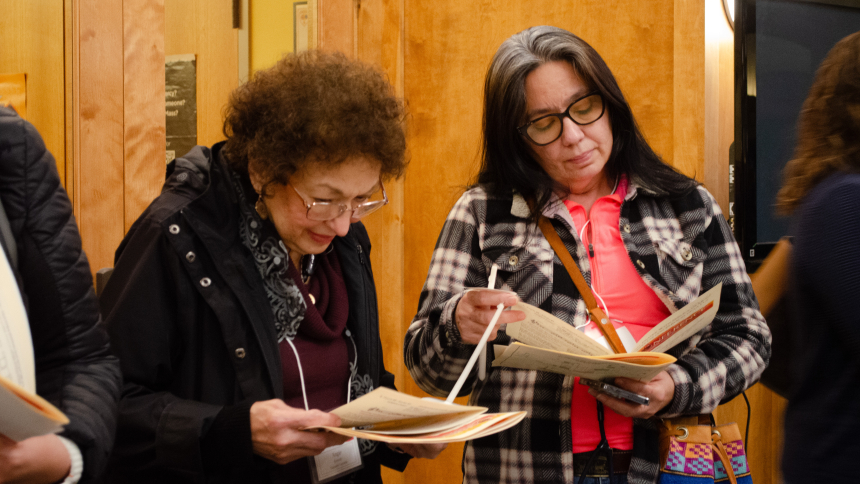
SCHERERVILLE – Lectors, music ministers, Extraordinary Ministers of Holy Communion, greeters, sacristans and more gathered to learn and participate in a diocesan event, reflecting on how the Church can best pass on the liturgical ministries to future generations. Speakers, Night Prayer, Mass and training sessions were all part of CONFERENCE ‘26 held on Nov. 6-7 at St. Michael the Archangel.
Keynote Father Martin J. Dobrzynski, MA, M.DIV, provided reflections on the role of lay liturgical ministry on the evening of Nov. 6. He discussed its importance as a sign of vibrancy in the church, its urgency as a matter of evangelization and understanding the cooperation with divine grace as given to every baptized member of Christ’s Church.
Father Dobrzynski, pastor of St. Michael, explained that during Mass, Catholic Christians engage in what is called anamnesis. They recall in the present the action of the past “enabling ourselves to see the fruits of that action in the present.”
“That's pretty much what the Eucharistic Prayer is all about,” he said. “It’s a remembering of what Jesus did, not as just some historical event, but entering into that event has never ceased to happen. It continues on throughout all history.”
Father Dobrzynski invited those gathered to use the practice of holy memory, calling to mind where the Church has been and how it still provides direction where its people need to go.
Each diocese, Father Dobrzynski stated, has its own personality. He described the Diocese of Gary as a young diocese established in December 1956 from the Diocese of Fort Wayne. The diocese has always been blessed with a great diversity of ethnic experience, creating a rich background “upon which we carry out Christ’s work today.”
The first Bishop of Gary assumed his chair in the cathedral in February of 1957. Just five years later, Bishop Andrew Grutka would be involved in one of the most significant ecclesial gatherings – the Second Vatican Council. The first document that came out of that council was the Constitution on the Sacred Liturgy.
Other documents began to reveal the laity’s role in assisting clergy in the larger mission of the Church. No longer was the laity’s role solely to come to Mass, pray, receive the sacraments and live holy lives. The laity’s role was being brought into an understanding of the Church that was becoming apostolic.
“The Church doesn’t change its documents, but we always want to be attentive to the signs of the times in order to bring the message of Christ’s love to others,” Father Dobrzynski said.
At the time of Vatican II, there was great enthusiasm in the laity’s ability to participate in liturgical ministries in a new way. However, Father Dobrzynski acknowledged that enthusiasm has since waned. He said that is unfortunate but doesn't reflect a waning from the Holy See.
“All (popes) have spent a great deal of ink spilled on the need for continued liturgical renewal,” he said. ”None of them are looking back. They’re all looking forward and constantly reminding us of where we need to go; what we need to pay attention to.”
Father Dobrzynski stated the signs of the times show that the Church needs to look outward rather than inward. In the Diocese of Gary, he noted, parish leaders are doing this through a pastoral plan centered around bringing others to Christ.
Father Dobrzynski shared that the liturgy has always been a magnet for those searching for faith. When they come to the liturgy, they then see the work of those assisting and helping in ministries.
“We live the liturgy that we celebrate so that others can literally see who we are as followers of Jesus and be attracted to it both by our encouragement and our way of life,” he said. “Evangelization is not just a matter of going after persons who don’t know about Jesus, but also going after fellow parishioners who need to know Jesus better.”
Father Dobrzynski added that it’s important to understand what the Church is up against today: forces in society that can devalue human connection and lead to painful divisions in families, communities and nations, like social media and artificial intelligence.
“The work of ministry is primarily concerned with understanding ourselves and the persons we minister to,” he said. “And understanding can be aided by our intelligence, but it can not be dominated by it. Understanding has to do with the heart.”
Father Dobrzynski cautioned that the Church is at a threshold and stressed that intelligence alone is not the way to a person’s heart, adding, “it doesn’t lead them to fall in love with Jesus.”
“The facts don’t make us fall in love with Jesus. Understanding makes us fall in love,” he said. “Nor does it move a person to give of their time and their talent to be Jesus for another work of ministry. Let us seize this moment in our journey to confront the underlying presumptions that place the quest for pure intelligence over the real human quest for understanding.”
Oscar Castellanos, MA, M.DIV, EdD, who provided a keynote in Spanish, told attendees that ministers need times of stillness, depth in their faith and the understanding that God is greater than their ministry.
Being ministers does not make them invulnerable. He asked them to remember not to confuse the vastness of God with their own inner turbulence.
“God is not the tsunami of our conflicts,” he said. “His love is the foundation that enables us to pass through them.”
Castellanos explained that God’s love is not a privilege. It is not a distinction that places one above others. It does not make a person a spiritual elite, nor does it make them the owners of the faith. Instead, God’s love reveals that every person possesses a dignity that must be recognized and respected.
“Ministry does not increase our dignity; it invites us to place that dignity at the service of others,” he said.
Castellanos went on to emphasize that the future belongs to God, pointing out that no one knows all the forms that the life of the church will take in the coming generations. Languages, cultural expressions, instruments and forms of worship, he said, will change. Therefore, it's important that ministers not be concerned with maintaining control. Instead, it's important they help others learn, grow and feel prepared to serve.
Castellanos asked the audience to reflect on the quote: “If, after ten years, no one else can do what I do, perhaps I have worked a great deal, but I have not necessarily trained anyone.”
The following day, Nov. 7, ministers were welcome to join Bishop Robert J. McClory for Mass before entering into smaller training sessions. During the homily, the bishop mentioned that he still remembers the person who taught him to be an altar server. The person, just five years older, always remembered that he trained him, and the bishop remembered the same of him.
Bishop McClory said he thinks of that time in his life in the context of “How do we prepare, how do we pass on to the next generation what it is to have a great gift of serving?” The bishop shared that although he grew up comfortable around the Mass, he was nervous to become an altar server, recognizing it was a significant role.
“As we reflect on how it is we engage those who come to serve the altar and come to service in liturgical ministry, it’s okay to work with someone who is a little bit nervous, little bit uncertain, needs a little bit of assistance, little bit of coaching, little bit of encouragement because that’s how we grow,” he said.
Deacon Michael Halas has been involved in the liturgical conference since its beginning - 40 years ago. He described the event as a time when those actively involved with the Church can renew themselves in the various ministries that they minister in and receive training.
“It's a good time to really come, and not only be renewed, refreshed and reenergized in ministry, but also to learn more about the ministry and also encounter Christ through ministry as well as the people.”
Deacon Halas served as the presenter for renewal and training of Ministries of Care. During his presentation, he emphasized the importance of the ministry of presence. Referring back to the theme of the conference, “From One Generation to the Next: Faithful to the Call,” he also wished to help ministers hand on the ministry to somebody else.
“Somebody handed it on to them, and someone before them had it handed on to them,” Deacon Halas said. “So, it's that idea of handing it down to somebody new, especially the youth and the young. We want to hopefully attract more of the younger adults to ministry, particularly to the sick and to the homebound, into those places like hospitals.”
Marisela Serrato is part of the Lay Ecclessial Ministry program and was there to help volunteer. She is a lector and an Extraordinary Minister of Holy Communion at St. Joseph the Worker in Gary. She said attending the conference provides affirmation that they are “doing things right” in their church and provides an opportunity to learn “as much as they can” about the faith.
Serrato added that attending the conference was important, as it helps create more interest among faithful in serving the church.
“If we can be a leader for those people who are interested to come, and join, and do, and be part of the ministers; it would be so beautiful,” she said.
Jessica Zbyak, a parishioner of St. Michael, is involved in several ministries, including serving as a Eucharistic minister and assisting as part of the hospitality team. She believes more people need to be active in the church and feels it is important to “lead by example.”
“The conference always has really great speakers,” Zbyak said. “Sometimes you just need that little spark, and I think that coming to conferences is this fantastic way to do that.”