GARY – Guided by the Holy Spirit, Deacon Martin Brown has spent more than a dozen years researching the history of Black Catholics, all in an effort to teach others.
“I do it because the Holy Spirit told me to,” Deacon Brown said of his research. “I want to educate people, share what I know.”
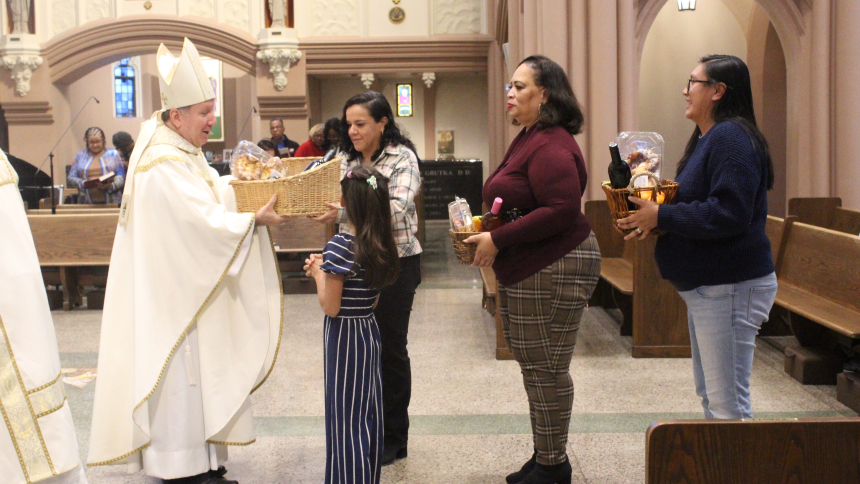
Toward that goal, the Diocese of Gary deacon hosted the fourth annual Black Catholic History Month celebration on Oct. 31-Nov. 1 at the Cathedral of the Holy Angels. The event began Saturday with a Mass celebrated by Father Charles A. Mosley. On Sunday, Bishop Robert J. McClory celebrated a Black Catholic History Month Mass, followed by a catered luncheon. The luncheon featured cultural artifacts and an exhibition detailing “Voices of Our People Past and Present – Contributions of Africa and The African Diaspora to the Catholic Church, also known as “The Voices Project.”
Mary Ann Carter, a parishioner at St. Joseph the Worker in Gary, said she had several reasons for spending the day at the Black Catholic History Month event on Oct. 31. “I want to learn more about black history in the Catholic Church, support Deacon Brown and his project, contribute to the rich history of blacks in the Church and continue to grow our history and bring more blacks into the Church,” she said.
Others in attendance are actually part of the history of black Catholics even before the Diocese of Gary was established in 1956. “I was born and raised in Gary,” said Minnie Durosseaux, 96. “My father’s family was Catholic, but my mother was a Methodist who would not convert. In those days, my father could not receive the sacraments because he was in a mixed marriage.
“St. Monica was the first black parish, and we were one of two black families living on Van Buren Street. We went to the library for catechism classes. I was married in a High Mass at St. Monica,” recalled Durosseaux.
Ann Thompson, 97, came to Gary in 1954 to teach at Roosevelt High School, “and I have lived here ever since. I was a member of St. Monica until it closed, and now I attend Mass at the cathedral.”
Dolores Turner, a parishioner at St. Mary of the Lake in Gary, remembers Deacon Brown when he was a kindergartner, “so I saw the flyer for this history program and decided to come celebrate.”
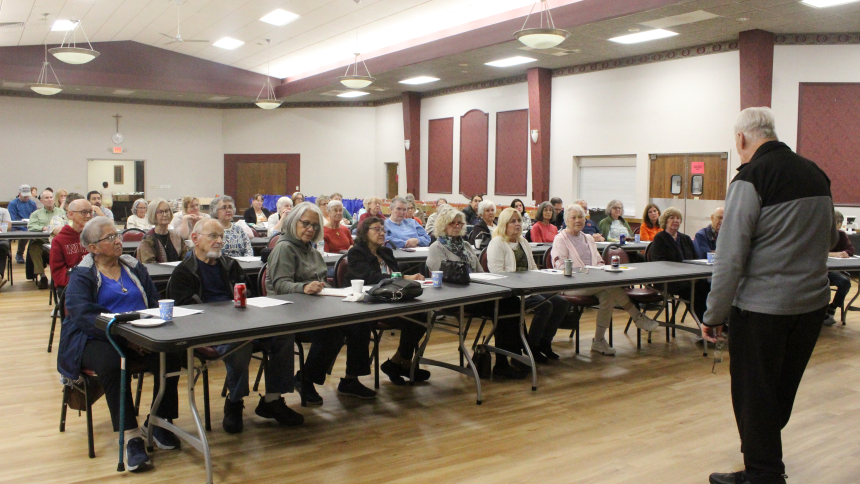
Deacon Brown surprised his audience by opening his first lesson, “The Early History,” with the news that the Catholic Church boasts three African popes, likely Black men, during its first 500 years – Pope Victor I, Pope Miltiades and Pope Gelasius.
He described the “rings” of the early Catholic Church, the first ring composed of church leaders who knew Jesus, the second ring made up of people who were trained by those in the first ring, and subsequent rings representing the next generations, with the three African popes in the fourth ring.
“Those three men from Africa did things that are fundamental to the way we do things today in the Church,” said Deacon Brown about the importance of those early popes. As an example, he detailed how Pope Victor I, faced with “a hodgepodge of traditions,” called the scholars of his time together, listened to them and his advisors, and decreed that Easter would be celebrated on a Sunday. When some faithful balked at being told what to do, “Pope Victor said that if you don’t do it my way, you’ll be excommunicated, and that’s how we still do it after 1,800 years,” said the deacon.
Other lessons Deacon Brown covered included: “The Stono (Slave) Rebellion of 1739 in South Carolina,” “The Healey Family” and “God’s Men of Color, 1954-60.”
Father Charles A. Mosley, priest in solidum of the Cathedral of the Holy Angels, St. Joseph the Worker and St. Mary of the Lake and the only black priest ordained for the Diocese of Gary, said it is important to commemorate Black Catholic History Month “because it shows the history of people of color in the Church, a history that many people don't know about. The foremost thing to put forth to people is that the Catholic Church is for everybody. We were the only church that welcomed everybody back in Antioch (after the death and Resurrection of Christ).
“We have a rich culture to offer, and there should be a place to offer that, so the Church can be more complete,” added Father Mosley.
In his homily at Sunday’s Mass, Bishop McClory spoke of his attendance the day before in Savannah, Ga., where five Spanish Franciscan missionaries killed in September 1597 during an Indigenous Guale uprising in Spanish Florida, now coastal Georgia, were beatified. He explained that he saw footprints in the dirt mound that marked their gravesite, some large, some small, some heavy and some light.
“All of those people were stepping into sacred space,” he said, making their mark known in a spot lost to time until the burial site was discovered 50 years ago. “We are but the current expression of those who came before us, and to present the history of those who came before is a noble calling,” the bishop said.
Noting the 99th anniversary of the establishment of St. Monica Church in Gary, Bishop McClory acknowledged that many in the congregation are “sons and daughters of that parish” and part of its history.
Before the closing blessing, he prayed “that we may be called the children of God, as we are, and may we reclaim our history, so that in this time and at this place, (we) can leave (our) mark.”
"Voices of Our People Past and Present – Contributions of Africa and The African Diaspora to the Catholic Church"—is an exhibition and research initiative co-founded by Anita Miller and Deacon Martin J. Brown. Operating within the Roman Catholic Diocese of Gary framework, the project focuses on documenting, curating, and sharing the extensive history and religious contributions of Black Catholics.
Caption: Bishop Robert J. McClory accepts the offertory gifts from Maria Gallegos and her daughter, Carolina Gallegos, during the Black Catholic History Month Mass on Nov. 1 at the Cathedral of the Holy Angels in Gary. (Marlene A. Zloza photo)