“The horrendous terrorist attacks on the United States on Tuesday, Sept. 11, have left us all in a state of shock and with broken hearts. In our faith, we find hope and we do not permit ourselves to be broken. In prayer and in solidarity, we find comfort and assurance in our grief.” – Bishop Dale J. Melczek, Third Bishop of the Diocese of Gary (Northwest Indiana Catholic, Sept. 23, 2001).
MERRILLVILLE – Everyone has their own story of where they were when they first heard of the terrorist attacks that occurred in New York, Washington and Pennsylvania on a day that would come to be known simply as 9/11. As that tragic day in United States history marks its 25th anniversary this year, members of the Diocese of Gary shared what they remember from living through the experience.
Most Rev. Robert J. McClory, Bishop of Gary, was a graduate student pursuing a master's in public policy and administration at Columbia University from 1985 to 1987. One area of interest for him was economic development, and an internship was part of that program. He ended up working for the economic development agency that built and managed the World Trade Center as the Port Authority of New York and New Jersey.
The summer internship developed into a year-long paid internship, as he worked on the 64th floor of Tower One. The bishop still has a key from that time, which he has kept as a memento. It accessed the floor’s bathroom and bears the words, “World Trade Center. Do Not Duplicate.”
Bishop McClory called it an extraordinary time in his life. He was between the ages of 21 and 23 and felt it was a great time to be in New York and experience the big city and all it had to offer. He would take the subway from 125th Street all the way to the World Trade Center every morning (or during the school year about two or three times a week).
“There was a tremendous amount of energy and excitement and vitality,” he said. “It certainly was just quite remarkable. It was also during the time that there were a number of great festivities during those years, including the 100th anniversary of the Statue of Liberty.”
Bishop McClory was on an extended pilgrimage with a group of pilgrims in September 2001. The itinerary of the pilgrimage began in the Holy Land and continued to Italy. On the evening of Sept. 10, Bishop McClory and the rest of the pilgrims flew out of Tel Aviv and landed in Rome that night.
The next day, the group had just finished visiting the Basilica of Santa Croce Jerusalem in Italy, which is the Basilica of the Holy Cross where there are relics of the True Cross and other artifacts associated with Christ's passion. They were making their way to the Archbasilica of St. John Lateran when one of the priests told him that he had heard that the Twin Towers were smoking.
“This would have been the pre-internet age, and as a result we really didn't have the kind of rapid access to news and information, so we just progressively kept getting bits and pieces of information about what was occurring,” explained the bishop. “We were also in a different time zone at that point, so we were experiencing this more in the afternoon. Then gradually we found out the full devastation of what had occurred.”
Bishop McClory acknowledged he experienced the attack on 9/11 differently from others because he was out of the country. As he continued on the pilgrimage, which lasted about 10 more days, he still remembers the outpouring of sympathy and support for the group as American pilgrims.
He said, “There was extraordinary solidarity from others in Italy as they knew we were Americans, and so there were shopkeepers who wanted to give us free items because they just wanted to do something to help Americans and to show us their compassion.”
Three days later, on Sept. 14, the Feast of the Triumph of the Cross, Bishop McClory reflected on a personal spiritual image. He envisioned Jesus on the cross, and seeing His two shoulders, it was as if one tower was on one shoulder and one tower was on the other. That reminded him that all the pain and the horror Jesus endured was for all of humanity at all times.
“While we can't entirely understand the suffering of that devastating terrorist attack, we can look to the suffering servant of Jesus, who came to absorb all the sins and the pains and the sufferings of the world,” he said. “We can place this pain on His shoulders.”
Bishop McClory graduated from Columbia University in 1987 and had not returned to New York for many years. However, he recalls that during a layover in Newark, he could see the World Trade Center and pointed out the towers to people traveling with him.
“I was kind of savoring it because I hadn't been there in many years,” he said. “And I was glad in retrospect that I was able to get one last view of the Twin Towers before this all unfolded.”
The events of Sept. 11, 2001, are something Christine Harsh remembers very clearly. She had just dropped her daughters off at elementary school and had a few minutes to grab a coffee before heading to work as an instructional aide at their school.
Harsh recalls she was driving down Glendale Boulevard in Valparaiso when the news broke on the radio.
“I remember thinking, ‘What is going on?’” she said. “I couldn't believe what I was hearing.”
At the time, Harsh was a member of St. Teresa of Avila Catholic Student Center at Valparaiso University. She remembers how many VU students came together during that difficult time, gathering at both the Chapel of the Resurrection on campus and St. Teresa of Avila.
“We were looking for comfort, answers and guidance,” she said. “We turned to prayer and to one another. Looking back, I think that is where we saw God – in the way we came together, supported each other and found hope during one of the darkest times in our country's history.”
Vicky Hathaway, coordinator of youth and young adults, was a freshman in high school when the 9/11 attacks occurred. She remembers entering her Honors English class and the television was on in the classroom, which was unusual. Something was on, but she couldn't figure out what it was. As she sat down, her friend informed her that “we're being bombed.” And that's when she saw that it was a building on fire.
“I remember teens being scared,” Hathaway said. “Many of my classmates’ parents worked in Chicago and there was a fear that something might happen there. When I came home that day, I remember feeling overwhelmed by the news and I took a walk in the woods by my house. I remember looking up at the blue sky, now devoid of any aircrafts, and I started praying. I prayed for all those who died, for those who were mourning, and for those who enacted the attacks. I remember feeling like no one was praying for them, so I thought I should.”
The following year, Hathaway found herself standing in Toronto listening to Pope John Paul II greet young people from around the world during the opening of World Youth Day. In his opening remarks, the pope reflected on how the new millennium began with two different images. The first was pilgrims coming to Rome for “the Great Jubilee” and the other was the 9/11 terrorist attacks, which he called “a sort of icon of a world in which hostility and hatred seem to prevail.” A statement she felt was very accurate.
“Not only were the acts of hijacking planes to kill others an evil act, but so were the discrimination and racist acts against people who just happened to be of the same ethnic or religious background as the hijackers,” she said.
The future saint went on to have the young people reflect on ‘what foundations we must build for the new historical era that is emerging from the great transformations of the twentieth century?’ That has been something Hathaway remembers reflecting on a lot.
“We could continue to focus on hate and revenge, leading to more harm, injury, dehumanization, and death or we could focus on loving our neighbors,” she said. “Hate is a four-letter word. So is love. What will we focus on and teach our young people? I would like to think we are being called to focus on love.”
Hathaway admitted it's hard to look back at what happened in New York, Washington DC, and Pennsylvania and easily see where God was in that moment… so much death, destruction and fear. But upon further reflection, she said, one starts to realize that God was there.
“In every moment, God was there,” Hathaway said. “With those who were scared, those who were injured. At the moment of their deaths. God was there with each person. Giving strength to first responders. Weeping with those who wept. Loving them in each moment. God is also with us now as we are still navigating the emotions from that day and how we choose to see the world around us. Each day calling us to love and love more. To care for others.”
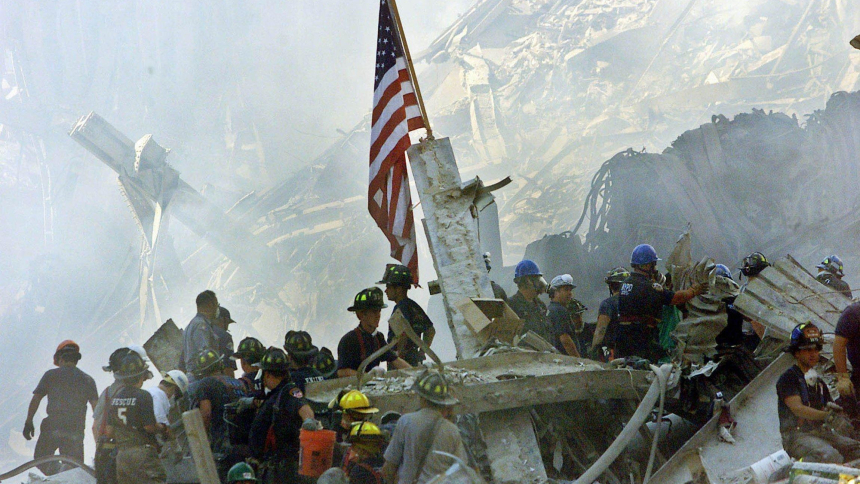
Caption: A U.S. flag is posted in the rubble of the World Trade Center Sept. 13, 2001, in New York, two days after the terrorist attacks. Sept. 11 this year marks the the 10th anniversary of the attacks that claimed the lives of nearly 3,000 people in New York City and Shanksville, Pa., and at the Pentagon. (OSV News photo/Beth Kaiser, Reuters)