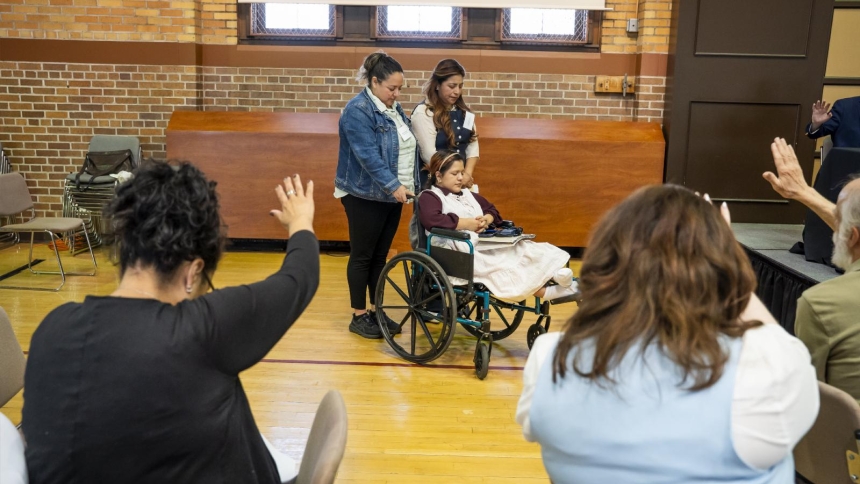
DETROIT (OSV News) - Priests, bishops, parish leaders and immigration rights advocates from 10 dioceses gathered at Sacred Heart Major Seminary in Detroit to discuss the Church's prophetic witness regarding the debates surrounding immigration and the impact current federal policy has had on immigrant communities over the past two years.
More than 200 people participated in "Witness to Hope: Pastoral Care of Immigrant Communities" May 6 to discuss what the Church can do at the parish and diocesan levels to accompany immigrant communities amid the expansion of immigration enforcement initiatives taking place during President Donald Trump's second administration.
The daylong summit was a collaborative effort between the Archdiocese of Detroit, Catholic Charities of Southeast Michigan, the Hope Border Institute in El Paso, Texas, and the Center for Migration Studies of New York.
It followed previous "Witness to Hope" gatherings in Providence, Rhode Island, and in Phoenix in recent months.
"The goal here today is to get us energized to take the next steps as dioceses, parishes, religious congregations or as groups of Catholic organizations, because some of you might be doing pretty well in a lot of things," said Father David Buersmeyer, a priest of the Archdiocese of Detroit and chaplain for Strangers No Longer, a Detroit-based, lay-led Catholic immigration rights advocacy group.
"Then there are some of us who might need to start something, so what are the initial steps? Where can we get inspiration to start?" Father Buersmeyer added.
The conference was attended by clergy and lay leaders from the Archdiocese of Detroit and the dioceses of Gaylord, Grand Rapids, Kalamazoo, Lansing and Saginaw in Michigan, as well as the dioceses of Cleveland, Columbus, Toledo and Youngstown in Ohio.
Detroit Archbishop Edward J. Weisenburger welcomed the various groups advocating for immigrant rights in their communities, including his brother bishops: Bishop Earl A. Boyea of Lansing, Bishop David J. Walkowiak of Grand Rapids and Auxiliary Bishop Jeffrey M. Monforton of Detroit.
Archbishop Weisenburger recalled his days studying philosophy at the Catholic University of Louvain in Belgium, where a professor lectured on the dynamics of two people when one helps the other.
"My professor would speak of the face of the other, and when you look into the face of the other who is in need, you discover the other has a hold on you," Archbishop Weisenburger said. "And if you turn away from that and deny that obligation, it is a denial of our very humanity."
The archbishop recalled his experiences as the bishop of Tucson, Arizona, where Catholic Charities and the Kino Border Institute were processing up to 1,400 people a day sent to them by U.S. Customs and Border Protection.
"I found myself looking at the situation and how the public political paradigm was so very different from the Church's Gospel paradigm," Archbishop Weisenburger said. "I found myself struggling to bring those worlds together. It wasn't just the stories of the migrants, immigrants and asylum-seekers that came through. It was also the thousands of volunteers who came in day after day. Once they had looked into the face of the other, they could not quit. They recognized that their humanity and their salvation in some way depended on their response."
It was in this context -- seeing the presence of Christ in the other -- that Archbishop Weisenburger suggested those in the Church examine issues related to immigration.
The conference featured lawyers and policy experts who delved into Catholic teaching on immigration enforcement and the rights and responsibilities of nation-states in regulating their borders.
"First of all, let me say that Catholic teaching says that sovereign nations do have a right to control their borders, but it's not an absolute right," said Kevin Appleby, senior fellow for policy and communications for the Center for Migration Studies. "It must be governed by the preservation of human rights and human dignity. And we see currently that human rights and human dignity are being violated."
Appleby encouraged attendees to refrain from using vague or commonly used statements, such as "secure the border," when discussing immigration policy, which often lack clarity and detail.
Catholics can instead look to statements from Popes John Paul II, Benedict XVI and Francis, recognizing the inherent rights people have to migrate, Appleby said. In particular, Appleby cited St. John Paul II's 1993 encyclical "Veritatis Splendor," which classified mass deportations and the forced removal of people as "intrinsic evil."
"In November of last year, the U.S. bishops stood up, and for the first time said, ‘We oppose the indiscriminate mass deportation of people,'" Appleby said. "That was a big step by the bishops."
Appleby cited studies showing that only 2% of immigrants deported were gang members and only 0.5% were terrorists, while more than 50% had no criminal record, contrary to the political rhetoric used to justify mass deportation policies.
"What the bishops are asking for in immigration reform is, first of all, that immigrants with equity, families, jobs, who contribute to communities, should not be enforcement priorities," Appleby said. "The Church says they should be put on a path to citizenship. There should be immigration reform. These are people who have contributed over the years to the well-being of our communities, who have built equity, bought homes, started businesses and families. They should not be deported. They should be given a chance to become citizens."
Jazmin Rubio, family programs manager for Catholic Charities of Southeast Michigan's La Casa Amiga program in Pontiac, spoke about her father's immigration story.
Rubio described how her father spent two days crossing the desert on his journey to the United States from Mexico. Over the next five years, he worked three jobs and, eventually, saw three of his children go to college.
"I tell you this story to show that as a daughter of an immigrant, I know how it feels to love from far away," Rubio said.
In her current role, Rubio said she often sees the personal impact of deportations play out in struggling families.
Monica Tay Belej, director of the La Casa Amiga Legal Clinic, stressed the importance of speaking with clarity about the facts of immigration.
Belej said on average, immigrants -- both those with documents and those without documents -- commit fewer crimes than the native-born population.
"Most of our clients come from what we call a ‘mixed-status family,' meaning that within one household you could have one undocumented parent or one parent who's currently going through removal proceedings," Belej explained.
Meghan Kennedy Riordan, an attorney with the Kitch Law Firm in Detroit, gave a presentation about the rights people have when interacting with personnel from Immigration and Customs Enforcement, or ICE, and the Department of Homeland Security.
Riordan said ICE officers need signed warrants from state or federal judges -- not an immigration judge -- and need to wear credentials identifying them as federal officers.
"Knowledge is power, and we need to speak the truth," Riordan said. "We must speak up and break down these immigration myths. It is not a crime to enter the United States illegally; it's a misdemeanor. You are not a criminal if you commit a misdemeanor. Being in the United States unauthorized is akin to a speeding ticket."
Riordan said it is incumbent on people to correct their fellow parishioners, friends and family members when they are mistaken about immigration issues.
Riordan added that parishes with prominent immigrant populations should prepare for eventualities should ICE commence an enforcement operation on their grounds.
"You need to go out and educate your congregation," Riordan said. "You need to start putting up signs that say ‘private.' A deportation order or administrative warrant is not sufficient for them to enter private or non-public areas. Individuals such as secretaries or personnel are not required to answer questions from ICE agents and can ask to see a warrant before allowing entry into private spaces."
In the second half of the conference, participants broke into diocesan groups to discuss the unique challenges they see in supporting immigrants in their own communities.
Todd Scriber, education outreach coordinator for the Office of Migration Policy and Public Affairs at the U.S. Conference of Catholic Bishops, spoke on a panel about the Catholic response to the current situation regarding immigration.
Scriber said the USCCB used to have a staff of around 180 to work migration issues, but because of a lack of funding due to cuts through the federal executive branch's Department of Government Efficiency, that number is now six.
This has led the conference to work more closely with the Center for Immigration Studies, the Hope Border Institute and Catholic Charities agencies across the country.
Beyond calling for comprehensive immigration reform, Scriber said the bishops have called on the faithful to lower the temperature of the political rhetoric surrounding immigration.
Scriber highlighted the USCCB's "You Are Not Alone" initiative, which provides resources and information to help parishioners understand the Church's teaching on migration and the efforts people can take to support immigrants in their communities.
Others on the panel discussed strategies at both the diocesan and parish levels to assess which initiatives supporting immigrants can begin or be expanded. These include creating free legal clinics so immigrants are represented at court hearings, prayer vigils at detention facilities, and communicating with local law enforcement about their concerns regarding cooperating with ICE and DHS in federal cases.
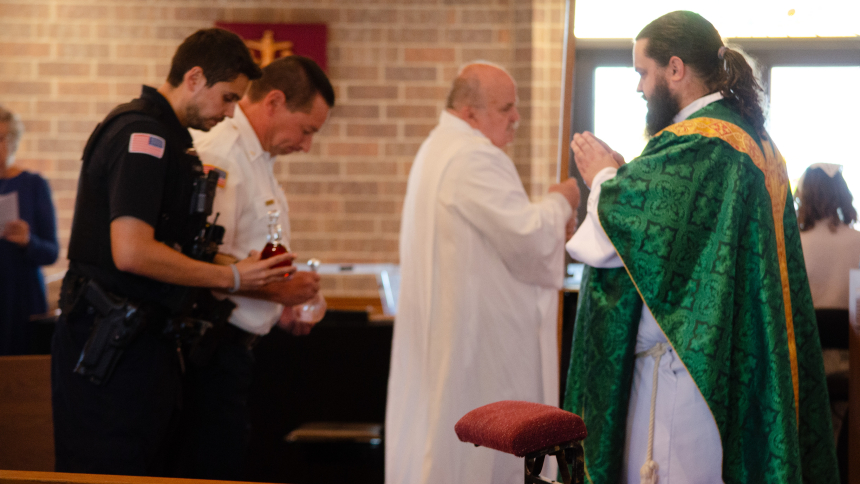
Caption: Participants of the "Witness to Hope: Pastoral Care of Immigrant Communities" summit at Sacred Heart Major Seminary in Detroit May 6, 2026, pray over Daris Bartolon and her daughter, Maddeline. Daris and her daughter fled their native Guatemala in order to get away from her domestic abuser. She has a court date June 1 to hear her plea for asylum. (OSV News photo/Valaurian Waller, special for Detroit Catholic)