NEW YORK (OSV News) – In 1954, British author William Golding published his debut novel, "Lord of the Flies," a deeply pessimistic parable about the evils inherent in human nature and the fragility of moral standards. Although initial sales were slow, the book proved to have staying power and went on to become both highly regarded and persistently controversial.
Two English-language film versions followed. The first, helmed by Peter Brook, premiered at the 1963 Cannes Film Festival. Brook used an untrained cast and relied heavily on improvisation. The 1990 remake, directed by Harry Hook, was criticized for the degree to which it departed from its source material.
Golding's work also inspired Filipina director Lupita A. Concio's 1975 movie "Alkitrang Dugo." (Currently known as Lupita Aquino-Kashiwahara, the filmmaker is the sister of martyred Filipino statesman Benigno Aquino whose widow, Corazon, went on to become the nation's president from 1986 to 1992.)
Earlier this year, a small-screen adaptation -- created and written by Jack Thorne and directed by Marc Munden -- aired on the BBC. All four roughly hour-long episodes of the series are currently streaming on Netflix.
Golding's plot will be familiar to many from their high school days since his book is a favorite with English teachers. An airplane crash strands a group of preadolescent British schoolboys on an uninhabited island. They are thus left to fend for themselves, with the older lads needing to hunt for food, build shelters and protect their vulnerable and helpless juniors.
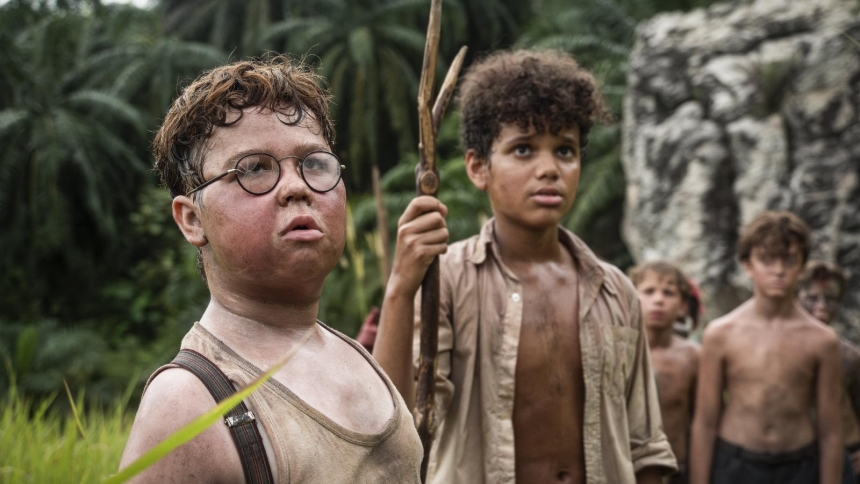
Three central figures emerge as the boys attempt to organize themselves. Overweight, asthmatic Nicholas (David McKenna), cruelly nicknamed Piggy, represents civilization and rationality. Power-hungry choir leader Jack (Lox Pratt), by contrast, embodies animalistic high spirits, rebelliousness and, ultimately, barbarous anarchy.
Wavering between these two is mostly good-hearted Ralph (Winston Sawyers). Though Ralph starts out as Piggy's ally, once elected the community's leader -- much to Jack's fury -- he proves weak-willed in standing up to Jack and his followers. Laziness and mutual antagonisms take hold, leading not only to conflict but to missed opportunities for rescue.
Thorne and Munden rely heavily on visual imagery and facial expressions to guide viewers through Golding's tale. As a result, long periods elapse without any dialogue. Fortunately, the young actors prove more than equal to the task of conveying a variety of emotions via non-verbal means.
Though there are moments of suspense, moreover, the story unfolds at a leisurely pace. Artful shots of the boys' new environment reflect the beauty as well as the savagery and corruption of the natural world -- and thus symbolically suggest the range of spiritual possibilities among the island's new inhabitants.
Given this artistic approach, the music of the soundtrack takes on added significance. In this context, viewers of faith will note that a crucial early moment, the first appearance of Jack and his fellow choirboys, is accompanied by an ethereal setting of the Kyrie Eleison.
Based on the first two installments screened for review, "Lord of the Flies" is best suited to older adolescents and their elders. While off-color talk is kept to a minimum and the boys' scatological banter is fleeting, gruesome sights -- including a gory corpse -- and a momentary indulgence in distasteful sensuality preclude recommendation for kids.
Whether the subtleties and unhurried cadence of this production will win over the TikTok generation seems open to question. But patient TV fans may come to appreciate the aesthetic sophistication of this latest iteration of Golding's deep-delving narrative.