“Vocation is the place where our deep gladness meets the world's deep need.” – Frederick Buechner
MERRILLVILLE – Catholic Social Teaching is a call to live faith through justice, service and love of neighbor. But how do we help young people move from understanding these teachings to living them?
Vicky Hathaway, coordinator for youth and young adults for the Diocese of Gary, set out to provide a brief overview of Catholic Social Teaching during an online program the evening of April 28 titled “Catholic Social Teaching & Young People.”
“The goal of tonight is to help people get those basic understandings of what Catholic Social Teaching is and to see how it can be used when we're talking about our ministry with young people and why it is so important, especially for the Church, and especially for young people,” she said.
What is Catholic Social Teaching? Hathaway shared that many people call it the Catholic Church's best-kept secret, but she quickly noted that it should not be the case, as it should not be a secret.
“It should be something that is shared with everyone and is something that should help guide the way that we interact with the world around us, and especially in our communities,” she said.
Hathaway described Catholic Social Teaching as the church's rich treasure of wisdom about building a just society – living lives of holiness amidst the challenges of modern society.
“It's really kind of bridging who we are called to be as people of the Gospel and how we are called to love and care for our neighbor,” she said.
Hathaway went on to discuss the four fundamental principles of Catholic Social Teaching and the seven themes that comprise it.
The first principle is the common good. Hathaway shared that this concept is central to Catholic Social Teaching. The principle of the common good reminds people that everyone is responsible for each other and that they must work within social conditions to ensure that every person and every group in society can meet their needs and realize their potential.
Solidarity is a principle that reminds us that everyone is human, and as humans, we cannot survive on our own. People need each other to grow and achieve their full potential within their relationships.
“We are very social creatures,” Hathaway said. “We need each other. God made us to be together in a community, and so, because of that, we know that we need each other for our salvation.”
Another principle is subsidiarity. It is related to how everyone is called to participate in the act of service. The act of showing love to others, especially when helping people who might be less fortunate, is a reminder that if we are making decisions about a group of people, that group needs to be part of the solution- making process.
“If we are saying that we are called to help the poor, the poor need to be part of that process,” she said.
A good example, Hathaway stated, is Catholic Relief Services, which is assisting those in Lebanon and other war-torn places. She explained the organization is not limited to caring for those impacted by their religious affiliation. As long as they are in need, CRS will help them.
The last principle, which Hathaway calls “the main crux of everything,” is the dignity of the human person. All persons have the same nature and the same origin, redeemed by the sacrifice of Christ. All are called to participate in the same divine beatitude; all, therefore, should enjoy it in equal dignity.
“We're made in the image and likeness of Christ; we are all worthy of dignity,” she said.
There are seven themes of Catholic Social Teaching, which examine different aspects of society through these four principles. The first one is the life and dignity of the human person. Everyone, no matter what crimes they've committed, deserves to be loved by others in that moment. This theme shows up when the Church addresses issues like abortion, euthanasia, cloning and the death penalty.
Hathaway said, “The church calls us to defend human life at all stages, from conception to natural death, to work to avoid war whenever possible and to seek peaceful ways to prevent and resolve conflict.”
The next theme is the call to family and community participation. This means that the human person is not only sacred but also social. It recognizes that people are organized in society by economics, politics, law and policy, and because of that, we are called to participate in the world and bring the Gospel to others in all places.
Another theme is rights and responsibilities. Every person has the right to what they need, such as food, healthcare, education, clean water and safe shelter. Those are basic rights that people are called to have by nature of being human beings. Responsibilities come from helping to enact those rights.
“We're responsible for other people. We're responsible for each other, responsible for our families, and we're responsible for the wider society, Hathaway said. “We can't just always look at ourselves and ask, ‘What do I need?’ We need to look and know that we're here to love our neighbor, and so we need to be working towards the common good for our neighbors as well.”
The theme of solidarity, as mentioned, refers to the concept of one human family, regardless of racial, ethnic, economic or ideological differences. Hathaway pointed out that because the Catholic Church is a global and universal church, the idea of loving neighbors extends beyond the country’s borders.
Dignity of work is a principle, Hathaway admits, that is not discussed as often. She explained that the Church teaches that the economy should exist to serve people and not the other way around, emphasizing that there is dignity in work.
“Work is more than just earning a living, but it's helping to participate in God's creation,” she said. “It's helping us to live out our call in the different areas that we are in. It's also helping our communities by giving services that are needed for us or for our communities.”
The principle of the option for the poor and vulnerable can be described as a key moral test of society. How are people treating the most vulnerable? How are people caring for the poor? How are they loving the poor? Hathaway said it’s important to find that balance, and help and care for those who go without or don't have as much.
Last is a theme that was highlighted by St. Pope John Paul II and carried forward by Pope Francis – care for God's creation. This involves finding ways to care for creation throughout everyday living. It should also include setting up parishes, schools and communities to really care for creation and advocating for the planet.
“As we're forming young people in the faith, we are called to help them remember that this is something that the church does, but also it kind of goes a little bit deeper than that,” Hathaway said. “Young people are looking for a purpose. They're looking for a reason, and when we're looking at these different issues, we can find ourselves being drawn to one or two issues a little bit more than the others. Being really drawn in can lead to seeing ‘How I can use my gifts in this place?’”
Hathaway shared that it can be a good idea to talk with young people about the issues that matter and are happening around them, reminding them that there's a call to prayer on these themes. She encourages adults to have conversations about justice, charities, the root cause of issues and the Church’s teachings for youth and young adults.
“It helps strengthen that feeling of belonging,” Hathaway said. “When you find other people who are interested in helping certain causes, it helps you find a community. Also, seeing how your own community is helping or how your parish is helping the wider community can also help people find more strength in or a deeper feeling of belonging.”
Hathaway then spent some time discussing a service design process created by the National Federation for Catholic Youth Ministry (NFCYM) called the Drexel Project. It is framed by four pillars: accompaniment, youth protagonism (empowering teens to lead in service and faith), shared leadership and theological reflection.
“It helps participants recognize God’s presence and God’s call,” Hathaway said. “We do that through discussion and through discernment with others. We can do it by ourselves, but it really grows when we do it with other people.”
Jalynn Edwards, a parishioner of St. John Bosco, is currently teaching a social justice class at Marian University centered around Catholic Social Teaching. She shared that recently, eight students were allowed to hold their own social justice events. They followed a similar process that includes a mentor and time to reflect on an issue. Some of the issues focused on mental health and social incarceration.
While it was not a service project, the students put on an exhibit, shared testimonies from real people and studied theological reflection on scripture.
“We were trying to explain to them that you have to portray to your audience that they have a role to play in this and they have to take this into their own communities and be the change that they wish to see,” Edwards said.
Deacon William Hathaway, who serves St. Edward in Lowell, shared that the parish asks youth to complete service hours as part of its confirmation program. He said at the very beginning, and all the way through the program, the church tries to stress that it's not asking for free labor but developing and forming habits in people using their gifts and sharing them with others.
“While we say that constantly, I don't know that it really sinks in,” he said. “And so this sounds like a way to make what we're trying to accomplish better understood by the kids, so I think it's kind of interesting.”
For further information on the Drexel Project, visit https://nfcym.org/programs/the-drexel-project. To view resources on youth and young adults, visit https://www.garyoyya.org. Additional leadership formation opportunities can be found at https://dcgary.org/leadership-formation. To reach Vicky Hathaway, call 769-9292 or email vhathaway@dcgary.org.
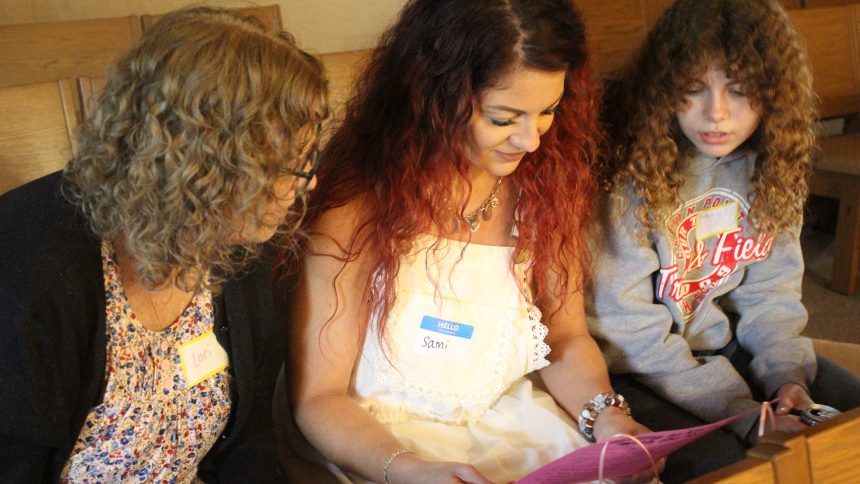
Caption: Young adults discuss their role in the Church and the challenges and opportunities facing today's youth on March 7, 2024 at the Pastoral Center in Merrillville. The listening session was part of the Diocese of Gary's participation in the global Synod on Synodality. (Erin Ciszczon photo)