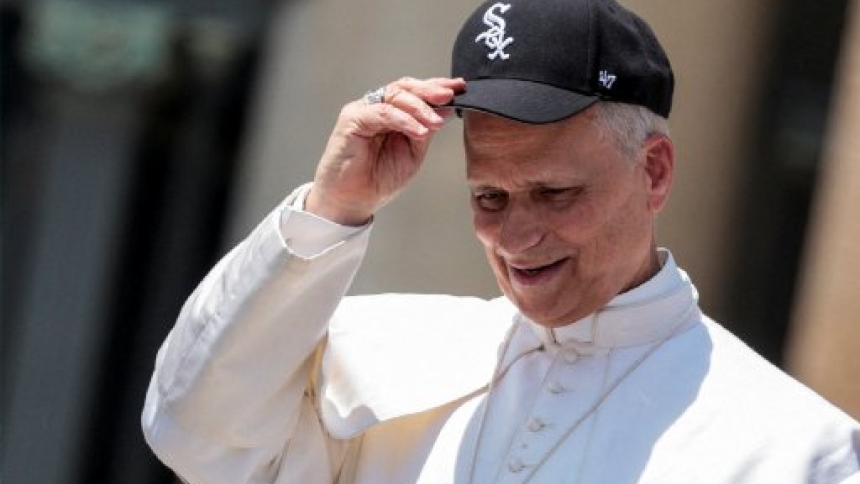
(OSV News) - As a South Sider, it still feels strange to say it out loud: The pope is from the South Side of Chicago and a diehard White Sox fan. Never in my wildest dreams did I imagine this would happen in my lifetime.
In the 20th century, Chicago was to American Catholicism what New York was to finance or Hollywood to film - central, influential and formational. Yet, it is currently undergoing some hard times.
Take St. Mary of the Assumption Parish in Dolton, Illinois, the church attended by Pope Leo in his childhood, which stands vacant and dilapidated. Now there is talk of its restoration, and it is my hope that with the election of Pope Leo, there will be a renewal of the faith throughout Chicago, especially on the South Side.
There are many places to pray for such renewal. Not far from the pope's hometown is the National Shrine of St. Jude, located in South Chicago, a working-class neighborhood that has gone through rough times. The shrine became a haven during the Great Depression for the thousands of workers who lost their jobs when local steel mills closed. The local priest encouraged devotion to this patron of impossible causes.
Further west is another shrine dedicated to a patron saint of impossible causes, an Augustinian saint familiar to our Augustinian pope, St. Rita of Cascia. Adjacent to the shrine is an all-boys Catholic high school under her name where Pope Leo used to teach math and physics during his studies at the Catholic Theological Union in Hyde Park. The high school and shrine are currently located in what used to be Quigley South, the second archdiocesan minor seminary.
Chicago Catholic schools, especially the high schools on the South Side, were often the heart of their neighborhood's identity. Pope Leo's brother John is a retired principal of St. Gabriel Catholic School in Canaryville.
Where earlier generations might have identified most strongly with their parish and its school, today many South Side Catholics identify with their Catholic high school. Rivalries -- especially in sports -- run deep, but so do the loyalties they forge. Even those who've long since left the neighborhood still carry its spirit. These schools were not just places of learning -- they were training grounds in camaraderie and grit, hallmarks of the South Side.
Chicago is a city shaped by waves of immigration, and many parishes founded in the late 19th and early 20th centuries were built as ethnic enclaves. Germans, Irish, Czechs, Italians and Poles each established their own churches -- places where national identity was maintained.
This began to change under Cardinal George Mundelein, the legendary archbishop of Chicago from 1915 to 1939, who sought to move beyond what he saw as immigrant parochialism by promoting the "post-immigrant" parish model.
But the relics of this past still remain. When driving along the city's expressways, you can't miss the monumental churches that rise from the city blocks -- testaments to the faith of those early communities and one reason that Chicago, despite its political drama and violence, earned the nickname "The Heavenly City."
For me, it was the dome of the Byzantine-Romanesque church of Our Lady of Perpetual Help that always stirred a sense of awe. As a child, I'd spot it from the Stevenson Expressway on our way to a Sox game in Bridgeport. It's one of the "Polish cathedrals" that still grace the skyline -- cathedrals not by designation, but by scale and grandeur.
There's an old saying about Chicago immigrant foundations: The Germans built the businesses, the Irish the pubs and the Poles the churches. Like most such adages, it's exaggerated -- but not without truth.
Chicago's most iconic "Polish cathedrals" are clustered northwest of the Loop, tracing the arc of the Kennedy Expressway through neighborhoods once filled with Polish immigrants. At the heart of what's known as the Polish Triangle stands St. Stanislaus Kotska, the "mother church" of Polish Chicago. Today it's also the Sanctuary of the Divine Mercy, famous for its perpetual Eucharistic adoration and iconic 9-foot-tall monstrance, a wooden carving of Mary as the Ark of the New Covenant, with the Eucharist displayed in the center.
Just a short way down Milwaukee Avenue is St. John Cantius, another spiritual attraction known for its rich liturgical life and celebration of the Latin Mass.
Further north, past Goose Island, is St. Mary of the Angels, the largest church in Illinois, loosely modeled on St. Peter's Basilica in Rome. With its massive dome and Renaissance interior, it's easy to mistake it for the cathedral -- but that is located further downtown, near the Magnificent Mile, Chicago's primary shopping district along Michigan Avenue.
Holy Name Cathedral often finds its way onto Mafia-themed tours, with guides pointing out the bullet marks that still scar its stone facade -- remnants of the 1926 assassination of mob boss Hymie Weiss, when Al Capone's men opened fire as part of their bloody bid to control Chicago's underworld. These faint pockmarks, however, pale in comparison to the damage caused by a devastating fire in 2009, which destroyed much of the cathedral's roof and prompted a major restoration.
But Holy Name is no stranger to renovation. In the years following the Second Vatican Council, the cathedral underwent a dramatic interior transformation in response to the Constitution on the Sacred Liturgy's call for "noble beauty rather than mere sumptuous display." Out went many of the statues, stained glass windows and devotional accretions -- elements that a rising Catholic cultural elite viewed as distractions from the centrality of the altar, or even embarrassing.
The post-Vatican II changes to Holy Name Cathedral were controversial, but they did not come out of nowhere. They were the visible fruit of a transformation that had been building for decades in Chicago and beyond. The roots of the liturgical movement go back to northern Europe, where the rebirth of Benedictine monasticism after the French Revolution and Napoleonic Wars gave rise to a renewed focus on the liturgy at the heart of the Christian life.
In the United States, the movement found a powerful ally in Cardinal Mundelein, who appointed one of its foremost advocates, Msgr. Reynold Hillenbrand, as rector of the archdiocesan seminary, St. Mary of the Lake. Located far north of the city, the seminary campus -- opened in 1926 -- is, in my opinion, the most beautiful seminary campus in the country.
That same year, Chicago hosted the 1926 International Eucharistic Congress, a landmark event in American Catholic history. The Mass at Soldier Field, lakefront home of the Chicago Bears, was one of the largest religious gatherings in the U.S. at the time -- a bold, public declaration that Catholicism in America had come of age. The Congress concluded with a pontifical Mass and Benediction held on the ground of the brand-new seminary. A temporary railway line was even built to bring pilgrims to the event.
Cardinal Mundelein famously called the seminary the "Vatican of the West," and the architecture speaks to that ambition. The buildings combine neo-Georgian and Colonial American exteriors with Roman-inspired interiors, centered on a chapel dedicated to the Immaculate Conception -- a structure that curiously resembles the First Congregational Church of Old Lyme, Connecticut, a classic New England Protestant meeting house.
The cardinal's message to the sons of immigrants was unmistakable: Be loyal to Rome, but also to America. That is now embodied in Pope Leo XIV, the first American pope.
While Chicago might not boast the sheer volume of cultural institutions found in New York, what it does have is world-class -- and much of it sits along one of the most scenic urban waterfronts in the world. In Hyde Park, the Museum of Science and Industry still stands as a relic of the 1893 World's Columbian Exposition, a landmark in Chicago history.
If you want to further explore, drive up Lake Shore Drive to the Museum Campus along Burnham Harbor, where you'll find the Field Museum of Natural History, the Shedd Aquarium and the Adler Planetarium. Further on is the Art Institute of Chicago, nestled beside Grant Park with its magnificent Buckingham Fountain. Walk north along Michigan Avenue to the riverwalk and you will be treated to one of the best views of Chicago's iconic architecture.
But for a truly breathtaking panorama, take the elevator up to the 94th floor of the former John Hancock Tower. From the lounge, you can see the entire city laid out before you -- Lake Michigan to the east, skyscrapers to the west, Wrigley Field to the north, and to the south, what I will always call Comiskey Park (now Rate Field), where the White Sox play.
Pope Leo XIV is a White Sox fan, which means he knows what it means to suffer -- a fitting trait for a pope. I take Pope Leo as a sign of that same promise for the Catholic Church in Chicago: a reminder that out of decline can come renewal, that deep roots still matter, and that hope, even on the South Side, is never out of reach. Chicago is now the home of the first American pope.
And somehow, that feels exactly right.
Caption: Pope Leo XIV wears a Chicago White Sox baseball cap during his weekly general audience in St. Peter's Square at the Vatican June 11, 2025. The new co-owner of the Chicago White Sox calls meeting Pope Leo XIV at the Vatican Nov. 19 "a really wonderful experience and one that I won't forget." News reports said he asked for a papal blessing on a future new stadium he hopes to see one day. (OSV News photo/Remo Casilli, via Reuters)