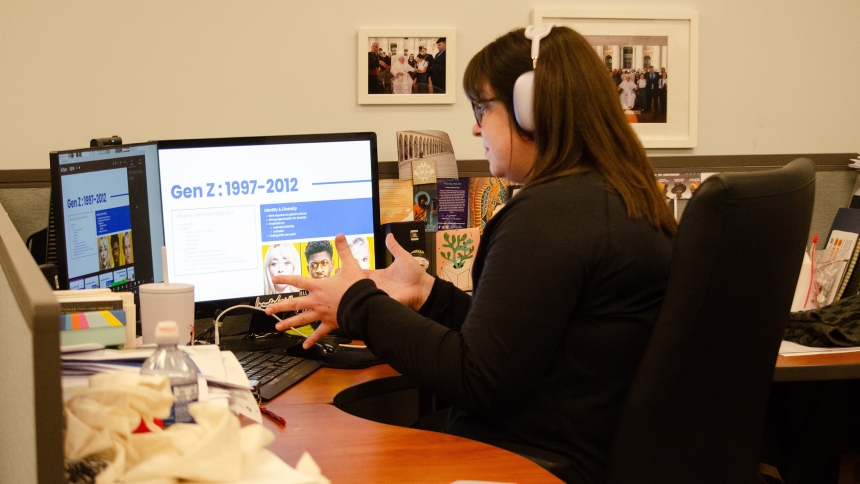
MERRILLVILLE - As part of a series in leadership formation, Vicky Hathaway, a member of the Office of Missionary Discipleship and Evangelization, led a conversation online entitled “Understanding Gen Z and Gen Alpha” on Jan. 27.
Hathaway, the coordinator for youth and young adult ministry for the Diocese of Gary, presented some information for reflection about younger generations from her office at the Pastoral Center, allowing individuals to tune in remotely or view the recording at a later time. Her goal was to provide those in ministry a better understanding of Gen Z and Gen Alpha.
Hathaway started by saying, “We're going to kind of break that open when we say Gen Z, and when we say Gen Alpha, who are we talking about? What are the distinctions? What are some characteristics of who they are as a generation? Then we're gonna be diving into a little bit about their experiences, especially when it comes to the world around them and faith and how the Church is called to respond.”
She added, “This is important because when we're talking, when we talk about ministering to young people, we should know who they are first. We should really understand who they are.”
Hathaway noted that it's really important to remember when talking about the generations that they are people who have had different experiences, different lives. She said it's important to see who they are as a whole, and not just a snapshot or a stereotype that was based on what someone heard about young people.
Gen Z
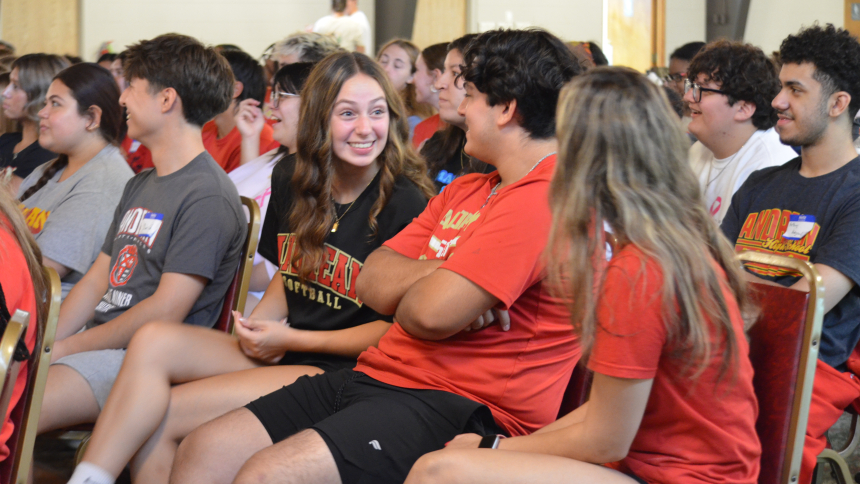
Gen Z is the older of these two generations. The years associated with this generation are approximate because Gen Alpha is an emerging generation, but, in general, Gen Z are those born between 1997 and 2012. They are 13 to 28-year-olds, which includes middle school and high school students. It also includes people in college, people who just graduated college and people who are starting off in their careers.
"They're still forming their maturity, their identity, and their faith,” Hathaway said.
Hathaway explained that those who are considered Gen Z should not be confused with Millennials, who are now in their late 30s to early 40s. She stated that Millennials can be described as the older siblings or older cousins of Gen Z.
The defining characteristic of Gen Z, Hathaway noted, is that these young people are true digital natives. They grew up in the smartphone era. Their lives are mediated by screens. They are also one of the most diverse and inclusive generations to date.
“If you look at the data, you know that the diversity, the number of cultural backgrounds, especially in the United States, keeps growing,” she said. "These young people are comfortable with the speed and scale of constant access to information.”
Gen Zers are apt to quickly pull out their phone and find the answer to whatever they're looking for. They are self-reliant and also highly collaborative. A lot of their education, especially in the United States, focused on collaboration and working together in small groups, so they know how to do that well.
Major events that happened during this generation include “flashball moments” like the Great Recession and COVID-19. Their lives were disrupted by the pandemic, and the popularity of smartphones and social media bloomed when these young people were very young. Many of these young people are too young to remember 9/11, but they are very much affected by the consequences of 9/11.
At the same time, Gen Zers are also looking at climate change and environmental responsibility.
“If you ask the young people, that is one of their major concerns,” Hathaway said, “You’ll see a lot of young people taking the lead when it comes to climate change. They are calling for the larger society, larger systems to do better.”
Finally, Gen Zers are more likely to question rules and authority. They will question, “Why is it this way?” and “Why do we have to do this? “ They don’t always see authority as being there to help them or support them.
“They're really looking at ‘what is my identity?” Hathaway said. “They're looking at labels and ‘what can I connect myself to?’ and ‘what can I define myself as?’ This generation is also conscious of inclusion and making sure that everyone is heard or everyone takes part.”
Gen Alpha
Gen Alpha are the “tweens” and younger. There are over 2 billion members of this generation worldwide, making it the largest generation in history. These range from babies, toddlers, elementary school and early middle school students. They are the children of the Millennials.
Hathaway said, “These young people are definitely in a different spot than even their previous generations.”
She described that these young people are trying to grow up in an even more connected world than previous generations. They are sometimes called the “iPad kids.” They've never known a world without a screen in front of them. From day one, they've been videoed, and most of them have been put on social media from birth.
The COVID-19 pandemic shaped a major part of Gen Alpha’s lives. These young people were entering school or were in elementary school when the pandemic was happening, so a big part of their socialization was disrupted.
“A lot of these young people never went out to a friend's house or never went out into the community,” Hathaway said. “They might not have done some of these bigger socialization activities that maybe their older siblings have done.”
Due to the digital landscape, this generation is aware that they may be watched at any moment. They might feel like they are being observed under a microscope, and so they behave in that way too.
“They don't want to engage in certain activities, because even if they think that they're silly [they know] that they could be seen in a different way because someone's going to have a phone on them,” Hathaway said. “They know that their digital reputation really, really matters.”
Gen Alpha have always had easy access to YouTube, Snapchat, Twitch and TikTok – anything that allows them to connect online. One of the big things that's shaping their generation is AI. Some young people are hesitant about AI, while others are embracing it, turning to it for many different things.
Gen Alpha tends to be more family-focused, Hathaway explained, because they were spending so much time at home that they've built better relationships with their parents. Therefore, they see their parents as their first influencers, and their parents' opinions and values matter.
“They usually follow along with what the parent does,” Hathaway said. “So, if the parent goes to church, the young person is much more likely to go to church.”
Understanding the Generations
Hathaway said that one of the major things that Gen Z and Gen Alpha are experiencing is a feeling that the world feels unstable. Both generations have experienced events like the pandemic, mass shootings, climate change, wars livestreamed on their phones and political polarization.
“Security that young people see is very temporary, because especially some of the older generations have seen their parents go through the Great Recession and they understand financial difficulty,” she said.
Hathaway shared data that showed those within those generations often feel lonely, isolated and unsupported. Young people crave a sense of belonging. Hathaway described three levels at which they start to feel connected to a place or group. Those steps include being noticed, being named and then being known.
“They are children of God, and so we want to know them as that precious gift that they are,” Hathway said. “This might be kind of difficult. It might be hard, especially if the young people are not talkative.”
She continued, “When we enter into the life of a young person, start by practicing non-judgment. Instead of judging, maybe some choices that young people make, we encourage people to turn to wonder about something that you might not understand.”
A list of upcoming leadership formation programs can be found at https://dcgary.org/leadership-formation. To contact Hathaway, email vhathaway@dcgary.org.