(OSV News) - The feast of the Holy Family, which is situated appropriately between Christmas and New Year's Day, serves as a context for the events it bridges: the birth of Christ and the octave of Mary.
As the humanity of Jesus is our path to the Father, remembering the family of Jesus is a fitting way to end and begin a year. When we recall that Jesus is Emmanuel - God with us - we are sustained in our darkest hours, and are able to find hope and joy. It puts our whole life in perspective. As we treat ourselves and others, so we treat him (see Mt 25:40; 45).
In their Gospels, evangelists Matthew and John most profoundly emphasize Jesus as the Word made flesh, and they also stress that it's love of the church, and particularly its most vulnerable members, that is the determining factor in the final judgment. The epistles of James and Paul likewise echo this perspective.
This most profound theological concept is realized in the foundational moral concept of love of neighbor and self, and this unity is a hallmark of biblical and Catholic teaching.
Living in a loving manner sometimes can be most difficult within the family (the domestic church), where intimate conflicts yield deep wounds, and where routine and familiarity can breed contempt and complacency. So we look to the Holy Family as models of fraternal love in a world of fractured family life and institutions.
To best learn how to live as the Holy Family did, we must incorporate Jesus, Mary and Joseph into our lives through affection. As within our own families, analysis and reason are insufficient when it comes to enduring trials. Only love, supplemented by faith and hope, will suffice. As human beings, love is a choice that we are always free to make. Thus the Gospels and the church, particularly in her liturgy, stress Jesus' total freedom in giving his life for us.
Embracing the Holy Family means accepting them as they are -- and ourselves as well. We (re)discover the Holy Family through the process of lectio divina on the Scriptures, by which we invite them into our lives and open ourselves to the Spirit. Traditional devotions such as the rosary and the Stations of the Cross are proven ways of entering into the mystery. We embrace them as we would a family member, and in a different way they are no less challenging. They long to become a part of us, related by adoption through human and divine choice.
The feast of the Holy Family is a wonderful time for Catholics across the theological spectrum to renew their devotion to them. Devotion to the Holy Family and love of family are complementary practices as the former is the model of the local and universal human family.
Embracing the Holy Family means entrusting ourselves to them like a child, in the manner proposed by Jesus (Lk 18:16-17). Through emulation in prayer, service and obedience, we cultivate this enthusiastic disposition.
Reflection on Scriptural accounts of the Holy Family aided by reading between the lines and common sense inferences will remind us that the struggles we undergo are anticipated in them. Dealing with a miraculous virginal conception and the social responses it surely engendered, marital celibacy (unprecedented and baffling for Jews and arduous for any couple), poverty, ostracization, death threats, a refugee beginning, confusion, painful misunderstandings and loss (Joseph's death) gives them first-hand familiarity with the trials we endure. They are our unparalleled advocates, and the consolation and reassurance they offer us amid our crosses is a supreme grace.
May we turn to them amid our struggles, confident of their loving and efficacious support.
Karl A. Schultz writes and speaks on Catholic and biblical spirituality, pastoral care, and men's and marital spirituality.
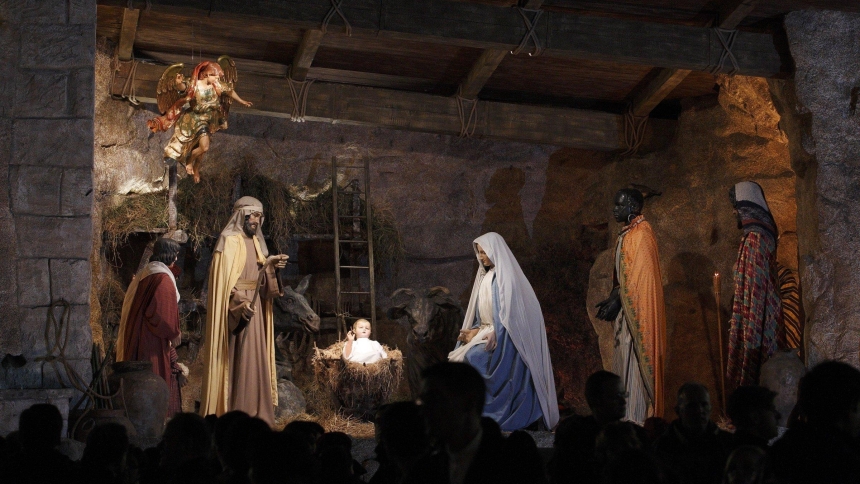
Caption: A file photo shows people visiting the Nativity scene in St. Peter's Square after Christmas Eve Mass at the Vatican. (CNS photo/Paul Haring)