There is beauty and value to friendships. Friends offer support in trials, increase happiness and reduce stress. Some friendships are temporary while others endure a lifetime. As human beings, we are created to be in relationship. We are social beings oriented to form emotional bonds in friendship with other persons.
As the world experiences a loneliness epidemic, the yearning for companionship increases. Many people, including three out of four teenagers, have used AI chatbots for relationships, using apps such as Character.AI, Replika, Anima, ChatGPT and anime-inspired Grok Ani.
Users turn to these apps for emotional support, seeking deeper connection without the complications of human relationships. Yet human beings are wired for something more than connection; we are created for communion. In this digital culture, authentic friendships are necessary for full human flourishing, and the theological virtues of faith, hope and love provide the resilience AI chatbots lack.
Humans are social beings, the imago Dei, made in the image and likeness of God (Gn 1:27) with qualities of intellect and free will oriented to divine communion. God is Father, Son and Holy Spirit, three divine persons in a communion of love. Human beings participate in that intimate union of trinitarian love as friends of God. Christ calls us his friends (Jn 15:12-15) and commands us to love as he loves us, which makes friendship a path to holiness and integral growth.
The problem with artificial relationships with machines is that AI lacks a soul. It may mimic human intelligence but it lacks the spiritual qualities needed to form relationships based on divine communion. It blurs reality offering lifeless images and soulless conversations that can lead to greater digital isolation. The antidote lies in human friendships that embody the virtues of faith, hope and love.
The theological virtues form the foundational pillars of resilient companionship infusing human bonds with a transcendent purpose. This contrasts with their absence in chatbots. These virtues express an endurance and selflessness that elevates human friendships beyond utility and orients them toward their eternal purpose. Chatbot companionships, in comparison, superficially express what the user wants to hear, void of genuine care.
Faith gives human relationships inherent dignity and a capacity for spiritual and moral growth. St. Thomas Aquinas says that human relationships are naturally ordered to communion, and we cannot separate human love from our ultimate end of union with God. Faith within relationships allows for the ability to overcome conflicts in light of the story of salvation and growth in holiness. Chatbots are without faith because they are soulless machines that cannot transcend the material world. They simulate empathy but lack authentic compassion and trust that faith provides.
Hope sustains friendships through perseverance even amid challenges. For example, we hope for the good of our friend now and in eternity. Relationships sustained by hope lead to resilience and commitment for the good of the other. AI chatbots, however, lack the capacity to long for a future or desire the well-being of others that is outside of a static or goal-oriented focus. Hope in relationships is instead directed to a person's entire well-being, body and soul.
Charity (love) is the expression of self-sacrifice that reflects the communion of love in the Trinity. Aquinas speaks of charity as friendship with God, which extends to other relationships that express genuine affection and moral responsibility. This virtue involves forgiveness as a God-like quality that dispels animosity through self-giving love. AI mimics empathy but cannot love in a sacrificial way or make moral choices for the good of another. As merely transactional conversations, chatbots are unable to form deep ties reflective of divine love. Authentic friendships require "the richness of being with others in their pain, their pleas, and their joy" (Antiqua et Nova, no. 58).
Artificial intelligence may be useful as a sounding board for our ideas and thoughts, but it lacks any relational depth or emotional connection. The church warns against anthropomorphizing technology (giving an inanimate object human qualities).
Without clear discernment and reflection, AI use can lead to emotional dependency, erode true relationships and hinder spiritual growth.
Nurturing real friendships rooted in the virtues leads to lasting relationships that support our human and spiritual development, something no AI can do.
Here are some ways virtues uplift our relationships:
FAITH: Join prayer groups and attend events at the church. Praying together as friends centers the relationship in God.
HOPE: Seek out the sacraments during hardships and invite others to join you. Offer encouragement to seek life's meaning in God.
LOVE: Practice active listening and forgiveness in daily life. Volunteer when feeling isolated or alone.
The virtues lead us to be the best human beings possible and likewise to be the best companions to others. True friendship reflects the relationship of the Trinity which is irreplaceable by technology.
As Catholics, let's prioritize embodied relationships by discerning our AI use, reaching out to others, and being witnesses of authentic friendship in Christ.
Sister Nancy Usselmann, a Daughter of St. Paul, is director of the Pauline Center for Media Studies in Los Angeles and a media literacy education specialist.
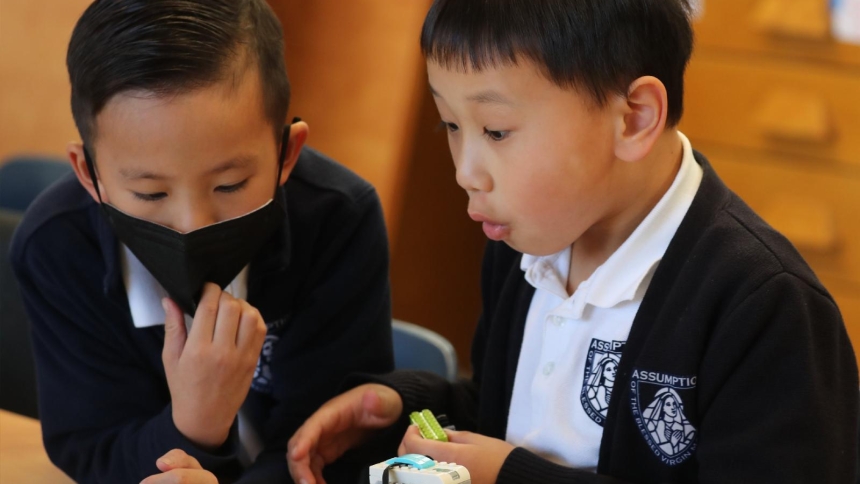
Caption: First-graders Connor Nguyen and Jasper Zhao work in a science, technology, engineering, and math program, or STEM, at Assumption of the Virgin Mary School in Pasadena, Calif. Jan. 15, 2025. Experts and teachers from coast to coast told OSV News that artificial intelligence, AI, is poised to transform Catholic education. (OSV News photo/Bob Roller)