(OSV News) - An encyclical is a pastoral letter addressed by the pope to the whole Church. Encyclical letters generally address matters of faith or morals, encourage a particular commemoration or pious devotion, or deal with matters of Church discipline which are to be universally observed.
The apostles used letters to address the faithful of the various churches they had helped to establish. Most notably, St. Paul wrote a number of letters (epistles), 21 of which are included in the canon of the New Testament. Their successors, the bishops, followed this practice and would often send letters to one another and to the members of the particular churches entrusted to their pastoral care in order to ensure consistency in faith and practice, especially with regard to the celebration of the liturgy.
The bishop of Rome himself would write letters to be circulated to all the bishops. He also received letters from the bishops, which he, in turn, would circulate to other bishops.
Decline and revival
During the Middle Ages, the practice of sending these letters fell into disuse. During this time, the popes would send letters only to individual bishops about particular matters within their dioceses. Bishops would respond in writing only to the pope.
Pope Benedict XIV (r. 1740-58), wisely employing the power of the newly invented printing press, revived the ancient practice of the pope writing letters to all the bishops of the world.
It was Pope Gregory XVI who applied the term "encyclical" to these letters, from the Latin word encyclicus, or circular, because they were addressed to the entire Church.
Since 1740, popes have produced nearly 300 encyclical letters, which have addressed any number of issues pertaining to the life and ministry of the Church.
'He who hears you, hears me'
Encyclical letters are not considered divinely inspired and do not contain matters considered to be new revelation. However, they are regarded as instruments of the ordinary magisterium containing the authoritative teaching of the vicar of Christ.
As regards the question of the binding authority of the teaching contained within an encyclical, Pope Pius XII stated the following in his encyclical letter "Humani Generis," dated Aug. 12, 1950: "Nor must it be thought that what is contained in an encyclical letter does not of itself demand assent, on the pretext that the popes do not exercise in them the supreme power of their teaching authority. Rather, such teachings belong to the ordinary magisterium, of which it is true to say: 'He who hears you, hears me' (Lk 10:16); for the most part, too, what is expounded and indicated in encyclical letters already appertains to Catholic doctrine for other reasons."
The Second Vatican Council declared in "Lumen Gentium": "Religious submission of will and of mind must be shown in a special way to the authentic teaching of the Roman Pontiff, even when he is not speaking ex cathedra. That is, it must be shown in such a way that his supreme magisterium is acknowledged with reverence, the judgments made by him are sincerely adhered to, according to his manifest mind and will. His mind and will in the matter may be known chiefly either from the character of the documents, his frequent repetition of the same doctrine, or from his manner of speaking."
Sources of joy, challenge
Papal encyclical letters at times have been received by the Church with joy as they have addressed matters of popular piety or devotion. At other times, the popes have written encyclicals addressing matters pertaining to the great moral issues of their time. Such letters have often been the source of much debate among various scholars and theologians.
Encyclicals are not in and of themselves considered to be infallible pronouncements of the pontiff. And while the teachings contained therein may sometimes prove burdensome and difficult for some to accept and to follow, Catholics of good will everywhere are obliged to acknowledge their apostolic authority and strive to humbly assent to their teaching.
How blessed the Church has been to receive the teaching of the Lord and the guidance of the Holy Spirit that is contained in the encyclical letters of the popes down through the ages.
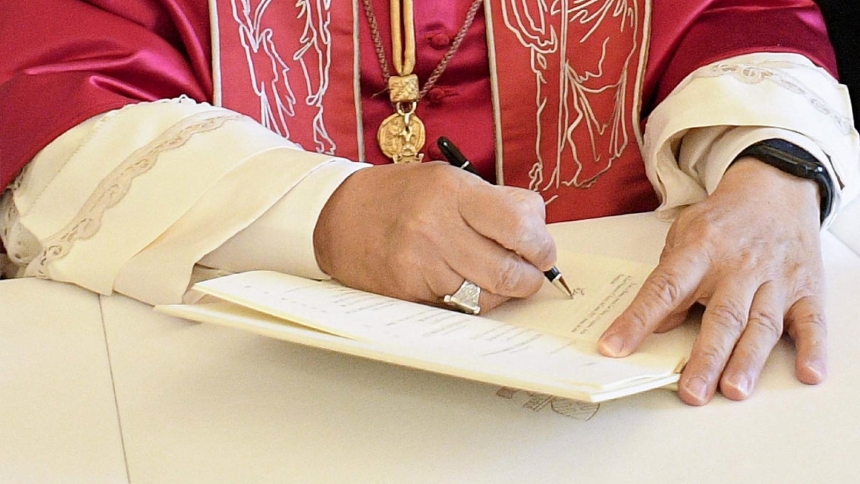
Caption: Pope Leo XIV signs his first apostolic exhortation, "Dilexi Te" ("I Have Loved You"), in the library of the Apostolic Palace at the Vatican Oct. 4, 2025, the feast of St. Francis of Assisi. His first encyclical, "Magnifica Humanitas," will be published May 25, 2026, addressing artificial intelligence and the protection of human dignity, the Vatican announced May 18, 2026. (OSV News photo/Vatican Media/CPP)