(OSV News) - Even though God has already "said everything" through Jesus Christ, as the Church teaches, some Christians throughout the centuries have attested that they have seen or heard Jesus, the angels or the saints, especially the Blessed Mother.
Thus "throughout the ages, there have been so-called 'private' revelations, some of which have been recognized by the authority of the Church," as the Catechism of the Catholic Church teaches (No. 67). "They do not belong, however, to the deposit of faith. It is not their role to improve or complete Christ's definitive Revelation, but to help live more fully by it in a certain period of history."
What follows is a description of six of the most influential approved Marian apparitions of the past five centuries.
-- Our Lady of Guadalupe (1531)
On Dec. 9-12, 1531, Our Lady appeared four times to St. Juan Diego Cuauhtlatoatzin (1474-1548), a member of the Chichimeca people and a convert, on the hill of Tepeyac near Mexico City.
"Know for certain, least of my sons, that I am the perfect and perpetual Virgin Mary, mother of Jesus, the true God, through whom everything lives, the Lord of all things near and far, the master of heaven and earth," she said. "It is my earnest wish that a temple be built here to my honor. Here I will demonstrate, I will manifest, I will give all my love, my compassion, my help and my protection to the people."
Our Lady asked Juan Diego to make known her request to Bishop Juan de Zumárraga. The bishop asked for a sign during a visit with Juan Diego. When he saw Our Lady again, she directed him to a hilltop where he saw a flower garden; he cut the roses and placed them in his cloak, or tilma. When he returned to the bishop, he opened his tilma. The roses fell to the floor, and the image of Our Lady of Guadalupe appeared miraculously on his tilma.
In 1754, Pope Benedict XIV approved Our Lady of Guadalupe as patroness of Mexico, and St. John Paul II named her "patroness of the Americas" in 1999. He visited her basilica in 1979, 1990, 1999 and 2002. Pope Francis visited in 2016.
-- Our Lady of the Miraculous Medal (1830)
In 1830, the Blessed Virgin Mary appeared three times to St. Catherine Labouré (1806-1876), a member of the Daughters of Charity of St. Vincent de Paul. The second time, she saw Mary crushing a serpent, with rays coming forth from her hands. She also saw the words, "O Mary conceived without sin, pray for us who have recourse to you," and heard a voice say, "Have a medal made on this model. Those who will wear it with confidence will receive great graces."
In time, the archbishop of Paris consented to the request.
In 1980, St. John Paul II made a pilgrimage to the chapel in Paris where St. Catherine saw the apparitions. "You obtain from God, for us, all these graces that the rays of light that radiate from your open hands symbolize, on the sole condition that we dare to ask them of you, that we ourselves approach you with the confidence, the boldness, the simplicity of a child," he prayed.
-- Our Lady of La Salette (1846)
In 1846, Our Lady appeared to two French children, Maximin Giraud (1835-1875) and Mélanie Calvat (1831-1904), in southeastern France. She deplored sins of blasphemy, the refusal of most villagers to attend Mass in the summer and the lack of fidelity to Lenten discipline.
"If my people do not obey, I shall be compelled to loose my son's arm," she warned. "It is so heavy I can no longer restrain it." Bishop Philibert de Bruillard of Grenoble approved the apparition in 1851.
"Mary, Mother full of love, in this place showed her sadness at the moral evil of humanity," St. John Paul II wrote in a letter marking the 150th anniversary of the apparition. "Through her tears, she helps us to better understand the painful gravity of sin, of the rejection of God, but also the passionate fidelity that her son keeps toward her children -- he, the redeemer whose love is wounded by forgetfulness and refusal."
-- Our Lady of Lourdes (1858)
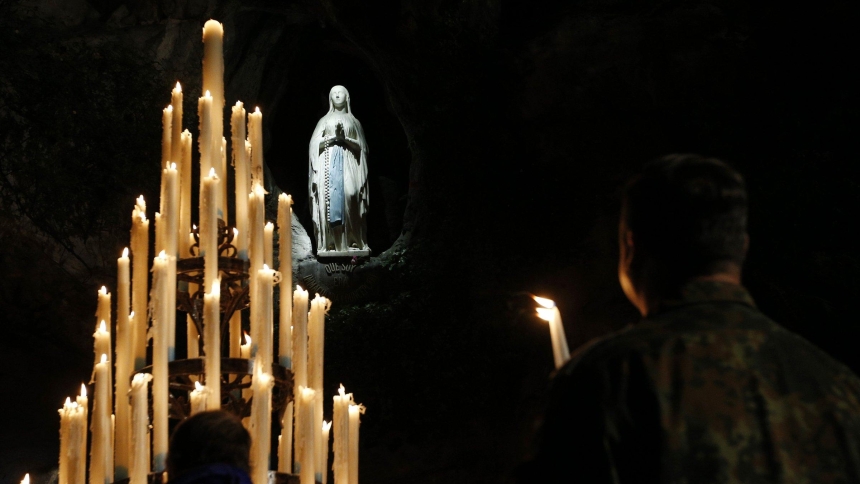
Our Lady appeared 18 times to St. Bernadette Soubirous (1844-1879) in Lourdes, a town in southwestern France.
"From Feb. 11 to July 16, 1858, the Blessed Virgin Mary was pleased, as a new favor, to manifest herself in the territory of the Pyrenees to a pious and pure child of a poor, hardworking, Christian family," Pope Pius XII wrote in a 1957 encyclical.
Our Lady said on one occasion, "Penance! Penance! Penance! Pray to God for sinners. Kiss the ground as an act of penance for sinners." After a spring began to flow, Our Lady said, "Go, tell the priests to come here in procession and to build a chapel here." When Bernadette asked her to identify herself, she declared, "I am the Immaculate Conception."
Bishop Bertrand-Sévère Mascarou-Laurence of Tarbes-et-Lourdes approved the apparitions in 1862. In 1911, St. Pius X wrote that the Lourdes shrine "surpasses in glory, it seems, all others in the Catholic world." St. John Paul made pilgrimages there in 1983 and 2004, as did Pope Benedict XVI in 2008.
-- Our Lady of Knock (1879)
In 1879, 15 people of all ages in Knock, Ireland, witnessed an apparition of the Blessed Mother, St. Joseph and St. John the Evangelist on a rainy evening; the Blessed Mother prayed but did not speak. Within months, Archbishop John McHale of Tuam found their testimony credible, and the site soon became a place of pilgrimage.
In 1979, St. John Paul II celebrated Mass at Knock and dedicated the Basilica of Our Lady, Queen of Ireland. "For a whole century now, you have sanctified this place of pilgrimage through your ?r???rs, through your sacrifice, through your penance," he preached. "All those who have come here have received blessings through the intercession of Mary."
"From that day of grace, 21 August 1879, until this very day, the sick and suffering, people handicapped in body or mind, troubled in their faith or their conscience, all have been healed, comforted and confirmed in their faith because they trusted that the mother of God would lead them to her son, Jesus," he added.
Pope Francis visited the Shrine of Our Lady of Knock in 2018 and elevated it from a national to international shrine.
-- Our Lady of Fátima (1917)
In 1917, Our Lady of the Rosary appeared for six consecutive months to three Portuguese children: Venerable Lúcia Santos (1907-2005), St. Jacinta Marto (1910-1920) and St. Francisco Marto (1908-1919). Her message was one of prayer, atonement and devotion to her Immaculate Heart.
"Say the rosary every day to bring peace to the world and an end to the war," she said. "And after each one of the mysteries, my children, I want you to pray in this way: O my Jesus, forgive us our sins, save us from the fire of hell. Take all souls to heaven, especially those who are most in need."
"Make sacrifices for sinners and say often, especially while making a sacrifice: O Jesus, this is for love of Thee, for the conversion of sinners, and in reparation for offences committed against the Immaculate Heart of Mary," she added.
She revealed to the children a three-part secret: a vision of hell, a request for the First Saturday devotion and consecration of Russia to the Immaculate Heart, and the killing of a bishop dressed in white, along with other clergy, religious and laity. Pope Pius XII, St. Paul VI, St. John Paul II and Pope Francis have consecrated the world to Mary's Immaculate Heart, and the Congregation for the Doctrine of the Faith released text of the third part of the secret in 2000, along with commentary.
During the final apparition on Oct. 13, Our Lady requested the construction of a chapel, and 70,000 onlookers witnessed the sun dance in the sky. Bishop José Alves Correia da Silva of Leiria-Fátima approved the apparitions in 1930, and St. Paul VI, St. John Paul, Pope Benedict XVI and Pope Francis all made pilgrimages there.
Caption: Candles are seen around a statue of Mary in the grotto at the Shrine of Our Lady of Lourdes in France in this file photo. (CNS photo/Paul Haring)