
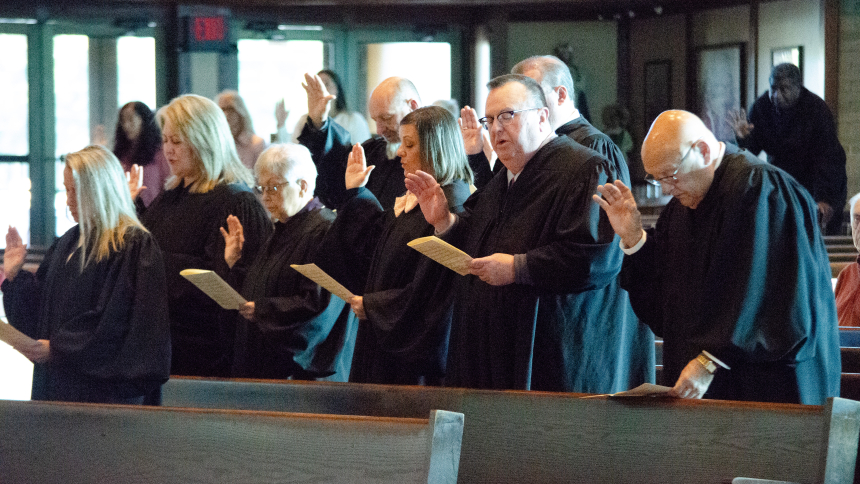
MERRILLVILLE – A “Red Mass” is offered with the intent to invoke the wisdom of the Holy Spirit upon judges, justices and members of the legal profession. The red vestments used in the celebration of Mass represent the tongues of fire imparted by the Holy Spirit upon Christ’s disciples.
The Diocese of Gary held its annual Red Mass on Oct. 7 at Our Lady Queen of Martyrs in Merrillville. Bishop Robert J. McClory presided over the service, which he said calls legal professionals to “renew our individual calling to be servants to one another and to our community, and to live as faithful stewards of the earth and all its resources.”
During the liturgy, The Honorable Mark Chargualaf asked the judges and attorneys present to rise and recite the Indiana Attorney’s Oath. They pledged to “maintain respect due to courts of justice and judicial officers” and “not counsel or maintain any action, proceeding or defense, which shall appear to me to be unjust.”
Judge Eugene Velazco was invited to the Red Mass when he first became judge and has attended it every year since. He alluded to the timing of the Red Mass in October, which he feels is appropriate as it marks the start of the new judicial cycle.
“I like the fact that there are as many members of the jury, who are also of my religion and that they participate,” Velazco said.
After the Mass, members of the Indiana Disciplinary Commission, Daniel Vinovich and Holly Wojcik Rooth, provided a Continuing Legal Education (CLE) course in the parish hall. Vinovich, of the Hilbrich Law Firm, began by saying he appreciated the opportunity to have a discussion about "Ethical Rules and Implications of AI Misuse."
Vinovich first explained the role of the disciplinary commission. He shared that members get appointed by the Supreme Court, receiving a call from one of the justices inviting them to serve. It's a five-year term. The commission has seven attorneys and two laypeople. Vinovich acknowledged a staff of 15 additional attorneys assists with paperwork, noting “it's quite the process because there are a lot of people in the state of Indiana who file ethical complaints against attorneys right or wrong.”
“We are charged as a commission to review those complaints,” Vinovich said. “We are charged with protecting the public from unethical attorneys, but we are also charged with protecting attorneys from complaints that have no validity or merit.”
Wojcik Rooth, an attorney with Langer & Langer, added that those on the disciplinary commission are volunteers. She said the Supreme Court has tapped them because of their reputations as ethical attorneys. They spend many hours each week and month reviewing everything that comes to them with a “fine-tooth comb.”
“Oftentimes, that end decision is, ‘Is this the right thing?’ and ‘Are we doing the right thing?’” Wojcik said. “That’s how I see my job on the disciplinary commission and while I'm on the judicial district disciplinary commission.”
Admitting they are not AI experts, the two lawyers began discussing the ethical issues surrounding artificial intelligence.
“It's something that we're all going to have to get used to and incorporate into our practices in some way over the years,” Wojcik Rooth said. “It's coming. It's not going to be stopped, and we have to roll with it, or we'll be left behind.”
She assured the group that the American Bar Association already has rules in place on how AI applies to ethics. She explained that there are no new rules, so legal professionals don't have to learn anything beyond what they already know. They just have to “learn about how AI applies to what already applies to us.”
The first existing rule that should apply, Wojcik Rooth stated, is professional conduct. AI can create hallucinations – false, misleading, or completely fabricated information. Artificial intelligence can make up case law and statutes and legal authority. It is up to the lawyer to ensure he or she is not providing false law to the court.
Wojcik Rooth shared a video of a real case where an individual attempted to use an AI lawyer in the courtroom. The judge quickly realized it was not a real person and reprimanded the individual for not mentioning it in the application. The defendant was a founder of an AI company and was trying to push the product.
“I don't appreciate being misled,” the judge said. “Either you are suffering from an ailment that prevents you from being able to articulate, or you don't. You are not going to use this courtroom as a launch for your business.”
Another case Vinovich and Wojcik Rooth mentioned occurred in New York. A lawyer cited at least three cases that were fictitious, hallucinations, and nobody caught them except for the judges.
“If you're on the other side of it, you are obligated to check your opposing counsel’s citations, quotes, cases, and to bring that up to the court,” Wojcik Rooth said. “And I think one of the most brutal phrases from that argument was that the defense attorney was so apologetic. He said, ‘I'm sorry, Your Honor, I apologize to the court,’ and the court said, ‘Don't apologize to us. Apologize to your client and that was live-streamed all across the state.’”
Wojcik Rooth stressed that lawyers must verify every citation and that neither the attorney presenting it nor the attorney defending it can make false statements. If a mistake is made and recognized, she said, the error must be immediately corrected.
This led to a brief conversation among those in attendance about the time required to investigate sources and who should be responsible for checking citations. Wojcik Rooth suggested the attorney drafting the filing is most responsible, followed by the opposing counsel and then the trial court judge.
Wojcik Rooth took a moment to acknowledge that there are a lot of things AI can do for attorneys, really fast and easily. As an example, she referred to a time when she worked on a case that had 10,000 pages of medical records that were scanned in and loaded into an AI program. She was able to review and locate specific details quickly using the technology.
Vinovich referred to the American Bar Association, which also addresses competent representation to a client. Competent representation requires the legal knowledge, skill, thoroughness and preparation reasonably necessary for the representation. A lawyer should keep abreast of changes in the law and its practice, including the benefits and risks associated with the technology relevant to the lawyer's practice.
Vinovich stated lawyers have a duty to at least understand the tool and know its capabilities and limitations.
“Understand the tool if you're going to use it,” he said. “Verify the output. Double-check and make sure these things are real. Independently check those things before relying on it, and most importantly, keep your judgment as an attorney.”
In addition, the presenters emphasized the significance of confidentiality. They advised that when using an AI platform, one must know where the data goes.
“People are excited about it, but a lot of people are scared. And a lot of our clients are scared,” Wojcik Rooth said. “They want to know, ‘Is the information that you put in there going to be out here on the whole internet?’”
She said her firm now includes in their contracts that they will use an AI platform and points it out when a client signs. She said it’s important to explain to clients what they're going to do with AI, how it can make the job easier and how the information is going to be protected.
Lawyers not only need to be aware of how they are using AI but also pay attention to how their clients use it. In United States v. Heppner, an indictment was made related to security fraud and falsifying corporate records. Prior to the formal charges, the accused went on Claude, an AI assistant, and asked it for a defense strategy. The government later seized his computer. His lawyer argued that the information found on the computer was attorney-client privilege, but the court found it was discoverable because the AI documents were not direct communications between the defendant and his counsel.
“It didn’t happen in our jurisdiction,” Vinovich said, “but perhaps we could see this happening. You need to be careful when you counsel your clients about their use of AI as well.”
The Red Mass is hosted by the Catholic Foundation for Northwest Indiana. The non-profit currently holds over $20 million in 50+ endowed funds to permanently support parish ministry, Catholic education, charitable services and vocations. For more information, visit catholicfuture.org or email info@catholicfuture.org