ROME (OSV News) - As the world awaits Pope Leo XIV's first encyclical on artificial intelligence, expected to be signed May 15 and released by the Vatican by the end of the month, here is a look at what the pope has said on AI since his election a year ago.
The first American pope and a former mathematics major, Pope Leo has returned to the subject of AI again and again in speeches, messages and interviews since his election in May 2025, leading Time magazine to include him on its 2025 list of the world's most influential people in artificial intelligence.
Pope Leo has already addressed AI in a wide range of contexts, telling teenagers gathered in a sports stadium to use AI "in such a way that if it disappeared tomorrow, you would still know how to think, warning priests not to use chatbots to write their homilies, calling on the media to preserve "human voices and faces," and telling legislators from 68 countries that AI is a tool meant to serve humans, not replace them.
From a speech in central Africa on AI's potential to change humanity's "relationship with truth" to a message to tech developers gathered in Rome, Pope Leo has emerged as one of the most prominent global voices on the ethical challenges posed by artificial intelligence even before the publication of his much-anticipated encyclical.
Words of wisdom to young people on the use of AI
One of the pope's most direct and memorable statements on AI came in response to a high school student from Honolulu, who asked Pope Leo about young people's use of ChatGPT and other AI tools for homework from writing an essay to solving a math problem.
"Use it in such a way that if it disappeared tomorrow, you would still know how to think," Pope Leo said.
He urged the student to "be careful that your use of AI does not limit your true human growth," underlining the importance of knowing "how to think, how to create, how to act on your own, how to form authentic friendships."
The pope spoke via video link to a crowd of 16,000 young people gathered in Indianapolis for the National Catholic Youth Conference in November.
"AI can process information quickly, but it cannot replace human intelligence," Pope Leo told the students. "And don't ask it to do your homework for you. It cannot offer real wisdom. It misses a very important human element: AI will not judge between what is truly right and wrong. And it won't stand in wonder, in authentic wonder before the beauty of God's creation."
Pope Leo has also expressed concern for AI's potential effect on children's "intellectual and neurological development," adding "we must pause and reflect with particular care upon the freedom and inner life of our children and young people."
"The ability to access vast amounts of data and information should not be confused with the ability to derive meaning and value from it. The latter requires a willingness to confront the mystery and core questions of our existence," he said.
"It will therefore be essential to teach young people to use these tools with their own intelligence, ensuring that they open themselves to the search for truth."
AI and the job market
Pope Leo expressed interest in the issue of artificial intelligence and the dignity of work since the first week of his pontificate, telling the College of Cardinals days after his election in May 2025 that he took his name partly in honor of Pope Leo XIII, who wrote the social encyclical "Rerum Novarum" in 1891 in the context of the first industrial revolution.
"In our own day, the Church offers to everyone the treasury of her social teaching in response to another industrial revolution and to developments in the field of artificial intelligence that pose new challenges for the defense of human dignity, justice and labor," Pope Leo XIV said, two days after his election.
In his first interview after his election, Pope Leo warned of "extremely rich people" who are investing in AI and totally ignoring "the value of human beings and humanity," adding, "I think the Church needs to speak up."
Speaking to legislators from 68 countries gathered at the Vatican for the Jubilee of Governments in June, the pope said, "it must not be forgotten that artificial intelligence functions as a tool for the good of human beings, not to diminish them, not to replace them," adding that AI can "be of great help to society, provided that its employment does not undermine the identity and dignity of the human person and his or her fundamental freedoms."
In a December 2025 speech to participants in an AI conference in Rome, the pope asked, "How can we ensure that the development of artificial intelligence truly serves the common good, and is not just used to accumulate wealth and power in the hands of a few?"
"This is an urgent question, because this technology is already having a real impact on the lives of millions of people, every day and in every part of the world," the pope added.
Co-workers in creation, not passive AI consumers
"Human beings are called to be co-workers in the work of creation, not merely passive consumers of content generated by artificial technology," Pope Leo said in the same December speech.
"Artificial intelligence has certainly opened up new horizons for creativity, but it also raises serious concerns about its possible repercussions on humanity's openness to truth and beauty, and capacity for wonder and contemplation," he added.
The pope expanded on his idea in his message for the 60th World Day of Social Communications, published in January, warning that AI systems "have increasingly taken control of the production of texts, music and videos," putting "much of the human creative industry at risk of being dismantled and replaced with the label 'Powered by AI,' turning people into passive consumers of unthought thoughts and anonymous products without ownership or love."
The masterpieces of human artistic genius, he added, are being reduced to "mere training grounds for machines."
"Renouncing creativity and surrendering our mental capacities and imagination to machines," Pope Leo wrote, "would mean burying the talents we have been given to grow as individuals in relation to God and others."
The pope has urged priests to resist "the temptation to prepare homilies with artificial intelligence."
"To give a true homily is to share faith," and artificial intelligence "will never be able to share faith," the pope told priests of the Diocese of Rome.
"People want to see your faith, your experience of having known and loved Jesus Christ," he added.
‘Preserving human voices and faces'
Pope Leo titled his 2026 communications' day message focused on AI "Preserving Human Voices and Faces."
"Faces and voices are sacred," he said. "God, who created us in his image and likeness, gave them to us when he called us to life through the Word he addressed to us."
By simulating human voices, faces, emotions, and relationships, he added, "the systems known as artificial intelligence not only interfere with information ecosystems, but also encroach upon the deepest level of communication, that of human relationships. The challenge, therefore, is not technological, but anthropological. Safeguarding faces and voices ultimately means safeguarding ourselves."
The pope has also spoken about deepfakes -- AI-generated videos, images and audio -- and their capacity to deceive.
Pope Leo recalled how only a few days into his pontificate someone asked him if he was OK after falling down a flight of stairs. "I said: 'No, I didn't,'" he recalled, "but there was a video somewhere where they had created this artificial pope, me, falling down a flight of stairs as I was walking somewhere, and it apparently was so good that they thought it was me."
He also disclosed that someone had approached him with a proposal to create an AI version of the pope, so that visitors to a website could participate in virtual papal audiences. His response was unequivocal: "I said, 'I'm not going to authorize that.' If there's anyone who shouldn't be represented by an avatar, I would say the pope is high on the list."
Chatbots as an ‘oracle of all advice'
Pope Leo, the first pope to be an active Twitter user before being elected as a successor of Peter, has observed that "as we scroll through our feeds, it becomes increasingly difficult to determine whether we are interacting with other human beings or with ‘bots' or ‘virtual influencers.'"
Chatbots based on large language models, he noted, "are proving to be surprisingly effective at covert persuasion through continuous optimization of personalized interaction." Because they are "excessively affectionate, as well as always present and accessible, they can become hidden architects of our emotional states and so invade and occupy our sphere of intimacy."
The danger, he wrote, is when people substitute AI systems for real human relationships, they create "a world of mirrors around us, where everything is made 'in our image and likeness,'" robbing themselves of the "opportunity to encounter others, who are always different from ourselves, and with whom we can and must learn to relate."
Pope Leo also questioned the "naive and unquestioning reliance on artificial intelligence as an omniscient ‘friend,' a source of all knowledge, an archive of every memory, an "oracle" of all advice," saying that this can "further erode our ability to think analytically and creatively, to understand meaning and distinguish between syntax and semantics."
Under a subheading of his communications message titled, "Do not renounce your ability to think," Pope Leo wrote, "Although AI can provide support and assistance in managing tasks related to communication, in the long run, choosing to evade the effort of thinking for ourselves and settling for artificial statistical compilations threatens to diminish our cognitive, emotional and communication skills."
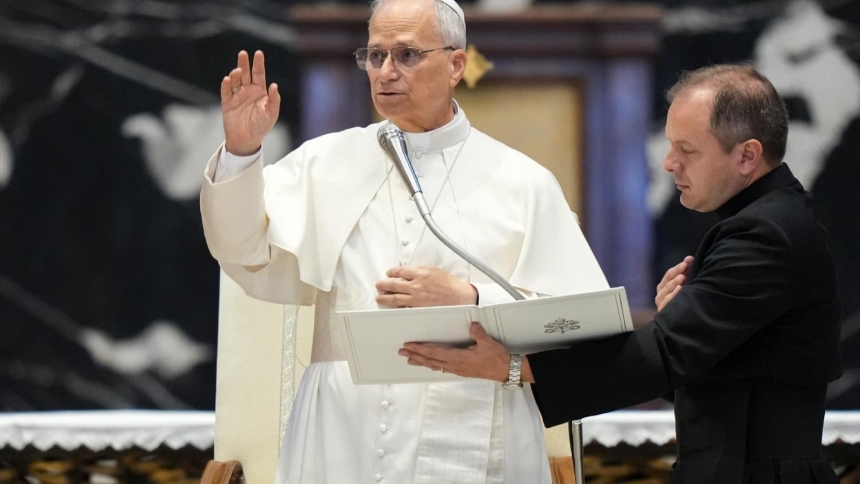
Caption: Pope Leo XIV gives his blessing to participants in the Jubilee of Digital Missionaries and Catholic Influencers after Cardinal Luis Antonio Tagle celebrated Mass in St. Peter’s Basilica at the Vatican July 29, 2025. (CNS photo/Lola Gomez)