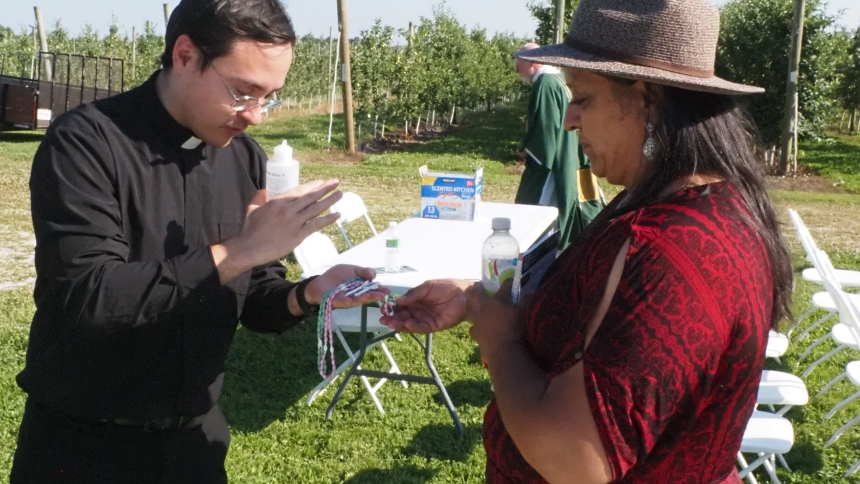
LAPORTE – At a time when 75 migrant workers normally would be busy tending to this year’s crops, they instead joined the faithful from throughout the Diocese of Gary to participate in Mass on the grounds of Garwood Orchards in LaPorte.
Bishop Robert J. McClory, with concelebrants Father Roque Meraz, Father Alex Kouris, and Father Ivan Alatorre, presided over the annual Mass for Migrant Farm Workers on July 12. A wooden shelter served as a makeshift sanctuary, surrounded by rows and rows of apple trees and their ripening fruit.
The outdoor Mass is an opportunity to bring the liturgy, the Eucharist, to those workers who sacrifice time away from their families to help produce and harvest food for consumers to enjoy. A meal, prepared by the Holy Family Hispanic Community, gave the workers and community a chance to gather as brothers and sisters.
“It's a blessing to have the fruits of their labors,” acknowledged Bishop McClory. “They work hard to put food on our table. They're hardworking people with beautiful families, and so it's nice to give them the opportunity to come together to celebrate their faith. And it's part of a wider migrant ministry. It's not just the Mass, but we do outreach throughout the year. And so, this is just one expression of it, but a very important one.”
Although the Mass was celebrated primarily in Spanish, many English-speaking people participated.
Bishop McClory offered a reminder that the Mass is the Mass regardless of the language it’s being celebrated in; it was about coming together as one body in faith. “While today the Mass was in Spanish, people from any language can really come and be able to follow it,” he said. “And of course, what we share in the Eucharist unites us. And beyond the sacramental unity is just the unity of being brothers and sisters. We hope that they had an experience of family and community today, even while they're away from their blood families; they're here with the spiritual family.”
That sense of unity has deeply touched Claudia Sadowski, Ph.D., coordinator of intercultural ministry, not only at the Migrant Mass, but throughout the year.
“Working alongside our migrant brothers and sisters has been one of the greatest blessings of my ministry,” she said “Every visit reminds me of their extraordinary faith, resilience, humility, and generosity. Many of our brothers and sisters leave behind their families, homes, and communities for months at a time in order to provide a better life for those they love. Their work is physically demanding, often unseen, and yet essential to all of us.”
Sadowski explained the Church’s beautiful tradition of going out to meet people where they’re at, instead of expecting our migrant brothers and sisters to come to us. “We bring the celebration of the Eucharist to them,” she said. “In doing so, we hope they experience not only the sacramental presence of Christ but also the love, gratitude, and closeness of the entire diocesan community.”
The number of migrant workers in Indiana varies annually, but estimates suggest that around 30,000 to 40,000 migrant farm workers are employed each year, primarily in agriculture. Many come from Mexico as well as Central and South America. This workforce is crucial for the state's farming sector, especially during peak harvest seasons.
Brian Garwood commended the migrant workers, who are vital to the success of the 180-plus year-old family-owned orchard. Garwood, a sixth-generation co-owner, pointed out that the domestic labor force, in general, isn’t willing to do the demanding labor required in farming, creating a labor shortage for many farmers, as well as other labor-intensive occupations.
Garwood’s currently farms over 350 acres, which includes approximately 200 acres of apples and 150 acres of peaches, raspberries, pumpkins, strawberries, cherries, sweet corn, peppers, cucumbers, and a variety of other vegetables.
“It means a lot to us because without these guys and ladies, we could not have a farm,” said Garwood. “They’re hard-working and willing to work the hours required in farming. They want to impress us so they can come back next year. And we've had about a 98% return rate, which I think speaks for them and it speaks for us too. They love coming here.”
Garwood shared that the workers are well cared for during the season, which runs from February through as late as November.
“They sacrifice being away from their loved ones- their kids and their family and their wives,” he added “And unfortunately, at home, they have no opportunity to ever get ahead. While they’re here, they all have very nice living accommodations, with each room including air conditioning, flat-screen televisions, and a kitchen. We try to make it very comfortable, so they're happy. If they're happy, they're better employees.” “It’s a blessing and a joy to bring our Lord to them here at our workplace,” said Joaquin DelReal, one of the migrant workers. “It's definitely uplifting. It’s just a good feeling when the community comes and celebrates Mass with us.”
This is the eighth year DelReal has worked at Garwood’s. He travels from Mexico, leaving behind a wife, a son, and daughter for several months. “It’s very hard being away from them because you don't see them growing all those months,” he said. “It’s really hard. I miss them every day.”
He knows God will provide and he’ll be back with his family after harvest.
In his homily, Father Roque Meraz praised the workers for the sacrifice and hard word. He reassured them that their labor is not in vain when it comes to their faith life.
“The work that you do, while you might not have time to go and do a holy hour at church, your work becomes your prayer,” he said. “When you begin the day, say, ‘who am I offering this work for?’ Maybe for a family who's far away, maybe yourselves, maybe someone who's in need. So, your work becomes your prayer, in the same way that Jesus worked with his hands. So that's... So that your work is not wasted, but it's offered to and lifted up to God.”
For those who receive the fruits of the migrant workers’ labors, Father Meraz reminded everyone to make a conscious effort to reflect on where their food came from and to pray for those who farm and the workers.
He added, “That meal did not magically appear at our table. There were many hands that made that possible. And we are sitting there enjoying it. So, thanking God for the people who planted and harvested and made sure that got to our table. That's the importance of us praying, privately and in public, for the people who made that possible.”
Editors note: A second Migrant Ministry Mass will take place on Sunday, Aug. 16, 2026, at 4 p.m. (CT) at Herr Farms in Lowell. For questions about donations or more information, contact Rich Serna (Herr Farms only) at 312-405-6805. To RSVP, visit https://dioceseofgary.jotform.com/261305505705147
Caption: Father Ivan Alatorre blesses Rosaries following the Mass for Migrant Workers at Garwood Orchards on July 12. (Michael Wellinski photo)