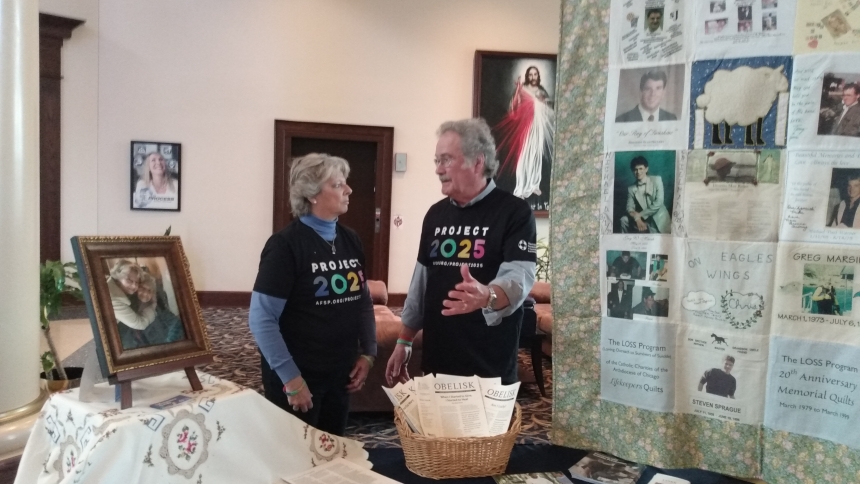
ST. JOHN – Just ten days after losing her fiancé, Erin Wojtczak found a program titled Loving Outreach to Survivors of Suicide (LOSS). It became the light in the darkest days of her life. Two and a half years later, she is still active in the group and uses its resources for ongoing support.
“It was the first place I didn’t feel alone because although not everyone in the LOSS program lost a person of the same relationship to them, we all go through a grief process that is different from any other type of loss,” Wojtczak said. “I believe it is crucial in the grief and healing process to have support from others that have experienced a loss of their loved one by suicide.”
LOSS is a ministry of the Archdiocese of Chicago and the Diocese of Gary. They are actively involved in raising awareness for support services for those who have experienced the death of a loved one by suicide.
“LOSS is not a bereavement group per say, it’s strictly for the family, friends and loved ones of people who have died by suicide,” explained Jim Kazmierczak. “It's totally different for these survivors because we all ask the same questions: if only, I should have, I could have, why didn't I see it coming? In the LOSS program, we help them find the answers to their questions with the help of other survivors.”
Kazmierczak, who is a facilitator of the NWI LOSS program with his wife Kris, shared the unfortunate fact that people of all ages take their lives, from those as young as 10 to those as old as 90. His mother-in-law was in her 90s when she passed away from suicide in 2017. She was a Holocaust survivor and felt she was becoming a burden after dealing with a broken femur.
“She wasn't and wouldn't be, but for an elderly person, the thought of losing their independence can be overwhelming,” Kazmierczak said.
He went on to explain that for children who end their lives, not being accepted by peers or coming from a broken home often plays a role in their decision. As an example, he stated that a father in the LOSS group lost his 14-year-old to bullying.
“In the LOSS program, they see that they're not alone and in time they find they can get through this after all,” Kazmierczak said. “You realize the person just wanted to get through the pain they were going through. Pain could be anything – bullying, financial, breakups, job loss.”
The LOSS program aims to help families understand that this final act by their loved one is not their legacy, but that their life is their legacy. Kazmierczak acknowledged that people sometimes believe their loved one is in hell because they took their life, which is not the belief of the LOSS program.
“This is a mental disorder and God understands this,” he said. “But that's what was taught over the years. If God is all-knowing and loving, it doesn't make sense that he would condemn someone for this. That's no longer taught by the Church.”
Kazmierczak continued, “Suicide is a tough subject and along with it comes the stigma. This is another thing LOSS helps people through because it's out there.”
LOSS began as an outgrowth of Compassionate Friends – a support group for parents, siblings and grandparents navigating the death of a child – started in the Archdiocese of Chicago. Three couples had all met at Compassionate Friends and formed a natural bond due to the fact that each of them had lost a child to suicide. One of the survivors had a relative working at Catholic Charities in Chicago and approached Father Charles Rubey, the director of the mental health program at Catholic Charities, and asked if the possibility of Catholic Charities sponsoring a program for people who had lost someone to suicide. He met with the three couples and LOSS was established, and the first meeting was held in March 1979.
In a column written by Father Rubey, he wished for better understanding and appreciation for those people who suffer from depression or other forms of mental illness. He wrote that those who live with depression have beautiful and creative souls that have been clouded by the ravages of their illness.
“This does not make them into someone who should be subjected to misunderstanding and avoidance,” he stated. “Rather, they are people who need our attention and affection.”
Currently, there are 16 different monthly groups in different locations. An eight-week group session is offered several times a year. There is a Spouse Group held in DesPlaines. A Young Adult Group, a Sibling Group, a Spanish-speaking group and a Group for Veterans and their families were also added. In addition, there is an annual Children & Youth Grief Retreat in the summer and a LOSS Evening of Remembrance held in November.
A local LOSS group meets on the first Thursday of every month from 7-9 p.m.in the Narthex of
St. John the Evangelist. The church is located at 10701 Olcott Ave. in St. John.
The LOSS meetings in Northwest Indiana began shortly after the COVID-19 pandemic started to come to an end in 2022. Kazmierczak noted they started out with zero people for months and after knocking on doors, interviews on TV, radio, advertising in church bulletins and having a booth at different public events, attendance started to grow. The group now has an estimated 12 individuals who gather regularly.
Kazmierczak said he is most proud of the moments when they are noticeably able to help someone.
“Sometimes a person will come to a meeting so distraught that they can't put a sentence together without crying, and later they are jumping in and helping others,” he said. “It is an awesome feeling.”
Kazmierczak said his mission is to reduce the stigma of suicide, sharing the understanding that people who end their lives by suicide are just trying to get away from their pain. He said that through talking to people, he has found that many have been touched by suicide and the stigma keeps them back from seeking help.
He added, “Robin Williams said it best when he said, ‘Suicide is a permanent solution to a temporary problem.’ For the world to realize this is a mental disease and can be treated as such would be a huge step in the right direction.”
For more information, contact Jim and Kris Kazmierczak at 219-690-1268, or call LOSS at 312-655-7283 or email LOSS@CatholicCharities.net.