ST. JOHN – “I do it with a sense of mission,” is the way Tom Hocker describes what began as a curiosity about the political situation in Latin America four decades ago and turned into a partnership to support the Mayan artisans of El Salvador and Guatemala.
Tom Hocker, then a Hammond resident, first visited El Salvador in May 1985, during a civil war, after working for 10 years as a photographer at Inland Steel. “I spent a month there (on a visa as a photojournalist) and was in the zone of contact for the leftist liberation front,” said Hocker. “I kept going back, and in 1986, I also took a bus to visit Guatemala because of my interest in the region.
“By 1987 was importing products to sell at trade shows and church events, working with Lita Chacon de Contreras, a painter in the village of La Palma, El Salvador,” he added. “I met her on my first trip there in 1985, when I went as a photojournalist to record the impact of the civil war. She and her family work with neighboring carpenters to create the wooden crosses that their town is famous for.”
That effort turned into Tree of Life Imports, a business that employed fair trade practices to financially support not only the El Salvadoran artisans, but also Mayan weavers in Guatemala who “draw on centuries of traditional skills. They have been marginalized and exploited since the Conquest, but have maintained their heritage to the extent that Spanish is still a second language within family life,” Hocker said.
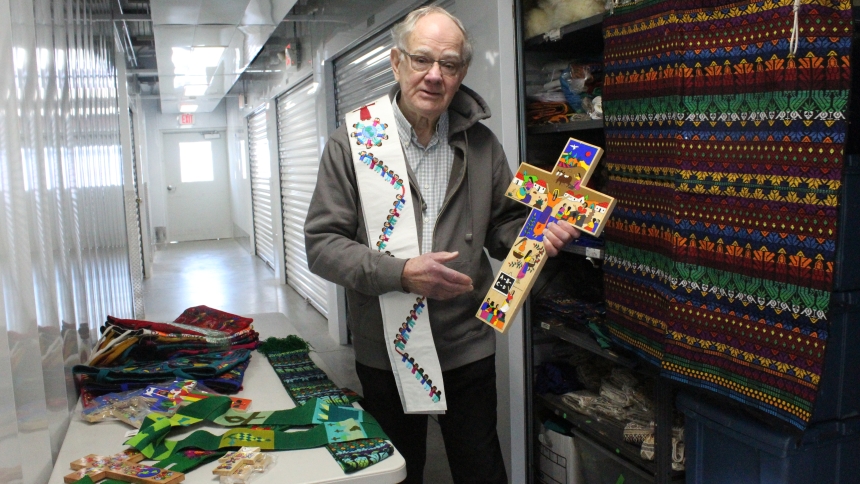
The Guatemalan products include the very popular embroidered stoles sold to ministers and priests, scarves, purses, tote bags, coin purses, cross body bags, shawls and eyeglass cases. Religious designs, added Hocker, incorporate plants and animal life from the fields and forests around them, showing harmony with the natural environment.
“The beauty of colorful imagery supports (social justice) teaching and strengthens moral messages,” he said.
The fundamental qualities of fair trade, explained Hocker, who now works from his St. John home and sells the imports at area churches as well as at trade shows, religious conferences and vendor fairs throughout the U.S., are that: “the producers set their own prices that ensure a sustainable living wage, the buyers commit to a long term connection that fosters stability in producers' lives, and buyer and producer work together to create new products that enlarge the market for their work. Mutual respect is essential.”
While not directly associated with the Catholic Church, Hocker is proud that his efforts support several specific tenets of Catholic social justice teaching that can be affirmed by shopping for fair trade. Of the seven principles of Catholic Social Teaching, Hocker pointed to: the Option for the poor and vulnerable, Protecting the dignity of work and the rights of workers, and Solidarity with every member of the human family.
“Loving our neighbor means working for peace and justice,” said Hocker, 83, who also served as a photographer in the U.S. Army (1969-70). “Also implied in the imperative to preserve family and community is seeking the common good and well-being of all, including the producers.”
Hocker, a Texas native who earned his college degree in history at Rice University and studied at the Institute of Design at the Illinois Institute of Technology in Chicago, suggested that children can easily be introduced to Catholic social justice teaching by studying the mission of businesses like Tree of Life Imports.
“A discussion of social justice can start with a parent or teacher talking about the mother in Central America who sits in her kitchen weaving or painting to earn money for her family’s food,” explained Hocker, whose wife, Kathleen, formerly served as director of religious education at St. John Bosco in Hammond. “This art provides a concrete symbol in your ministry program that may lead to deeper understanding. It is truly ‘the work of human hands’.”
“Fair trade unites a church community in solidarity with village families and supports the dignity of their labor and communities,” said Hocker, who continues to document his own St. John community and his mission with his photography. “Our fair trade program provides a living wage, markets for traditional skills and cash advances.”
The crafts he distributes “foster peace making through a more inclusive community, both locally and worldwide,” Hocker suggested. To arrange a product display, email thockertreelife@gmail.com or phone (219) 613-5002. To view an online catalog, visit thetreeoflifeimports.com.
Caption: Tom Hocker of Tree of Life Imports displays crosses, stoles and tote bags that he imports from El Salvador and Guatemala as part of his fair trade business. All are handmade and embroidered by local artisans. (Marlene A. Zloza photo)