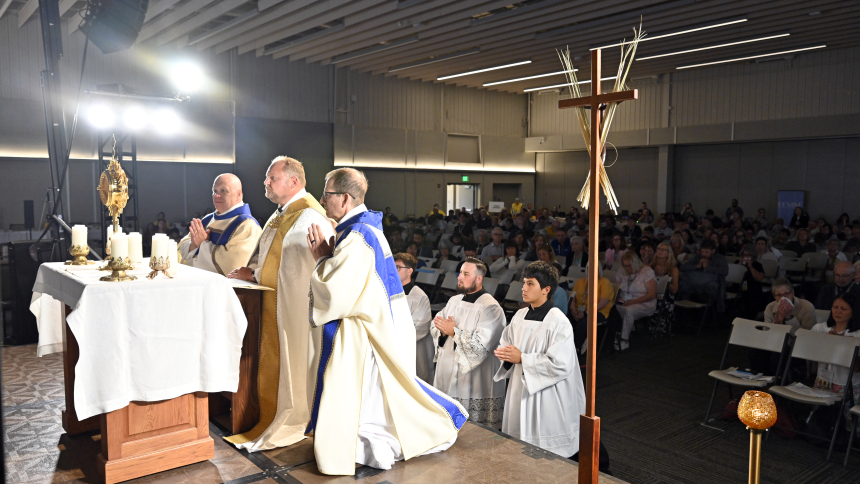
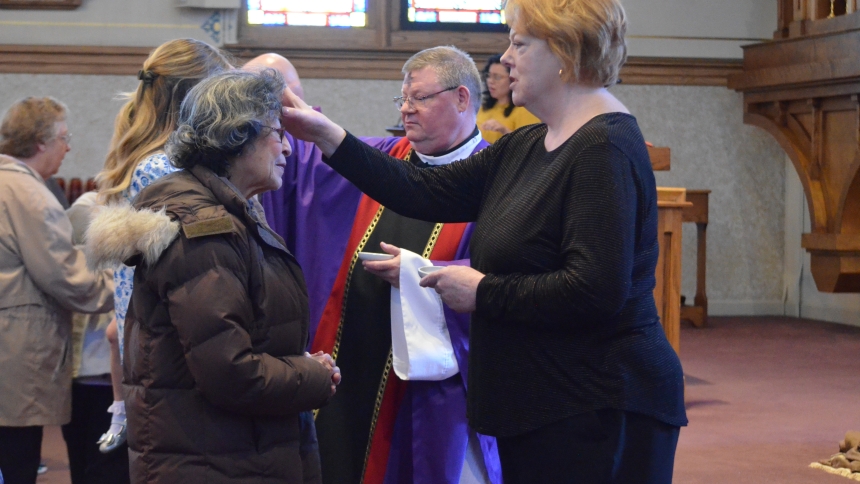
Through self-discipline and a focus on faith, often involving giving up luxuries or adopting spiritual practices, parishioners in the Diocese of Gary were ready to welcome the season of Lent on Ash Wednesday on Feb. 18.
Mike Skura of Schererville shared that this Lent he hopes to eat better, exercise more and limit alcohol. More importantly, he said that during Lent he takes time to think about how Jesus died for everyone’s sins, which paved the way for “everything that we have.”
“This is my special time of year – remembering the crucifixion,” he said.
Brittany Collier also views Lent as a time of preparation leading up to the death of Jesus. She sees the beauty in the period of time before Easter, just before spring arrives, that creates an atmosphere of new life.
“If you think about it, it's new life where there's tragedy, but that's how life works,” she said. “It's just a beautiful time within the Church, within the season itself.”
Collier acknowledged she was still debating what she may want to give up during Lent, but noted that her family does follow the Church’s teaching regarding avoiding eating meat on Fridays. She said she is grateful that her children, who attend St. Michael School, have the opportunity to learn about Lent in their classroom.
Carly Dehoyos, also a mother of a St. Michael School student, said she likes the idea of sacrificing everyday wants and needs during Lent as a sign of “the love that you hold for Jesus Christ.”
Dehoyos said she adheres to the regular Lenten guidelines and rules and plans to increase her prayer life over the next six weeks. She intends to say the Rosary with her mom every morning and at night.
Ann Marie Mikesh, a new parishioner to St. Mary in Crown Point, said she plans to give up a few of her favorite things during Lent and also pray more, including reciting the Rosary.
Mikesh said the season of Lent, especially Ash Wednesday, serves as a reminder to her of the certainty of death.
Mike Kucia, a longtime Crown Point resident, spent some time away from the church after the passing of wife in October, but decided it was time to return to Mass during Lent. For him, the season is a time of forgiving and an opportunity to renew his faith.
Kucia feels Lent is also about “being a better person.” During the forty days, he tries to be more aware of the ways he can help those in his community.
“I try to do good things like opening the door for people or simply saying hello to someone.”
“10 Things to Remember for Lent”
Bishop David L. Ricken of Green Bay, Wisc., former chairman of the Committee on Evangelization and Catechesis of the United States Conference of Catholic Bishops (USCCB), offered “10 Things to Remember for Lent”:
1. Remember the formula. The Church does a good job capturing certain truths with easy-to-remember lists and formulas: the 10 Commandments, the 7 sacraments, 3 persons in the Trinity. For Lent, the Church gives us almost a slogan – Prayer, Fasting, and Almsgiving – as the three things we need to work on during the season.
2. It’s a time of prayer. Lent is essentially an act of prayer spread out over 40 days. As we pray, we
go on a journey, one that hopefully brings us closer to Christ and leaves us changed by the encounter
with him.
3. It’s a time to fast. With the fasts of Ash Wednesday and Good Friday, meatless Fridays, and our personal
disciplines interspersed, Lent is the only time many Catholics these days actually fast. And maybe that’s why it gets all the attention. “What are you giving up for Lent? Hot dogs? Beer? Jelly beans?” It’s almost a game for some of us, but fasting is actually a form of penance, which helps us turn away from sin and toward Christ.
4. It’s a time to work on discipline. The 40 days of Lent are also a good, set time to work on personal discipline in general. Instead of giving something up, it can be doing something positive. “I’m going to exercise more. I’m going to pray more. I’m going to be nicer to my family, friends, and coworkers.”
5. It’s about dying to yourself. The more serious side of Lenten discipline is that it’s about more than self-control – it’s about finding aspects of yourself that are less than Christ-like and letting them die. The suffering and death of Christ are foremost on our minds during Lent, and we join in these mysteries by suffering, dying with Christ and being resurrected in a purified form.
6. Don’t do too much. It’s tempting to make Lent some ambitious period of personal reinvention, but it’s best to keep it simple and focused. There’s a reason the Church works on these mysteries year after year. We spend our entire lives growing closer to God. Don’t try to cram it all in one Lent. That’s a recipe for failure.
7. Lent reminds us of our weakness. Of course, even when we set simple goals for ourselves during Lent, we still have trouble keeping them. When we fast, we realize we’re all just one meal away from hunger. In both cases, Lent shows us our weakness. This can be painful, but recognizing how helpless we are makes us seek God’s help with renewed urgency and sincerity.
8. Be patient with yourself. When we’re confronted with our own weakness during Lent, the temptation
is to get angry and frustrated. “What a bad person I am!” But that’s the wrong lesson. God is calling
us to be patient and to see ourselves as he does, with unconditional love.
9. Reach out in charity. As we experience weakness and suffering during Lent, we should be renewed
in our compassion for those who are hungry, suffering, or otherwise in need. The third part of the Lenten formula is almsgiving. It’s about more than throwing a few extra dollars in the collection plate; it’s about reaching out to others and helping them without question as a way of sharing the experience
of God’s unconditional love.
10. Learn to love like Christ. Giving of ourselves in the midst of our suffering and self-denial brings us closer to loving like Christ, who suffered and poured himself out unconditionally on the Cross for all of us. Lent is a journey through the desert to the foot of the Cross on Good Friday, as we seek him out, ask his help, join in his suffering, and learn to love like him.