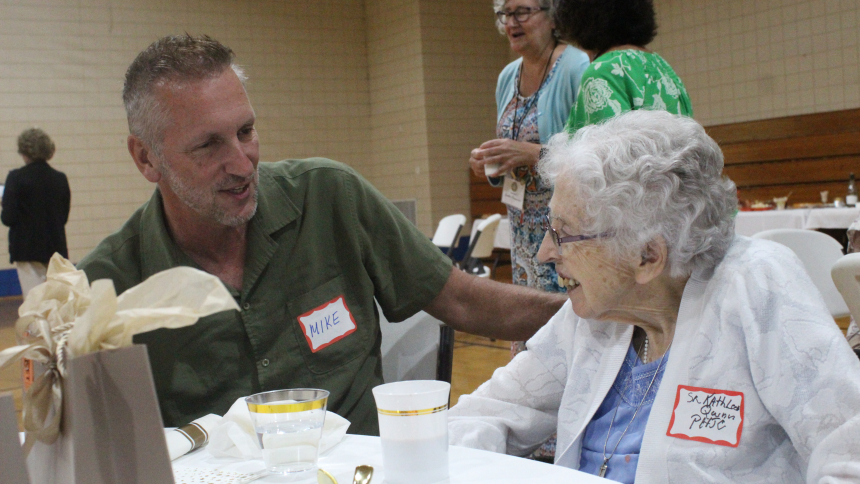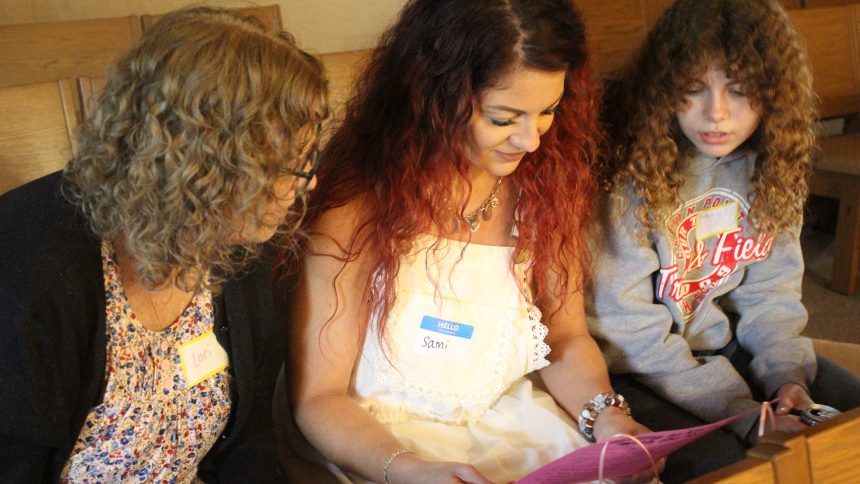
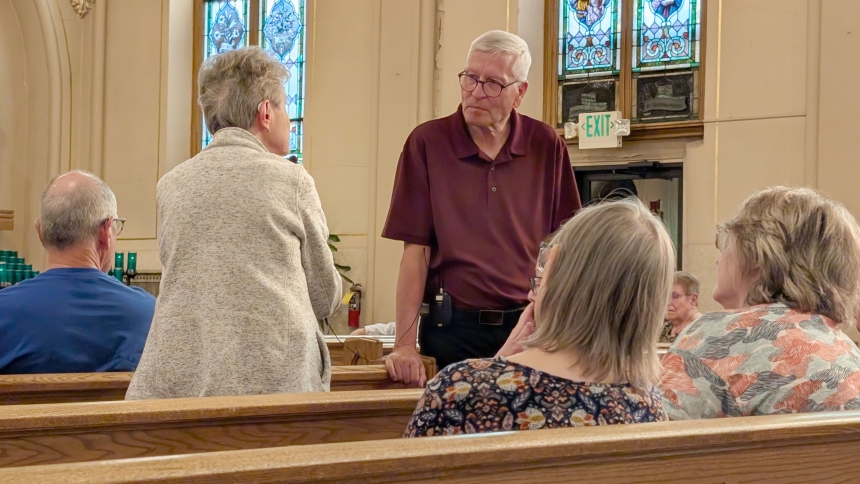
DYER – Parishioners from St. Joseph and St. Maria Goretti were invited to attend a series of three 60-minute reflections July 27-29 at St. Joseph to help parishioners navigate changes the community is going through now and in the future.
Members of both parishes learned about a planned transition for their community through a letter shared by Bishop Robert J. McClory the weekend of Feb. 28-March 1. The letter included an outline of the local pastoral planning committee’s recommendations and adaptations included with the bishop’s acceptance of the plan. As part of the plan, the parish community of St. Joseph will eventually merge with St. Maria Goretti.
Dan Lowery, who was ordained in the Diocese of Gary in 2013, led the retreat which focused on “Why this Change?” and “Why this Disappointment?” Deacon Lowery left Northwest Indiana four years ago and has since served in the Diocese of Indianapolis and now resides in South Carolina. While in the Diocese of Gary, he worked at Calumet College of St. Joseph, where he served as a professor and president (2011-2017).
Father Leo Gajardo invited Deacon Lowery to lead the retreat, as he had worked with the pastor and the parish council at St. Joseph in Dyer over the years on a variety of projects.
“I know we are talking about some significant changes this evening, and I have some experience with those changes and hope to bring a few insights that might be helpful to some of you,” Lowery said.
Deacon Lowery noted that he was not there to address the decisions that had been made or the decisions that ought to be made – that was not the reason he was invited to be there.
“When Father Leo called me, he said, ‘My parishioners are going through a change and some of them are experiencing a significant amount of pain,’ and asked if I had any thoughts in this regard,” he shared.
Deacon Lowery continued, stating that he had assisted parish transitions in the past and had worked with those experiencing grief that often accompanies unwanted change. He hoped to share that experience during the conversations. For those reasons, the three days were framed as a retreat – not a town hall – but a prayerful reflection for the benefit of parishioners of St. Joseph.
To begin the retreat, Father Gajardo shared a summary of recent events at the parish. He mentioned that on Oct. 16, 2024, he received a call from the bishop’s administrative assistant to schedule a meeting with Bishop Robert J. McClory. Upon meeting with him, Father Gajardo said the bishop surprised him by asking him to become pastor of St. Joseph effective Jan. 1, 2025. Bishop McClory also informed him that in early 2025, the diocese would launch a pastoral planning process for all parishes that had not yet participated.
“This process is said to be similar to the processes used by many dioceses across the United States,” Father Gajardo explained, “to organize their people and resources to meet the needs of the church today.”
On March 1, 2025, Bishop McClory announced a pastoral planning process that would take place later that year. It involved 41 parishes in the diocese that had not yet participated in the process, which included St. Joseph and St. Maria Goretti in the South Lake Deanery. As part of the preparation for pastoral planning, Father Gajardo was asked to select three key parish leaders. Together, the four individuals participated in a one-on-one session in which the pastoral planning process was explained to them. They completed a questionnaire that provided information about the parish and gathered with other pastoral planning teams from the area.
“In our meetings, we formulated priorities for parish ministry in the future, considered different models for organizing parishes, worship sites and priests to meet the priorities that had been set,” he said. “By the end, we agreed to a recommendation that we submitted to Bishop McClory for our pastoral planning area.”
That recommendation was presented to Bishop McClory in December 2025 along with recommendations from the other three planning areas. The bishop spent a few months praying with the recommendations and discussing them with the deans of the diocese. Bishop McClory then announced his decisions in late February of 2026, regarding the future organization of parishes throughout the diocese, including the merger of St. Joseph and St. Maria Goretti. The bishop also announced the eventual reduced or discontinued use of nine current parish campuses throughout the diocese, including St. Joseph.
Father Gajardo said he asked parish leaders of St. Joseph and St. Maria Goretti to be part of a transition team in preparation for the eventual merger of the two parishes. With the bishop’s permission, he and the transition team began developing plans for the eventual merger. Plans included combining parish staff and communication, as well as blending Mass and confession schedules.
Deacon Lowery invited those gathered to reflect on Psalms throughout the three days that would transition from descriptions of lamentation to words of hope. The first night, those gathered read aloud Psalm 88, which reads, “Lord, the God of my salvation, I call out by day; at night I cry aloud in your presence. Let my prayer come before you; incline your ear to my cry. For my soul is filled with troubles; my life draws near to Sheol. I am reckoned with those who go down to the pit; I am like a warrior without strength.”
Providing an opportunity for the parishioners to share their thoughts and feelings, Deacon Lowery proposed a question to begin conversation – What emotions are your fellow parishioners experiencing in this moment? As individuals took turns speaking, honest answers included words like anger, upset, heartbroken and sad.
Continuing the discussion, Deacon Lowery proposed a follow-up question: What impact regarding this change should we be most concerned about? Responses to that question conveyed concern regarding what would happen to the physical church building that was constructed in 1913 and concern for those who would not have the opportunity to grow in the faith there if the location were to close.
Deacon Lowery acknowledged that some of the comments voiced during the evening resembled those who are grieving. He noted that, similar to Dr. Elisabeth Kübler-Ross’s teachings on the five stages of grief, they may be experiencing forms of denial, anger, bargaining, depression and acceptance.
“The danger is people get stuck in these stages of grief, and they can’t get past it, so they withdraw, they leave, they get stuck,” he said. “And sometimes when they get stuck, they transfer their emotions to another person or another issue.”
On the second day of the retreat, Deacon Lowery shared a little information regarding “how did we get here.” He explained that in the northern part of the diocese, many parishes were formed based on ethnicity. He also mentioned Bishop Andrew Grutka, the first bishop of the Diocese of Gary, had a strategy in the 1960s to build more parishes within neighborhoods.
“There were a lot of priests. There were a lot of seminarians. There were a lot of practicing Catholics at that time,” he said.
Deacon Lowery clarified that today, when a diocese “crunches the numbers,” it looks at not only the amount of new housing in an area, but also the percentage of families expected to be Catholic and what percentage will be practicing Catholic.
“There is no bishop, there is no pastor, who wants to close a parish,” he said. “There just isn’t.”
Having worked on these issues in other cities and dioceses, Deacon Lowery shared some of the reasons parishes throughout the country close. Some of those macro issues he listed include the lack of active priests, burnout of priests, financial problems and the need for vibrant parishes.
“The bishop, like all bishops, wants healthy parishes,” he said. “What we see is the same people do everything. Could more be done in that regard? You bet ya. But a parish, in order to have vibrant ministries, does need a certain demographic – it does need a number of people.”
Moving into the evening’s period of reflection, Deacon Lowery asked the group to read Psalm 13. The passage begins with the words, “How long, Lord? Will you utterly forget me?” and later states, “But I trust in your mercy. Grant my heart joy in your salvation; I will sing to the Lord, for he has dealt bountifully with me!”
Lowery then asked two questions encouraging dialogue: “Where can I detect God’s presence in this experience?” and “What hopes and dreams do we still harbor as a community? ”
Parishioner Louise Standefer shared that she had recently been reading from the Book of Ruth, which made her think about the concept of hope. “There is a God who sees the bigger picture,” she said, “and we don’t know what that is right now. But I have to encourage all of us to trust that God is seeing the bigger picture.”
Later, when it was her opportunity to speak, parishioner Emma Gallenberger appealed to her fellow parishioners. She said, “I want us to be there for each other, and I want us to hold on to each other. I don’t wanna lose my parish community.”
On the final day of the retreat, parishioners arrived to share final thoughts before celebrating Mass together – the source and summit of the Catholic Church. Before the start of the liturgy, Father Gajardo took to the microphone to acknowledge the passion his parishioners have for their Church and their religion.
“In my year and a half plus that I’ve been with you, I’ve seen that you are a people of strong faith,” he said.
For more information on pastoral planning in the Diocese of Gary, visit https://dcgary.org/planning.