Epiphany is a Christian holiday, also called Three Kings Day, celebrated on Jan. 6 to commemorate the arrival of the Magi to see the infant Jesus and his manifestation as the Son of God to the Gentiles.
The word "epiphany" means "manifestation" or "revelation," and the holiday also broadly celebrates other revelations of Christ's divinity, such as his baptism. Celebrations vary globally, including traditions like gift-giving, special foods, parades, and the blessing of water.
“At the heart of the Epiphany story is really the manifestation of Christ, the revealing of Christ to the people,” said Father Jeffrey Burton. “It’s a reminder to each of us that God continues to reveal himself to us every day, making himself known in our conversations, interactions and relationships, but in a very significant way in the sacraments and in the life of the Church.”
Epiphany also marks the occasion of ”chalking the door.” Many Catholics have their home blessed on Epiphany to commemorate the visitation of the Magi to the child Jesus. Catholics bless their homes because God comes to meet them there. The Church recalls that Jesus spent much of his ministry sharing meals with people in their homes.
Father Burton, pastor of St. John Bosco, administrator of St. Joseph and chaplain at Bishop Noll Institute, shared that one of the best ways families can celebrate Epiphany at home is through blessing the house and using that as an opportunity to re-center their lives and their schedules around Christ.
He said, “I think one of the best practical things we can do is chalk that front door as a 365-day reminder to ask ourselves some fundamental questions each time we leave the house: Am I putting God first? Does my life revolve around putting matters of my soul first? What needs to get re-ordered in my life so I can be the person God destined me to be?”
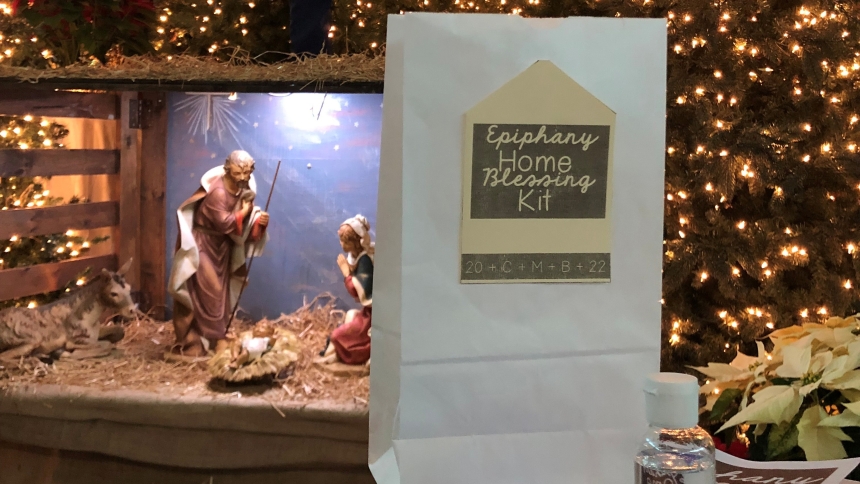
Each year, the Hammond parish prepares kits for its families to take home on Epiphany. It includes a piece of blessed chalk, a bottle of holy water from the font at St. John Bosco and a little worship aid families can use to mark their doors and bless their homes.
“Often in the Calumet Region, especially in the ethnic parishes, priests would visit parishioners’ homes around the Epiphany, blessing the home, paying a visit with the family, sometimes sharing a meal or a cocktail,” Father Burton said. “In addition to the spiritual and social nature, the visits also had a practical purpose, as the priest would use that as a method of updating the parish census.”
“There has always been at least a theological underpinning,” he continued. “We look at Mary and Joseph’s journey to Bethlehem to be counted in the census and we can connect that to the priest’s visit. While it’s largely impractical for most priests to visit each home, the connection to the magi is still inherent.”
Father Burton explained that part of the ritual calls for chalking the door with the letters C, M and B, which stand for the names of the three wise men who followed that star at the Epiphany, Caspar, Melchior and Balthazar. It also means “Christus Mansionem Benedicat,” in Latin, “May Christ Bless this Home.”
“So, in blessing the home, we really recommit our lives and our families to Christ and acknowledge that the family is really the 'domestic church,” he said.
In Dyer, home blessing kits were assembled by the 8th-grade Christian Formation Program students and were available in the back of churches on the weekends of Dec. 27-28 and will be again Jan. 3-4. In fact, over 200 home blessing kits were distributed during the first weekend. It went over so well, Kathy Hansen, director of religious education for St. Maria Goretti and St. Joseph, asked 9th graders to assemble 200 more for this upcoming weekend in time for Epiphany.
“It was part of the lesson on the Epiphany for the 8th graders,” she said. “They know about the Three Kings but not the House Blessing. We want to make known some of the Catholic traditions to the young people of our religious education program. Our students are always reminded of service opportunities that help spread Catholic traditions.”
Each year, the Hispanic community of Holy Family Parish in LaPorte celebrates the Feast of the Three Kings (Fiesta de los Tres Reyes Magos) to commemorate the Epiphany. The traditional way of celebrating this feast is through the sharing of the rosca, a crown-shaped sweet bread topped with candied fruits to symbolize jewels on the crowns of the kings.
Hidden inside the rosca is a figurine of the baby Jesus, “hiding” from King Herod. Each person gets a slice of the rosca, and whoever finds the baby Jesus in theirs is seen as good luck.
“In our community, finding the figurine also means that your family is responsible for hosting the fiesta for the Presentation (Feb.2), which marks the entrance of the baby Jesus into the Temple 40 days after Christmas,” said Father Nathaniel Edquist.
The pastor explained that due to the church’s numbers, it shares between 6-8 roscas any given year, so there are plenty of “winners” who team up to host the Presentation party.
“One of the great things about being Catholic is that we are not limited to the American experience,” Father Edquist said. “Instead, we treasure and incorporate the various cultural traditions that our immigrant populations bring. These are not only opportunities for community-building, but also chances to catechize the faithful on the deeply spiritual meanings behind these traditions. We hope to continue fostering the rich diversity of our community into the future.”
Caption: Father Ivan Alatorre and Father Jeff Burton filled 500 holy water bottles and then volunteers stuffed Home Blessing Kit bags the week before the Feast of the Epiphany. (Provided photo)