MERRILLVILLE – The Catholic Church does not tell its believers what candidate to vote for, but rather how to use a moral vision for society and the common good to discern the best choice.
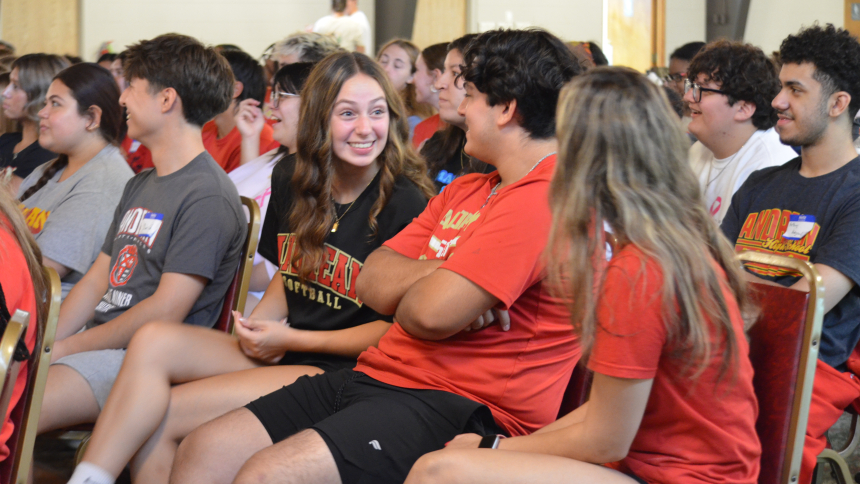
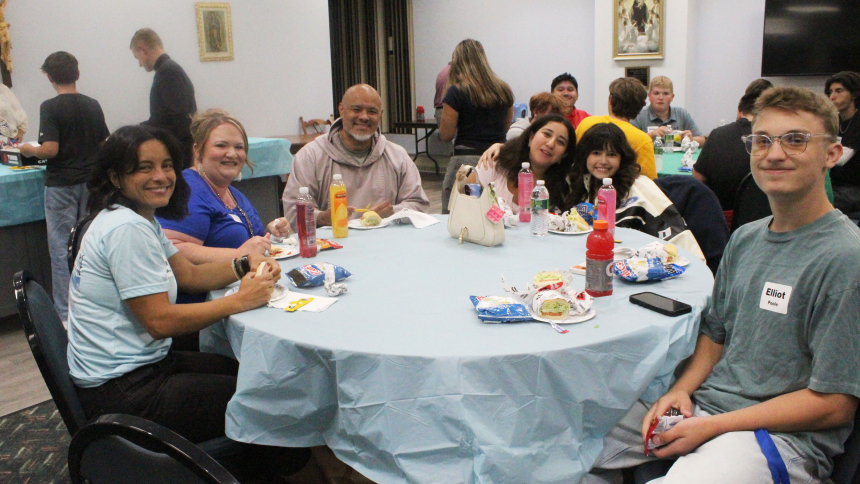
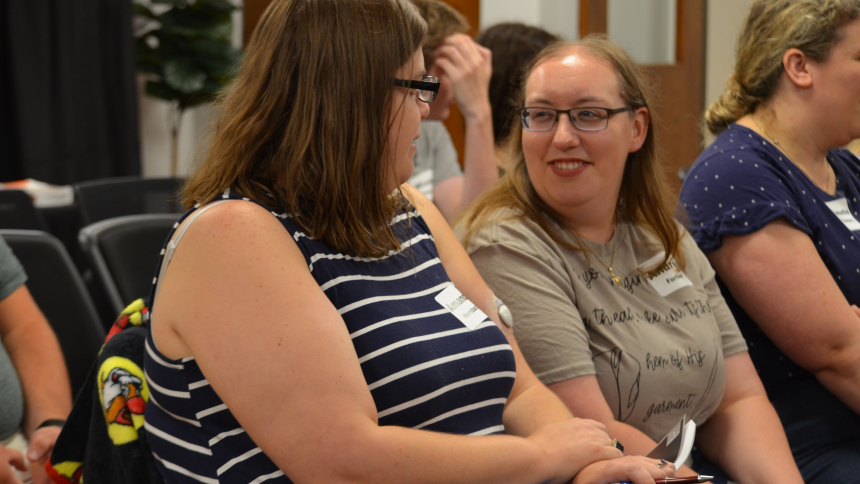
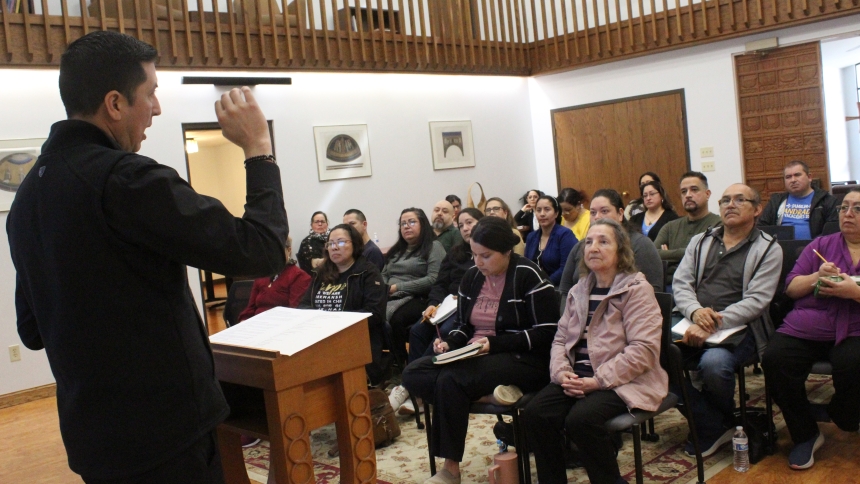
That was the message of a bilingual Saturday Formation class on “Faith and Politics” taught by Father Jacob McDaniel in English and Father Roque Meraz in Spanish on March 21 at the Diocese of Gary Pastoral Center.
Father McDaniel, chaplain of the St. Teresa of Avila Catholic Student Center in Valparaiso, began his presentation by assuring attendees, many of them lay ecclesial ministry students, that he would not be talking about what political party they should vote for, rating past U.S. presidents or discussing whether or not the Chicago Bears will build a new stadium in northwest Indiana. Instead, he focused on “what the Catholic Church wants to give us and what the bishops want us to think about” when it comes to supporting the common good.
In answer to the question “Why do we have laws?”, attendees suggested they are to keep social order, punish those who break them, prevent harm, protect freedoms and promote morality, and Father McDaniel offered the core principles of law as outlined by St. Thomas Aquinas: ordinance of reason (a law must be reasonable), for the common good (to allow human flourishing, not individual benefit), promulgated by legitimate authority and promulgated (publicly known).
“Every law teaches something about what a society believes is good or bad. Law is never morally neutral,” said Father McDanel, who is studying for a Canon Law degree. Unjust laws, he added, are those that contradict moral truth, violate human dignity or damage the common good.
Father Meraz echoed those remarks in Spanish, presenting the Principles of Catholic Social Teaching: human dignity, common good, subsidiarity (decisions should happen on the lowest, or most local, level) and solidarity.
“In a Catholic sense, law always reflects a moral vision - what is acceptable, what is right, and what we should avoid,” said Father McDaniel. “In a civil sense, we obey laws to avoid punishment, not go to prison, but in Catholicism, because we love our neighbor, we obey laws to not do harm and to avoid chaos.
“That’s the difference between the spirit of the law and the letter of the law,” he added. “When we look at our laws, we can see what we value.”
The formation of a conscience, both priests explained, is the result of Scripture, Church teaching, prayer, virtue and reason, while virtues for political life include prudence, justice, charity, fortitude and humility.
Moral evaluations consider intrinsic evils – no good can come of it - and prudential judgements, about which legitimate disagreements may exist.
Father McDaniel listed abortion, euthanasia, racism and direct attacks on human dignity as “laws that cannot be supported,” while judgements can differ on issues such as economic policy, immigration policy methods, healthcare options, taxation strategies and gun control.
So, how can a person live as a Catholic in political life?
Father McDaniel said there is a surprising amount of “grey area” in the answer. “The Church wants you to discern (about individual candidates), not vote a straight party ticket,” he said.
While abortion is an intrinsic evil and the protection of unborn life is preeminent, preeminent does not mean “only”, and Catholics should address the full range of life and dignity issues, balancing preeminent issues with proportionate reasons that match the moral gravity of the evil.
In the document “Forming Consciences for Faithful Citizenship: A Call to Political Responsibility from the Catholic Bishops of the United States,” the bishops stated that “As Catholics we are not single-issue voters. A candidate’s position on a single issue is not sufficient to guarantee a voter’s support. Yet if a candidate’s position on a single issue promotes an intrinsically evil act … a voter may legitimately disqualify a candidate.”
That same document noted that “Responsible citizenship is a virtue, and participation in political life is a moral obligation,” calling upon Catholics to vote.
Maria Patino, of St. Margaret Mary in Hammond, a Spanish language teacher at Bishop Noll Institute and a lay ecclesial ministry student, said she gained from “Faith and Politics” an understanding “of what human laws are and the laws of God. We should follow the law and be good to others, respecting human dignity.”
Steve Rudnick, a Cedar Lake resident and parishioner at St. Edward in Lowell, said he has started attending the Saturday Formation sessions as he seeks a path back to the Church. A cradle Catholic who left the Church after receiving all his sacraments, Rudnick said he started watching a streamed Mass from Milwaukee when he began feeling that God was calling him back to the Church. He has since observed Order of Christian Initiation for Adults classes and become an altar server.
“People ask me what’s the difference between Catholicism and Christianity, which has less rules and less obligations,” said Rudnick. “What I have come to believe is that people are coming into the Catholic Church for more, to have a closer relationship to God.”