MUNSTER – Fifty years is more than a lifetime for some people. For others, it may seem like the blink of an eye. At the unearthing of a time capsule, onlookers found a tactile way to flash back half a century.
Carmelite Fathers announced to those attending Sunday Mass in Polish on July 12 that following the liturgy, history would be made in the banquet hall on the monastery campus.
Church members and guests made their way to the hall under the escort of a Polish Highlander group called Koło Małe Ciche Wiktorówki. Their traditional attire and the flags they held brought regional flair during the day reserved to honor Our Lady of Jaworzyna.
Decorations in the monastery church spoke to the blessings of life in the U.S., as America celebrates its 250th year of independence. Fifty years ago, Americans marked the nation’s bicentennial, and those festivities did not pass the Region.
In 1976, members of the Polish American Congress, joined by the friars of the Carmelite Monastery and Catholics from throughout the Munster area, directed the burial of a time capsule near a grotto.
Speculation built about what could have been placed in the time capsule, which technically was not opened at the banquet hall, but rather dug up and unsealed the day before the reveal.
The soldered steel case – about the size of a large fireplace log – proved to be a sturdy container, which kept the elements away from its contents.
Grace Mazur-Biestek, a Munster resident and 20-year teacher of Polish natives gathered at the monastery, intently watched as members of the Polskie Kwiaty Dance Group recited patriotic poems.
“We would like to know what was important for those people 50 or 70 years ago,” she said. “What did they save that we will discover today? Of course, it is very important.”
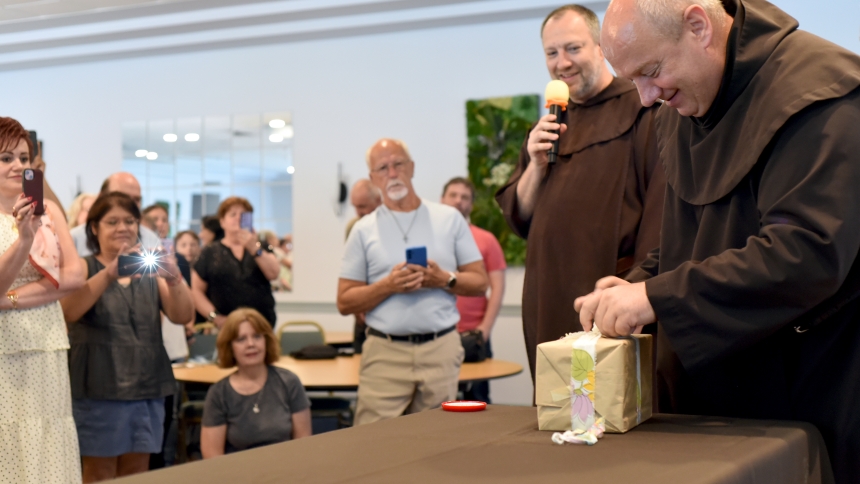
Father Andrzej Gbur, OCD, commenced the reveal while Father Franciszek Czaicki, OCD, and Father Bruno Socha, OCD, assisted in unwrapping the items from thick plastic bags.
Each formerly hidden treasure appeared undamaged, as if it had been placed in the container yesterday.
Father Czaicki, known as “Father Francis” to many parishioners, placed items on two large tables. Stacks of photos, both black-and-white and color, drew viewers to the stage.
The silver tones of twentieth-century coinage stood out amongst the numerous paper bundles. U.S. bicentennial literature and a copy of the Gary Sunday Visitor (a predecessor to the former Northwest Indiana Catholic newspaper) dated from 1976 were displayed.
Waclaw Borcz, a Portage resident, immediately noticed his late uncle Father Casimir “Wojciech” Borcz in a photo of the Carmelite friars from the bicentennial era.
“That’s him right there,” he said, pointing to a picture of the Carmelite Father in Munster from the early 1970s. “I used to visit them. When I first arrived, I stayed (at the Carmelite Monastery) on the first couple of nights.”
Borcz, who was born and raised in Poland, said the then-Soviet Communist authorities operating the government did not make it easy to leave the country. “To get a passport out of Poland was a (difficult) thing,” he commented.
His dream was to live in America's freedom as a citizen. “It took me a long time; when I came here on a tourist visa, I applied for a change of status, which was rejected,” Borcz said.
Having left the country for a time, he was eventually permitted to return to the U.S. to obtain citizenship.
Father Gbur scanned the layout of papers, coins and photos and appeared to be looking back in wonder at the feats of another generation.
“(I appreciate) what our brothers did 50 years ago without the Internet and the many things we use today,” Father Gbur said. “But they had the support of many people, maybe hundreds of people who were engaged … today we are more individual.”
He said of those who established a Polish monastery, first in Hammond in 1948, and then, after a move, at Ridge Road and White Oak Avenue, “I wish I had the same zeal to make community and
celebrate together.”
Earlier in his homily at the noon Mass, Father Gbur spoke of how there was a nice melding of groups at the monastery that Sunday – the traditional Polish Highlanders and the Munster church members of various backgrounds. He considers that vibrancy of culture to be “the fruits” of those who founded the Carmel.
Father Gbur said the capsule's artifacts will be archived and some may be donated to the Polish Museum of America in Chicago. However, there are no immediate plans to gather together items for a new time capsule.
Steve Tokarski was vice president of the Indiana chapter of the Polish American Congress in 1976. The longtime president of the fraternal organization’s state group recalled the pomp that surrounded the creation of the time capsule, “The priests just got everyone rounded up, and they worked on the (bicentennial effort),” he said.
In a short presentation, Tokarski reminded the audience that the efforts of the PAC in 1976 reflected a great civic commitment. Later, he lamented that the strength of Polonia appears to be more dispersed, but celebrated its strength around enclaves of faith.
“Us here in Lake County are pretty lucky. Not only do we have the Carmelites (in Munster) but also the Salvatorians in Merrillville. And we have Chicago right next door,” Tokarski explained.
Another close connection was uncovered when memorabilia donated by Tokarski’s aunt Evelyn Tolpa Lisek was found in the time capsule. The Hobart resident passed away on June 15 at age 100.
After viewing the unearthed treasures of a half century ago, many of the curious monastery faithful departed from the banquet hall to join in a traditional Polish picnic.
Gathering for Mass, then viewing historic treasures, and finally breaking bread (and dining on kielbasa and perogies) outdoors, a family of faith spent a summer afternoon in both a reflective and a hopeful mood.
Caption: Father Franciszek Czaicki (right), OCD, unwraps an unearthed package as Father Andrzej Gbur (back), OCD, looks on at the opening of a 50-year time capsule on July 12 at the Carmelite Monastery in Munster. Well-preserved artifacts such as photos, papers and coins were discovered in the steel case, originally buried on the nation’s bicentennial in 1976. (Anthony D. Alonzo photo)