MERRILLVILLE – Pastoral planning is a prayerful, strategic process by which a parish or group of parishes takes inventory of the current human and financial resources of a community and realigns them to meet future sacramental and pastoral needs.
The planning process involves meetings with key parish leaders and parishioners over several months to examine relevant data and mission goals to propose a plan to organize ministries and worship opportunities for local Catholic communities. When ready, the local planning committee presents its recommendations to the bishop, who then prayerfully considers how the plan will serve the local church.
Since arriving in 2020, Bishop McClory has encouraged parishes in the Diocese of Gary to enact pastoral planning to establish vibrant communities poised for missionary discipleship. Parish planning has been amplified, honoring and adjusting parish action plans created upon completion of the extensive diocesan-wide synod initiated in 2017 and refreshed through the synod in 2022 and Bishop McClory’s pastoral letter “We Proclaim Jesus as Lord.”
Over the last six years, parishes have entered collaborative pastoral planning in different ways, according to the needs of their local communities. Beginning in 2020, the Merrillville parishes elevated pastoral planning to more closely examine how best to provide spiritual and sacramental ministries to the local Catholics. As a result, five former parishes formally merged into one parish community in 2025, Our Lady Queen of Martyrs, with two worship sites.
In 2023, Michigan City parishes engaged in pastoral planning, merging St. Mary Parish with Queen of All Saints, and are continuing the planning process.
In the fall of 2024, parishes in East Chicago, Hammond and Whiting collaborated to examine local trends and resources, resulting in the planning committee preparing a recommendation for Bishop McClory’s consideration. In May 2025, Bishop McClory responded with his support and additional recommendations.
In the fall of 2025, the remaining 41 parishes, organized in four regions known as deaneries, engaged in collaborative pastoral planning. Similarly, key leaders and parishioners met over several months to review demographic data, trends, and human and financial resources relating to their local Catholic communities. These planning committees prepared recommendations for Bishop McClory to consider.
After prayerful reflection, consultation, and the unanimous support of the deans and consultation with parish leadership, Bishop McClory accepted the planning committee’s recommendations with a few adaptations, sharing his response with priests and deans. With the unanimous support of the deans, Bishop McClory summarized these recommendations in a letter to the faithful, which was made available at Sunday Masses the weekend of Feb. 28-March 1.
Bishop McClory stressed his commitment to supporting all parishes as they make adjustments to serve their communities. He added that diocesan leadership and staff also remain ready to walk with parishes throughout the process.
“We are all seeking the Lord’s guidance, wisdom and strength so that the Catholic Church in Northwest Indiana will always be a vibrant, caring and disciple-driven community,” the bishop said. “You can be confident of my abiding prayers for all the members of these parishes during this time of transition.”
Bishop McClory said the most recent pastoral plans continue a vision introduced shortly after he arrived in the diocese. Current pastoral plans are preparing the local Church to serve its communities well in the future.
Very Reverend Christopher Stanish, vicar general and moderator of the curia, said the changes are more than just part of a strategic plan. Over time, he stated, the pastoral planning that occurred will become a greater framework for renewal.
“In many ways, we stand at a very pivotal moment,” Father Stanish said. “This is not simply a moment of planning, restructuring and adjustments,” he said. “It really is a moment of grace. I think we've seen the Lord leading us over these years.”
Father Stanish explained the changes will help the diocese to continue its mission to establish vibrant parishes in the areas of missionary discipleship, spiritual maturity, Sunday experience and shared leadership.
“The goal is for every parish to create pathways that move people from encounter to conversion, from conversion to discipleship and from discipleship to missionaries,” he said.
Father Jeff Burton, dean of the North Lake Deanery, serves St. John Bosco and St. Joseph in Hammond and St. Stanislaus in East Chicago. He personally understands that part of the reason for the urgency in implementing a pastoral plan is due to the number of priestly retirements that are outpacing ordinations.
“There was a time when I was shepherding three parishes, two of which have grade schools,” he said. “That was in addition to being the chaplain of our largest high school and other diocesan responsibilities. Thirty years ago, 11 priests were doing what I’m expected to do today myself. I hope that, as difficult as these changes are, it may curb burnout among my brother priests and ultimately bear fruit in having happy, healthy priests shepherding our communities.”
As those parishes he was assigned to recently went through the same planning process, Father Burton understands there will be immense sadness in knowing one’s spiritual home is transitioning.
“For Catholics in particular, our church buildings are where we’re baptized, where we come to know Christ in the Eucharist, where people are wed and where we say that earthly farewell to those we love,” he said. “At the same time, statistically, fewer Catholics are celebrating those milestones in our churches and fewer are in the pews every Sunday.”
For more information regarding parish planning and a list of frequently asked questions, visit https://dcgary.org/planning.
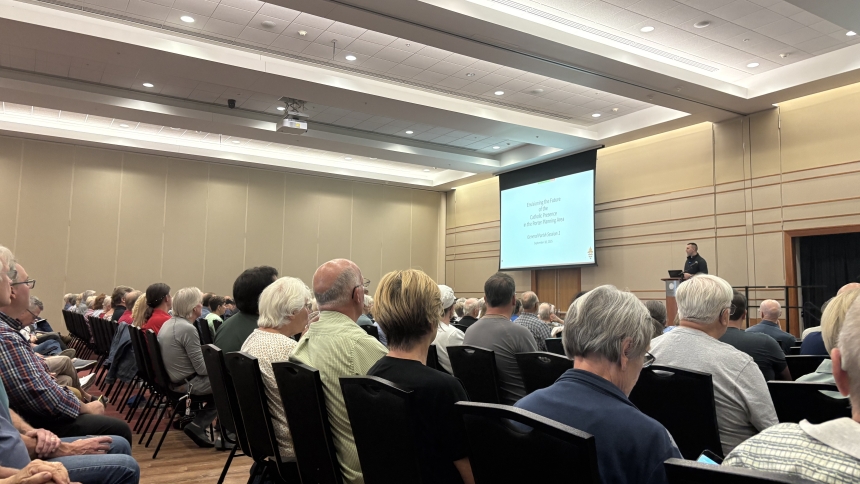
Caption: Very Rev. Christopher Stanish, vicar general and moderator of the curia for the Diocese of Gary, addresses a crowd of approximately 300 members of the faithful on Sept. 10, 2025 in the ballrooms at the Harre Union at Valparaiso University for a general session as part of the pastoral planning process for the Catholic parishes in Porter County. (Cecilia Cicone photo)