Who’s your favorite saint?
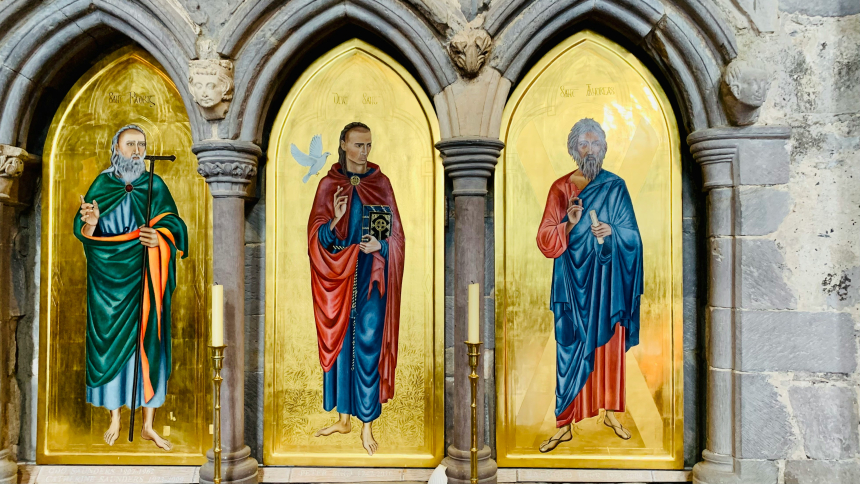
The saints of the Catholic Church are a diverse group of people with varied and interesting stories. Among the holy group of men and women are martyrs, kings and queens, missionaries, widows, theologians, parents, nuns and priests and “everyday people.” Most Catholics tend to identify with a specific saint – one they feel the strongest spiritual connection with, admire the most and pray to the most.
St. Thomas Becket is one of Collin J. van Waardenburg’s favorite saints. In his childhood, the diocesan seminarian developed a deep appreciation for history, especially the Middle Ages. He wanted to be a priest from a very early age, so he paid close attention to saints who were priests.
“I learned about St. Thomas Becket first because I spent a lot of my free time reading about medieval England and France, and their contemporary saints,” he said.
St. Thomas Becket was martyred in 1170 while celebrating Vespers on the orders of Henry II of England for his loyalty to the papacy as the king attempted to assert more direct control over the Church in England. Although Becket is a celebrated martyr in England now, van Waardenburg found his complex life compelling.
Becket died defending the rights of the Church, but his vocation did not begin that way. Becket was one of Henry II's closest friends, and was known for living a very immoral life. Upon being consecrated as Archbishop of Canterbury, the head of the Church in England, Becket underwent a dramatic personal conversion, and that was when the conflict began.
“I find the work of grace in Becket's life, particularly through his reception of Holy Orders, to be very compelling,” van Waardenburg said. “The great gift that he received in his ability to boldly speak truth to power is something very needed in our day.”
Van Waardenburg acknowledges he doesn’t have as much to change in his life as Becket did, but as he approaches diaconate ordination, seeing the fruits of ordination in Becket's life makes him even more excited for the graces that he hopes to receive at his own ordination.
Van Waardenburg added he is a big proponent of mid-20th-century saint movies. There's a 1964 film, simply called "Becket," which traces the life and conversion of the saint. Van Waardenburg tries to watch it each year around the saint’s feast day, Dec. 29, during the Christmas Octave.
Josh Schultz, pastoral associate for relational ministry at St. John the Evangelist in St. John, admires St. Moses the Black. He was an incredibly strong and physically imposing man who lived a rough life before encountering Christ. He began his life as an enslaved person who, after being freed, became the feared leader of a violent bandit gang. Hiding from the authorities, he took shelter with monks in a colony in the desert of Scete, and their peace and contentment began to deeply influence him.
“What I admire is that his conversion didn't make him weak,” he said. “It actually taught him what real strength was. He went from using his physical power to intimidate others to becoming a man of discipline, humility and faith.”
Schultz said he has always valued physical strength, working out, discipline and self-motivation. However, he has also come to believe that being a strong man means much more than “what you can lift or how tough you are.”
“It's about leading, protecting, serving and having the courage to put Christ first,” he said. “St. Moses reminds me that the strongest man in the room should also be capable of being the most humble. I am still a work in progress there.”
Schultz tries to honor what St. Moses the Black represents by challenging himself both physically and spiritually. Whether it's through exercise, prayer or helping other men grow in their faith, he feels called to use the strength God has given him for something greater than himself.
Jamie Sandona’s most beloved saint is St. Teresa of Calcutta because of her simplicity and care for all of humanity. The saint has always inspired the pastoral associate director of religious education at St. John the Baptist in Whiting. The saint reminds her “to see the face of Christ in those most in need whom I serve in my ministries.”
While reading the saint’s private letters in the book, “Come Be My Light,” many, many years ago, Sandona discovered that St. Teresa experienced a feeling of the absence of God in her life, an internal darkness in her soul – that she no longer felt the presence of God. Yet, she continued to serve and give, and always with a smile. She was a joyful servant of a God whom she no longer felt in her being. She felt abandoned, alone.
“How she found the strength to continue on, to move through the darkness without the spiritual guide she had always had... I don't know why, but that just sits with me: to always trust there is a plan,” she said. “Even when He is silent, he is still there.”
Sandona was also moved by an image of St. Teresa’s feet in sandals. She learned the saint gave the good sandals to those who needed them, and she used what was left to do the work of God.
Eva Cornejo, secretary at St. Mary in East Chicago, shared that her favorite saint is St. Jude Thaddeus. Why? “Because he is the most holy Apostle, a faithful servant and friend of Jesus, the Church honors and invokes him universally,” she said.
St. Jude, known as Thaddaeus, was a brother of St. James the Less, and a relative of Jesus. He was one of the 12 Apostles. Following his death, St. Jude's body was brought to Rome and left in a crypt in St. Peter's Basilica. Pilgrims came to his grave to pray and many reported a powerful intercession, leading to the title, "The Saint for the Hopeless and the Despaired."
“I feel close to this saint because, just like everyone else, I ask for his help when I have family problems or the loss of a family member to find the strength I need to continue with my life,” Cornejo said. “When I feel sad and alone, I pray that he fills me with the Holy Spirit.”
Cornejo said she honors him by remembering all the help she has received and by telling people how good she feels when she prays to him.
For more information about the saints, visit usccb.org/prayer-and-worship/prayers-and-devotions/saints and usccb.org/offices/public-affairs/saints.