Catechesis of the Good Shepherd explores religious values of childhood
“Young children have a natural ability to enjoy their relationship with God in a very deep way. Children are capable of enjoying the presence of God; they are able to give themselves totally to God’s love.” – Sofia Cavalletti, The Good Shepherd and the Child: A Joyful Journey
DYER – To speak about the history of the Catechesis of the Good Shepherd is to speak about two women living in Rome, Italy, who became friends and collaborators and who devoted their lives to working with children – Sofia Cavalletti and Gianna Gobbi. There are now six countries that have laid a foundation of catechist formation and atria serving children in churches and schools under the organization. Within the Diocese of Gary, the program is offered at St. John Kanty in Rolling Prairie and at St. Joseph and St. Maria Goretti in Dyer.
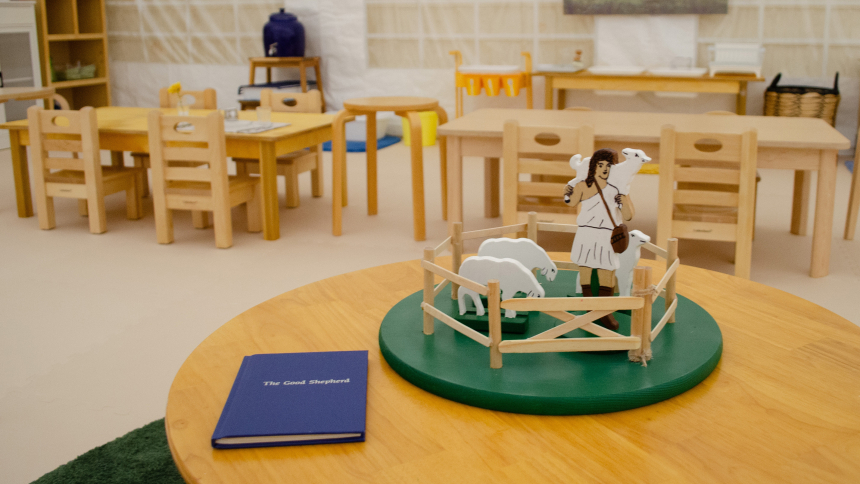
Sue Jett, who was hired as the CGS Coordinator for St. Maria Goretti and St. Joseph in July, explained that the Catechesis of the Good Shepherd (CGS) is rooted in the principle of “deschooling” catechesis. Rather than placing children in a traditional classroom setting, CGS invites them into a specially prepared environment, called the atrium, designed according to Montessori principles and the developmental needs of the child.
CGS recognizes distinct stages of development, with atrium environments prepared for children ages 18-36 months, 3-6 years, 6-9 years, and 9-12 years. Each environment and its materials are carefully adapted to the particular capacities, sensitivities, and spiritual needs of children at that stage. St. Joseph and St. Maria Goretti in Dyer currently have atria for children ages 18 months through 9 years old, with a goal of fully developing CGS through 12 years old in the next few years.
While deeply child-centered, CGS is also distinctly Christocentric and liturgical. Children encounter Jesus as a real person who lived in a particular place and time in history, while gradually coming to know the mystery of his life as it unfolds through the seasons of the liturgical year. Through carefully designed, hands-on materials, children explore the essential mysteries of the Catholic faith and discover the connections between Scripture, the sacraments, and the liturgical life of the Church.
“The atrium provides children with the time, space, and materials to linger with these mysteries – to wonder, contemplate, and make discoveries for themselves,” Jett said. “Through providing a sacred space for their purposeful work, children are invited not simply to learn about God, but to encounter him personally and respond to the relationship he offers them.”
Jett believes the “success” of CGS lies in its trust in God's design for the child – a design that unfolds through recognizable stages of human development – and in its faithfulness to the essential mysteries of the Catholic faith. Rather than determining what children should know based primarily on age or grade level, CGS attends carefully to the child’s developmental and spiritual needs and presents those mysteries of the faith that most deeply correspond to the child at each stage of development.
Father Leo Gajardo became aware of the potential of CGS to support his vision for lifelong faith formation and invited Jett to help explore how CGS might serve parishioners, beginning with the youngest members and extending to the adults who accompany them.
Jett said introducing CGS into a parish with an established model of traditional religious education naturally takes time. CGS represents a different way of thinking about catechesis – one that intentionally seeks to “deschool” the religious formation of children.
“Rather than simply transferring religious instruction from a classroom into another setting, CGS asks us to consider how the child encounters God and how we can prepare an environment that allows that relationship to unfold,” she said. “This can require a shift in expectations for parents, catechists, and the parish community as a whole.”
Jett describes the response to the program at St. Maria Goretti as slow but meaningful growth. She feels that, in many ways, this seems particularly appropriate for CGS.
“The image of the mustard seed is central to the work itself: something very small is planted, often growing quietly and almost imperceptibly, yet containing within it tremendous potential,” she said.
Jett’s hope is to see the Catechesis of the Good Shepherd offered in more parishes because of its potential to foster a broader vision of faith formation – one that creates sacred spaces where both children and adults can encounter the fullness of our Catholic faith and deepen their relationship with God. She loves to help parishes discover how the principles of CGS can enrich the entire faith community.
Jett explained that CGS does have a natural beginning to the year, and ideally children begin together rather than entering at various points throughout the year. This is not simply for scheduling purposes; it reflects the way the catechesis itself unfolds.
CGS typically begins six to eight weeks before Advent so that children have time to become oriented to the life of the atrium, learn how to work within the prepared environment, and begin developing a relationship with the prayer and liturgical life of the Church. Just before Advent, it introduces the geography of Israel, which provides an important foundation for entering into the mystery of the Incarnation – Jesus was a real person who entered human history in a particular place and time. From there, the presentations unfold in relationship to the seasons and celebrations of the liturgical year.
“Because the catechesis builds upon these earlier experiences, it can be difficult for a child who enters later in the year to fully engage with the themes being presented without first receiving that foundation,” Jett said. “For that reason, while we certainly want to welcome families who discover CGS after the year has begun, we also want to be attentive to what will best serve the child.”
Hollie Cook said CGS is a unique approach to evangelizing children and called it a huge blessing for her family and parish. Six of her eight children have moved through the CGS program, beginning at St. Matthew Cathedral in South Bend and continuing after it was introduced at St. John Kanty, where her youngest two children are currently enrolled. She and her husband are both formed in Levels 1-3 of CGS.
Cook agreed that a CGS program cannot be implemented overnight and the formation the catechists receive is an investment in them and the future of the Church.
“I’m not sure the fruits of all this work can be quantified, but I can say I am so grateful for my own personal growth in relationship and knowledge,” she said. “Insights that the children have offered for the parables, connections made in the Scriptures, an understanding of the signs and symbols of the sacraments… a lifetime as a Catholic did not unfold these to me like the CGS program has. I can only pray and trust that these same gifts have been given to all the children.”
Cook added that passing along the faith is the greatest task of a parent, and she cannot think of a better way than through the Catechesis of the Good Shepherd.
Alivia Brooks met a catechist through a co-op called Catholic Schoolhouse Merrillville who invited her family to join CGS Level 1. When Brooks heard there was a toddler program, she was so excited because two of her children would be able to participate. There were two things she loved the most about the program. First, she enjoyed intentionally taking the time to observe and learn about her daughter as a child of God.
“How often, as busy mothers, do we get the chance to delight in our children as God delights in us?” she asked. “I am now about to enjoy each of my children's ‘imago Dei,’ their image of God, just as He created them, in our day-to-day life from observing them participate in the program.”
Second, Brooks enjoyed being in a book club where mothers got the chance to explore Maria Montessori's philosophy and apply it to our domestic church. She gained many friendships and wisdom from her time with the other women.
Brooks has noticed a reverence in her children when it comes to prayer and singing praises to the Lord. She has witnessed joyful singing from her children during Mass that touches her heart, and she believes they gained that confidence at CGS.
Brooks has also seen her son take an interest in the Gospel readings. During the program, the catechist would read a line from the Gospel and ask open-ended questions to the children and let them explore the text.
She said, “It was so beautiful to witness their answers to Jesus's teachings, and now I know how to model that for my kids.”
Brooks wants other parents to know that their vocation was never meant to be done alone, and CGS provided her with a community. That community helped her grow as a parent and expanded her love for her children.
“Watching my children learn how to be independent and learn to love our Lord in such a beautiful environment is something I will never forget,” she said. “The discussions and laughs we shared as mothers in our book club discussions gave me so much peace. I am forever grateful for Catechesis of the Good Shepherd.”
Space for the Catechesis of the Good Shepherd atriums is limited. For details and registration, contact Sue Jett at SueJ@dyercatholic.org or (219) 865-8956, ext. 304. A CGSUSA Formation Course for Adults is also starting soon, scheduled for Thursday mornings from October through June. All adults are welcome.