Valparaiso community engages in public conversation on Magnifica Humanitas
VALPARAISO – Artificial intelligence is advancing at an unprecedented, exponential pace, with frontier capabilities doubling roughly every four to seven months, according to the AI Security Institute. With this new technology, many faithful might begin to wonder, “What does Pope Leo have to say?”
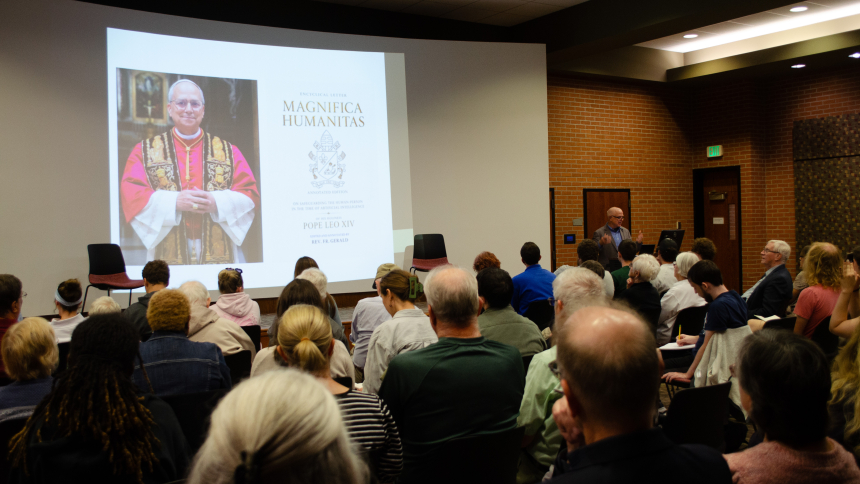
Faithful gathered for a public conversation on Sept. 21 on the campus of Valparaiso University to try and answer that question by reviewing the pope’s encyclical “Magnifica Humanitas.” Sponsored by Christ College, the St. Teresa of Avila Catholic Student Center, the Duesenburg Chair in Christian Ethics and Augustine Fellows Program, the evening discussion was led by Tal Howard, Ph.D., professor of humanities and history, and Ed Upton, Ph.D., associate professor of humanities, religion and literature.
Howard began by thanking those involved for the opportunity to speak on the topic of AI and commented on the number of attendees who comfortably filled the Mueller Hall Refectory Lecture Hall.
“I guess this is what you get when you have the world's oldest religious tradition commenting on the humanities’ latest technological innovation,” he said.
Howard acknowledged neither he nor Upton were experts on the local dimensions of AI but wanted to offer a means of thinking about AI theologically, “unpack” Pope Leo’s encyclical and discuss how it intersects with education.
Howard took a moment to define an encyclical and Catholic Social Teaching before discussing some of its implications for artificial intelligence.
An encyclical, he explained, means a circular letter. In the early periods of the papacy, the pope would write letters, but starting with Pope Leo XIII and continuing with Pope Benedict XV and beyond, they became more frequent and were written for wider audiences.
In 1891, Pope Leo XIII produced an encyclical in Latin and French. “Rerum Novarum,” which means “new things,” addressed the condition of workers or the working class. Howard shared that what the pope was trying to address in the late 19th century was a new phenomenon of an industrial society, especially the very poor and miserable position of workers that it developed in major cities at that time.
Another important turning point, Howard noted, was Pope John XXIII, who called the second Vatican Council, a very high household for understanding the shape of modern Catholicism. During this Council, he produced an encyclical, addressed not just to fellow Catholics, but to all people of good will.
Howard went on to define Catholic Social Teaching as an attempt to offer a vision of society premised on the belief that the gospel does not apply simply to one's private devotional life, but also to how one thinks about politics, economics, work and society.
“I would say it's not just a Catholic thing, but it's really for all Christians and all people, whether they're religious or not,” he said.
Howard then proceeded to share and outline the six principles of Catholic Social Teaching, which he identified as the following: Dignity of the Human Person, Common Good and the Community, Universal Destination of Goods, Subsidiarity, Solidarity and Social Justice.
“If all of these things are working well together, you get what's sometimes called integral human development or economic development, but it shouldn't be this pursuit of profits and destroying the natural environment,” Howard said. “You have to take the human into consideration in questions of economic and political development.”
Turning the attention to Pope Leo’s encyclical, he read aloud several portions before turning the microphone over to his colleague, including the following:
Paragraph 85: "Integral human development is the framework through which we can interpret the changes of our time, including those brought about by the digital revolution. Technological innovations, including artificial intelligence, are not neutral, for they can either foster participation and justice or exacerbate inequality, control and exclusion. For this reason, they must be evaluated by asking a crucial question: Do they truly help individuals and peoples to become more humane and fraternal, while respecting our common home and future generations?”
And Paragraph 94: “Technological progress – valuable in itself – requires careful discernment of the anthropological vision that guides it and the ends it pursues. If technological development advances without a corresponding ethical and social progress, the result may be an increase in means without a growth in humanity: “having more” without “being more.” In such a scenario, there is a risk that individuals will be evaluated principally according to the outcomes they produce.”
Upton said his task for the evening was to say a little bit about what Pope Leo asks of colleges and universities in this text. But before he did that, he wanted to contextualize his ideas theologically and sociologically. He began by referring to a passage near the end of the document where Pope Leo writes “a passage of almost mystical intensity.”
Reciting a passage by the pontiff, Upton read, “I invite everyone to contemplate in the face of the Son of God, the grandeur of humanity that shines a light also on the era of AI. In Christ, we are called to cooperate in the work of creation rather than be disinterested observers of technological processes that limit our freedom and responsibility. The dignity inscribed in each of us by the Holy Spirit can also be seen in our capacity to reflect critically, choose and love freely, and form authentic relationships. No computational system, however sophisticated, can create a heart that gives itself or a conscience that discerns good and evil.”
Upton said Pope Leo calls us to contemplate Christ's face and see there our humanity redeemed, fulfilled and transfigured.
“Christ’s human face is the center of history,” he said. “History exists on Christ’s work of recapitulation and affirming or recreating and purifying of creation and a drawing of all things to the Risen Christ. In this sense, Christ's human face is simultaneously both the center of history and the end of history.”
Upton added that, at the same time, Pope Leo refers to the individual human being as a creation of God, made in God's image and possessing an absolute dignity that demands recognition, respect and compassion.
“The gaze of other human beings draws us out of ourselves, asking us for our ethical attention and loving care,” he said. “When we see other human beings, we see icons of the Living God. To be drawn into a relationship is to experience the God who is both the center and the end of history.”
Upton said Pope Leo returns throughout the encyclical to meditate on a situation in which technology seems to separate people from one another, “taking us away from entering into engagement with actual human beings and sapping us of our freedom, creative agency, and activity of thought. He analyzes this through the lens of a particular understanding of the current political and sociological situation.”
“Instead of responding to the bases of human beings,” Upton said. “We think of them as our ideological or political or religious others. Into this already fragmented and volatile situation, the new technology of AI emerges, threatening to strain these very tensions or rather AI exacerbates a problem already introduced by social media, the internet and other technological developments. The real danger of the AI boom is the danger of a new form of colonialism, one in which a smaller group of private actors shapes the understanding and desires of the populace for their own gain.”
Following the speeches by both Howard and Upton, the audience had a chance to engage in conversation by asking questions that centered around the role of AI within the fields of mathematics, robotics and more.
Father Jacob McDaniel, chaplain of the St. Teresa of Avila Catholic Student Center, explained that St. Teresa wanted to partner for this talk because part of its mission at Valparaiso University is to bring the Catholic intellectual tradition into conversation with the important questions facing students and the wider community.
“Artificial intelligence is developing rapidly and will affect nearly every part of our lives,” he said. “The Church has something valuable to contribute to that conversation, especially concerning human dignity, moral responsibility, and the proper purpose of technology.”
Father McDaniel shared that he feels one of the most important things to remember is that AI must remain at the service of the human person rather than becoming a substitute for human thought, relationships, creativity or responsibility.
“Pope Leo’s teaching invites us to evaluate technological progress not simply by what it allows us to do, but by whether it promotes the dignity of every person and serves the common good,” he said. “AI can accomplish remarkable things, but it cannot replace the human capacity for conscience, compassion, wisdom or genuine encounter.”
Editor's Note: Valparaiso University students are invited to St. Teresa’s Fall Retreat, Oct. 23–25. It will be an opportunity for students to step away from the busyness of the semester, grow in their relationship with Christ, and build deeper friendships with one another. A registration link can be found at linktr.ee/valpocatholic. Students are also welcome each Sunday at 5 p.m. for Mass and dinner.