BNI alumnus connects faith and science in talk hosted by K of C
“Only a dynamic relationship between theology and science can reveal those limits which support the integrity of either discipline, so that theology does not profess a pseudo-science and science does not become an unconscious theology …. No one can read the history of the past century and not realize that crisis is upon us both. The uses of science have on more than one occasion proved massively destructive, and the reflections on religion have too often been sterile. We need each other to be what we must be, what we are called to be. – Pope John Paul II in a 1988 letter to Vatican Observatory Director Father George V. Coyne, SJ
HAMMOND – For centuries, it was thought that faith and science mixed about as well as oil and water, but that is no longer the case.
Theologians and scientists have taken the first tentative steps toward cooperation, but astrophysicist and biblical scholar Father John Kartje says the walk should not only continue, but carve a common path.
Speaking on Sept. 2 as the guest of the Indiana Knights of Columbus Cor Program, a faith formation initiative designed to refocus Catholic men on Jesus Christ and strengthen them in faith and virtue through a brotherhood committed to prayer, formation, and fraternity, the rector/president of the University of St. Mary of the Lake/Mundelein Seminary near Chicago since 2025 said “the heart of faith and the heart of science” can benefit from each.
An East Chicago native, Father Kartje returned to his alma mater, Bishop Noll Institute, to present “Heart Unto Heart,” bringing a message that faith and science should not fear each other, but rather embrace the harmony that can lead to truth and form a cornerstone of Catholic intellectual and spiritual life.
“‘Cor’ means heart in Latin, and the Indiana Knights welcome Father Kartje as we advance evangelization and faith formation and help propagate the Church by teaching our young people about our Catholic tradition,” said Mark Novetske, of Hobart, Cor Program director for the Indiana K of C. “Science and faith are compatible; biology, chemistry, statistics, math and astronomy all point to a Creator, an integrated design, and there had to be an origin for that.”
Novetske questioned Father Kartje during a question-and-answer period about Father George Lemaître, a Belgian priest and scientist who, in 1927, used Albert Einstein's general theory of relativity to calculate that the universe is not static, showing that it is constantly expanding, causing distant galaxies to move away from each other. His studies led Lemaître to propose the Hypothesis of the Primeval Atom, which is now known as the Big Bang theory.
Father Kartje said he was in high school on June 1, 1988, when Pope John Paul II “popularized the faith/science dialogue” by penning a letter to Father George V. Coyne, SJ, director of the Vatican Observatory, following the Holy See’s sponsorship of “a Study Week that investigated the multiple relationships among theology, philosophy and the natural sciences” hosted by Father Coyne.
In his letter, the pontiff noted: “Turning to the relationship between religion and science, there has been a definite, though still fragile and provisional, movement towards a new and more nuanced interchange. We have begun to talk to one another on deeper levels than before, and with greater openness towards one another’s perspectives. We have begun to search together for a more thorough understanding of one another’s disciplines, with their competencies and their limitations, and especially for areas of common ground. In doing so we have uncovered important questions which concern both of us, and which are vital to the larger human community we both serve. It is crucial that this common search based on critical openness and interchange should not only continue but also grow and deepen in its quality and scope.”
Father Kartje echoed those words, saying that while “both religion and science must preserve their own autonomy and their own distinctiveness … we can and should say more than this. While each can and should support the other as distinct dimensions of a common human culture, neither ought to assume that it forms a necessary premise for the other.”
Asking his audience to consider, “What is life? What is it to be human?” Father Kartje suggested that it “becomes the job of the scientists, theologians and culturalists to dig deeper and find the connection.”
“What you do as a scientist is discern things; the heart of a scientist is to look into mysteries,” he said. As a student, he added, “I looked at cosmology as encountering the God who cares about us, but what does that look like?”
Father Kartje pointed out that on the Road to Emmaus in the Gospel, Jesus acts more like a scientist than a man of faith. “He doesn’t give them a story, but asks them what they are thinking and feeling” after witnessing the death of their hero.
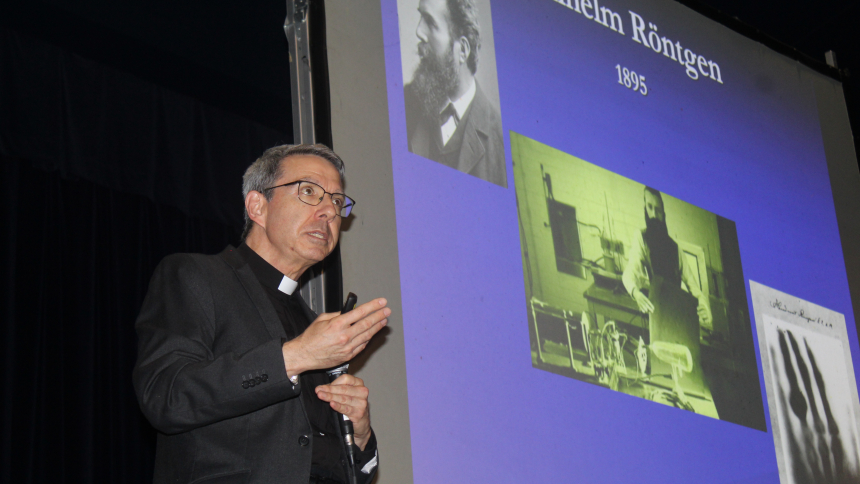
As an example of a scientist who explored the mystery he confronted, Father Kartge told the story of Wilhelm Röntgen, a German scientist who was studying cathode ray tubes in 1895 when he saw blips of light through paper placed over phosphorus. He began testing other materials to see if the light was still visible, finally using his wife’s hand, which led to the invention of the X-ray. “Good scientists don’t ignore a mystery; they stay with it,” Father Kartje said.
He stressed that it is a myth that “religion is grounded in faith, but science is grounded in data. Science is grounded in faith beliefs – not necessarily religious beliefs – like the belief that the universe is orderly and rational.
“But we think that faith is not based on evidence, but it is grounded in objective data. We can’t deny there was an empty tomb,” said Father Kartje. “While we can’t prove that the Eucharist is the Body of Christ, we can’t deny that millions of people believe that. You cannot have a meaningful religion without objective data.”
Robert Jackowski, who taught the German language to Father Kartge at BNI in the 1980s, came to listen to his former student both as a current theology graduate student at Catholic Theological Union in Chicago, and the co-teacher (with Gary Gray), of a course on “Faith and Science” at St. Paul in Valparaiso on the first Thursday of every month at 6 p.m. (Call the parish office at 464-4831 for more information.) “It is an interesting subject, and I was excited to hear Father Kartje’s perspective,” Jackowski said.
Joe Thoesen of St. Mary of the Lake in Gary, like Jackowski, a 1972 BNI alumnus, said his purpose for attending was to gain insight into “how to discern spirituality and science within a living world,” while Mary Jo Dybel, BNI class of 1969, said she was “interested in hearing a discussion on faith and science, especially in this day and age, when so many technological advances are happening.”
Caption: Father John Kartje, an astrophysicist, biblical scholar and, since 2015, rector/president at the University of St. Mary of the Lake/Mundelein Seminary, explains how scientist Wilhelm Rontgen (on the screen) pursued a mystery in his 1895 cathode ray tube research that led to the invention of x-rays. “Good scientists don’t ignore a mystery, they stay with it,” said the Bishop Noll Institute alumnus who retired to the Hammond high school on Sept. 2 at the invitation of the Indiana Knights of Columbus to discuss “Heart Unto Heart,” the relationship between faith and science. (Marlene A. Zloza photo)